
Ret’d. Gen. Andrew Leslie explains the strengths and weaknesses of Ottawa’s defence industrial strategy and why it needs to move quickly.
As the federal government rolls out its recently announced $6.6-billion strategy aimed at helping small- and medium-sized homegrown businesses break into the defence industry and prioritize Canadian-made equipment, one military expert says Canada must diversify its resources away from one, single source – the United States.
“It’s illogical to have 75 per cent of the defence expenditures internationally going to one country,” retired general Andrew Leslie told CTV Your Morning on Wednesday.
“I think by diversifying and focusing not necessarily exclusively on the U.S., will attract international businesses, big organizations to actually start producing military equipment for Canadians in Canada,” Leslie added.
READ MORE: Industry leaders point to potential barrier in PM Carney’s defence industrial strategy
Last year, Prime Minister Mark Carney told CBC’s Power & Politics that Canada pays 75 cents on every dollar of capital spent over defence to the U.S.
“That’s not smart,” Carney said.
The defence industrial strategy Ottawa released on Tuesday says this plan is “especially” important when it comes to protecting Canada’s Arctic sovereignty and promoting a “secure North,” along with adding 125,000 jobs.
“It will create high-paying careers across the entire supply chain – from steel and aluminum welders to engineers, scientists, and manufacturers who turn Canadian resources into the equipment, ammunition, vehicles, and other critical capabilities that keep Canadians safe,” a news release from the Prime Minister’s Office said.
READ MORE: Carney rolls out plans to build up domestic defence sector, add 125,000 jobs
Leslie says there is an “urgency” for Canada to start spending money “a lot faster than we’ve ever had.”
The newly announced financial plan acknowledges the importance of increasing funding for equipment and the defence of the Arctic people but is fuzzy on details, according to Leslie.
“Drones should be everywhere, but I don’t see swarms of them being produced for the Canadian Forces,” he said. “There’s a whole bunch of detail that’s missing, that’s got to be sorted.”
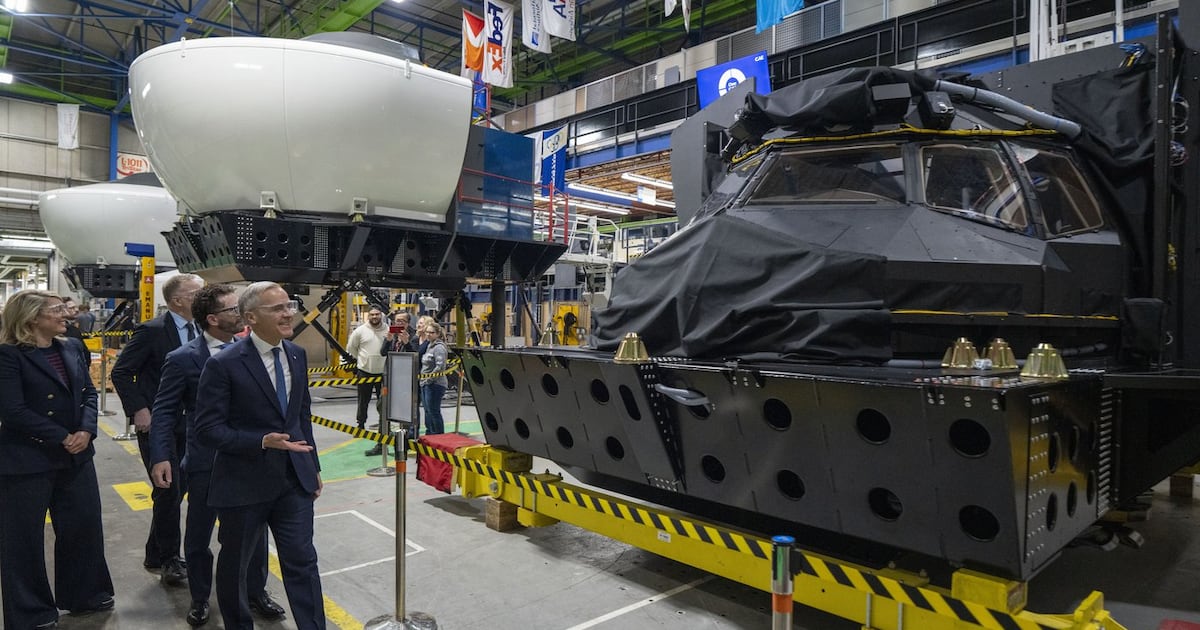
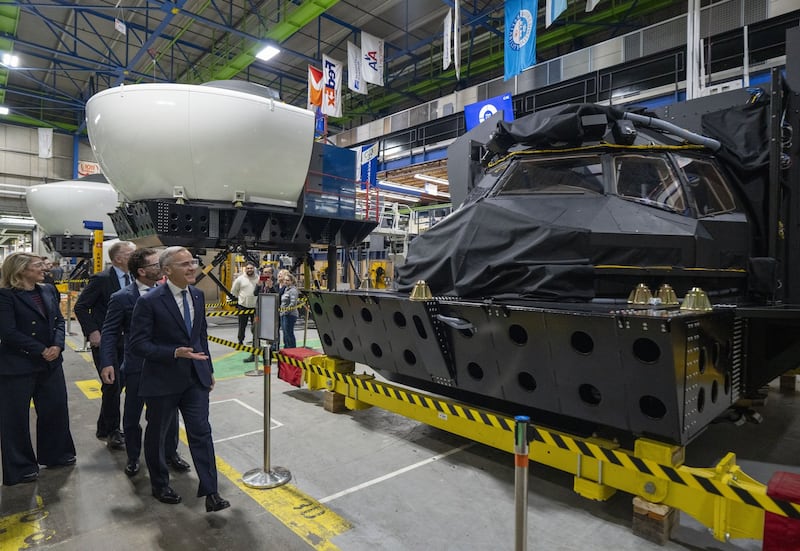 PM Mark Carney Canada defence industrial strategy Prime Minister Mark Carney tours the facilities of CAE Inc., in Montreal, on Tuesday, Feb. 17, 2026. THE CANADIAN PRESS/Christinne Muschi
However, Leslie says in the short term, Canada has to “bite the bullet” and start spending on equipment overseas, at least until the start of the production run begins in Canada.
“Over time, over years, you’ll build up the capacity of Canadian industries to produce it themselves,” he said.
READ MORE: Carney strategy for defence industry pledges 125,000 jobs, sweeping policy changes
Focusing on the army as an example, Leslie said the organization was “dramatically underfunded,” adding that it is more effective to start buying 15 to 20 per cent of heavy artillery from overseas, while building the rest in Canada.
Meanwhile, the military expert says the 10-year timeline is reasonable but adds that it could take longer than that, pointing to the finalization of Canada’s latest defence procurement.
“In terms of the other capabilities that are so desperately needed, what we have to start seeing is action,” Leslie added, saying that Carney’s predecessors delivered tanks, air defence systems, architecture, mine-protected vehicles and overall equipment to protect Canada’s troops within months.
“If you can do it, then we can do it,” he said.