
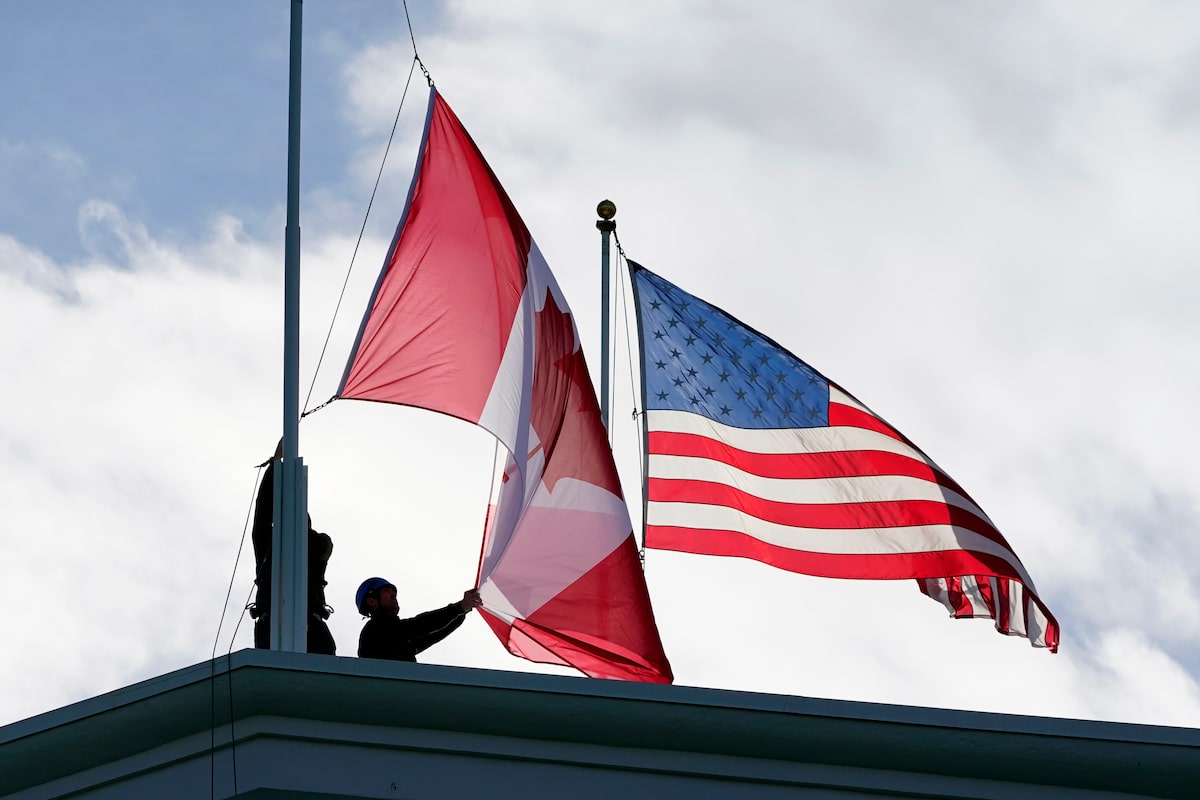
Columnist Claude Lavoie writes that since Canada shares a border and economic and security interdependence with the U.S., it can’t avoid trade with the country.Elaine Thompson/The Associated Press
Claude Lavoie is a contributing columnist for The Globe and Mail. He was director-general of economic studies and policy analysis at the Department of Finance from 2008 to 2023.
As the renegotiation of the U.S.-Mexico-Canada Agreement looms, game theory suggests Ottawa may have to accept higher American tariffs and make previously unthinkable concessions.
The calculus has fundamentally changed. In previous negotiations, all three countries shared a commitment to the principles of free trade which ensured co-operative outcomes. Now, the United States sees trade through a different lens entirely, one revealed in recent trade deals and policy statements. And while dismissing anything from President Donald Trump’s administration has become fashionable, the logic of their position isn’t entirely without foundation.
Trade diversification may limit the damage, but the best Canada can likely hope for is a new, less favourable equilibrium until evidence of economic damage in the U.S. or geopolitical shifts alter Washington’s position. Canada already has trade agreements with 50 other countries and trying to expand these or adding a few more countries will not suddenly accelerate our diversification. With a shared border and economic and security interdependence, Canada cannot avoid the United States.
Opinion: Facing 100% tariff threat, Canada must swallow its pride and compromise
Under the old consensus, multilateral free trade was understood as the optimal outcome. Negotiations centred on protecting specific sectors for political or security reasons and enforcing fair-trading rules. Countries recognized that demanding tariffs for one sector would invite others to seek protection for their own, creating mutual harm. This dynamic kept protectionism to the minimum needed for political acceptance.
The Trump administration has abandoned this framework. Recent U.S. trade deals with Europe, Argentina, Britain, Japan, South Korea and others follow a clear pattern: the U.S. imposes tariffs of 10 to 20 per cent while negotiating partners eliminate their own tariffs and grant preferential access to American products. Washington’s only concessions involve removing duties on natural resources unavailable domestically or products Americans cannot produce at sufficient scale. Prime Minister Mark Carney said countries agreeing to such terms are engaged in the “performance of sovereignty while accepting subordination.”
These agreements appear to reflect the optimal tariff argument advanced by Trump advisers Scott Bessent and Stephen Miran. The theory holds that when a large country with market power imposes import tariffs, foreign companies reduce their export prices to maintain market share in that crucial market, effectively absorbing the tariff in their margins. American consumers pay little more, while the U.S. government collects tariff revenue.
Opinion: In Carney’s world, Canada is more powerful than Trump thinks
Some evidence supports this approach. Canadian exporters, for instance, tend to lower their prices in Canadian dollars when the currency appreciates, keeping U.S.-dollar prices stable – a practice called pricing to market. Companies, however, can only reduce prices so far.
For small open economies like Canada’s, the GDP-maximizing strategy remains refraining from tariffs. Retaliation would serve only one purpose: forcing the larger country to abandon its strategy. But this path leads to tariff escalation and a game of chicken where the smaller country inevitably loses.
This explains why Britain, Japan and the unco-ordinated European Union accepted the U.S. demand to maintain zero tariffs while making concessions to keep American duties at manageable levels. It’s difficult to see how Canada can achieve better results unless small- and medium-sized countries co-ordinate their responses, as Mr. Carney suggested in his Davos speech. This would mean Britain raising tariffs on American imports when the U.S. targets Canada and Mexico, and vice versa. Yet asking populations to accept economic pain on behalf of another country is politically untenable and cannot produce a stable equilibrium.
Another possibility for the tariff strategy: the United States is simply abandoning trade benefits for national security benefits and looking for ways to make everything in-house. This strategy accepts lower per capita GDP in exchange for complete independence and rapid threat response, potentially including territorial expansion (Venezuela, Greenland) to ensure resource and action autonomy.
Harper warns of Trump threat, calls for reciprocal tariffs in gala speech
Canada can attempt to buy time, hoping developments shift the U.S. administration’s thinking or the midterm elections change the country’s direction. But even if the Senate or the House of Representatives turn Democrat in November, it’s not clear what role Congress would play in the negotiations, especially since Democrats are not inherently anti-tariff.
Pressure to change views could stem from severe inflation and economic damage, or from security gains failing to offset economic costs. Washington might eventually recognize that aggressive “alpha” leadership may benefit the country short-term, but breeds instability and potential decline over time. Studies of social dynamics across species show that societies with rigid, aggressive leadership prove less stable and resilient than co-operative ones.
Unfortunately, such realizations may not arrive before Canada must sign a new trade agreement. Let’s hope some of the concessions Canada ends up making also deliver long-term benefits to Canadians in areas such as air travel, telecom and dairy.