
Much has been written on Toronto’s current construction boom, which has transformed our city’s architectural identity into a collection of glass towers mixed with a smattering of iconic contemporary landmarks, but this is certainly not the first boom period for our city, and one could argue, not the most architecturally significant. At the turn of the 20th century, Toronto – and much of Canada – experienced a rapid influx of immigrants amidst a booming economy, and the city and country flourished. Between 1890 and 1920, Toronto’s population more than tripled to over half a million residents, and during this time much of the inner city that we know and love today was built.
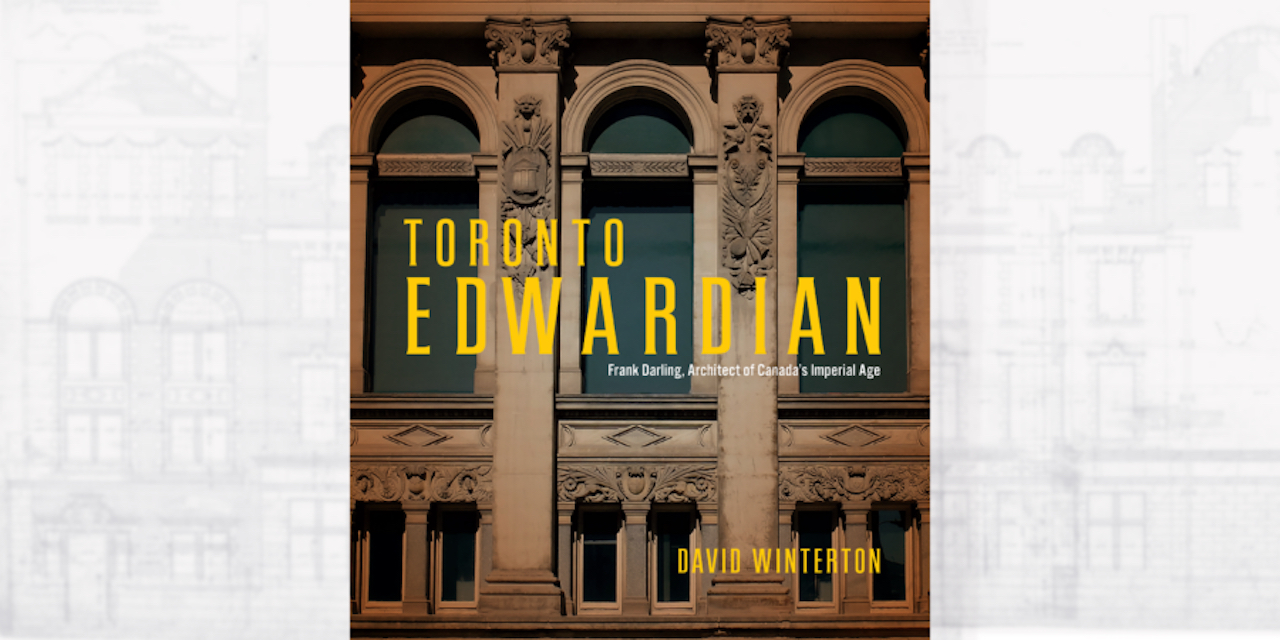
There were several major architectural figures active at this time that defined the city’s identity and whose architecture still holds significant impact today. Perhaps the most well-known is E.J Lennox, responsible for many landmarks like Old City Hall, Casa Loma, and the west wing of the Ontario Legislative Assembly. But one local name that is often overlooked is Frank Darling, by far the most prolific architect at the turn of the century, whose more than 360 works across the country defined a generation of Canadian architecture, and whose buildings still grace us with their presence today. The life and works of Darling are chronicled in meticulous detail in a new biography by local architect David Winterton, titled Toronto Edwardian: Frank Darling, Architect of Canada’s Imperial Age.
Front cover of ‘Toronto Edwardian’ by David Winterton.
Darling’s buildings were spread across the country and were predominantly non-governmental projects, focusing mainly on commercial, educational, and religious buildings, with a handful of residential as well. He partnered with several other architects throughout his career, the longest partnership being with John Andrew Pearson, with whom he worked for more than 30 years until his death in 1923. The name Darling & Pearson would become synonymous with prestigious architecture across Canada well into the mid-20th century.
Bank of Montreal building, currently the Hockey Hall of Fame, image from ‘Toronto Edwardian’.
The book also paints a vibrant picture of the context within which Darling rose to prominence. The turn of the 20th century was the adolescence of the relatively new Dominion of Canada, a period of growth, prosperity, and maturation. Winterton dives into how Darling’s talent and business acumen positioned him at the forefront of this important period, rubbing elbows with Toronto’s elite political class that landed him important commissions across the country, which in turn allowed him to define the architectural language of the time.
Portrait of Frank Darling from the 1920s, image from ‘Toronto Edwardian’.
The predominant architectural styles used in Toronto and most of Canada at the turn of the 20th century were heavily influenced by British architecture, but Winterton argues that Darling took the popular Victorian and Edwardian styles and made them distinctly Canadian. He describes in great detail the characteristics of Darling’s designs, what sets them apart from his contemporaries, and how they influenced the course of Canadian architecture in the decades that followed.
North Toronto CPR Station in Summerhill, image from ‘Toronto Edwardian’.
Several of Darling’s most notable buildings still dot the landscape across Toronto today. These include: the original Art Gallery of Ontario building (now fully enclosed by later additions, but Walker Court still remains); Convocation Hall, the Mining Building, and Trinity College all at the University of Toronto; the North Toronto CPR station, now a flagship LCBO at Summerhill; the Toronto General Hospital College wing, now part of the MaRS Discovery District; the Bank of Montreal building at Yonge and Front, now home to the Hockey Hall of Fame; the Dominion Bank Building, now part of One King West Hotel & Residences; and the Canadian Imperial Bank of Commerce Building, now referred to as Commerce Court North. Many more landmarks remain in other major cities across the country.
Lassonde Mining Building at University of Toronto, image from ‘Toronto Edwardian’.
Winterton’s biography includes a list of all known works by Frank Darling throughout his career, and delves into detail about the most influential and important ones. The book deservedly shines a spotlight on one of the most prolific Canadian architects from our past, and in turn paints a compelling picture of Canadian architecture at the turn of the 20th century.
Toronto Edwardian: Frank Darling, Architect of Canada’s Imperial Age is now available for purchase, so head to your local bookstore and grab a copy for a piece of Canadian history.
* * *
UrbanToronto’s research and data service, UTPro, provides comprehensive data on construction projects in the Greater Golden Horseshoe—from proposal through to completion. Other services include Instant Reports, downloadable snapshots based on location, and a daily subscription newsletter, New Development Insider, that tracks projects from initial application.