
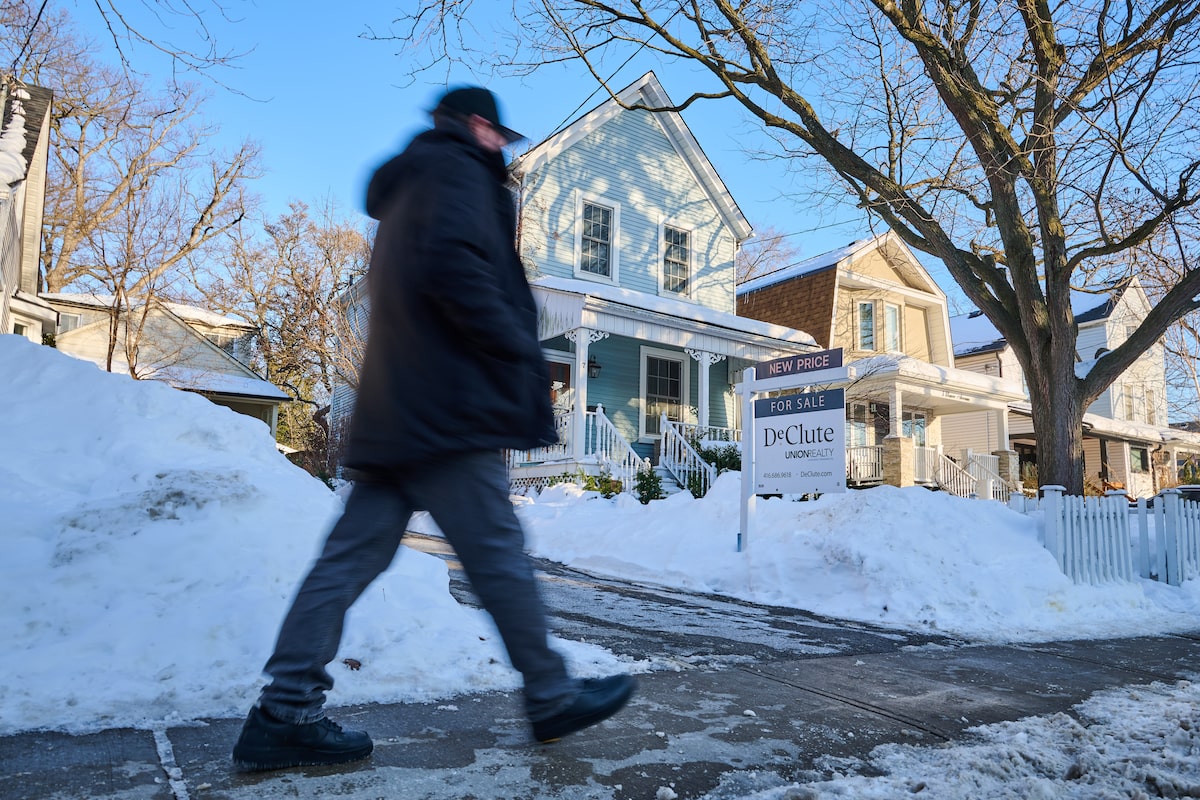
The average selling price for a home in Toronto in January fell below the $1-million mark for the first time since 2021, the Toronto Regional Real Estate Board said earlier this month.Sammy Kogan/The Globe and Mail
Home sales across Canada fell to multiyear lows in January, as winter storms compounded a market chill already driven by trade upheaval and economic uncertainty.
National home sales for the month fell by 5.8 per cent on a seasonally adjusted basis from December, and by 16.2 per cent in real numbers compared with January, 2025, according to data released Wednesday by the Canadian Real Estate Association. In comparison, sales were up nearly 3 per cent year-over-year during the same time last year.
A big reason behind the monthly slump was extreme winter weather disrupting real estate activity across Central and Southwestern Ontario – the most populous part of the country – according to Shaun Cathcart, senior economist for CREA.
“It’s what we would consider a logistical suppression of the market, not a fundamental one,” he said. “More noise than signal.”
Snowstorms and severe chills made it difficult to leave home, show properties or drive safely, he said. That will drive pent-up demand, effectively delaying transactions, he added.
“It’s the old toothpaste tube analogy,” he said. “You squeeze the toothpaste out of January, it shows up later on.”
The data also suggested listings are showing up early to start the year, signalling that sellers are eager to get going, according to CREA chair Valérie Paquin. Newly listed properties jumped 7.3 per cent on a month-over-month basis while national average sale prices dipped 2.6 per cent on a year-over-year basis in January.
The average selling price for a home in Toronto in January fell below the $1-million mark for the first time since 2021, the Toronto Regional Real Estate Board said earlier this month.
These monthly slumps are adding to an existing chill in the market driven by hesitancy from homebuyers still weathering a different kind of storm: the unravelling of decades of free trade and its seismic shocks across the national economy.
Benjamin Tal, deputy chief economist at CIBC World Markets, said that the dominant force keeping the housing market “a bit frozen” right now is still global uncertainty, with buyers and sellers hesitant to budge while trade rules are being rewritten.
He doesn’t foresee a dramatic market rebound any time soon. “The market is not strong by any stretch of imagination. We haven’t seen any resolution to USMCA,” he said, referring to negotiations over a renewal of the United States-Mexico-Canada Agreement on free trade. “But I believe on a yearly basis, the numbers will be a bit better.”
They bought their condos in the pandemic. Now, they’re stuck ‘bleeding cash’
That’s because the current market is comparing today’s period of extreme uncertainty to last January’s relative stability – something that won’t be the case going forward into spring. “In February and March, we were actually at peak uncertainty,” he said.
As buyers step back into the market as they usually do when the snow thaws, this may exacerbate demand.
Mr. Cathcart predicts that 2025–2026 will be the year when first-time buyers re-enter the market in a meaningful way after being shut out for years. “Especially now that the bank said, ‘Hey, rates, aren’t going to get any better at this point.’”
Limited supply down the line could tip the scales and stabilize prices, said Mr. Tal, particularly in the lower end of the market that encompasses smaller attached and detached homes. In other words, while there might be “pent-up demand,” Mr. Tal said, it’s set to unleash in a market with relatively few choices.
Looking ahead, buyers should expect fewer listings than anticipated because sellers will choose to wait rather than take risks in a weak market, he said.