
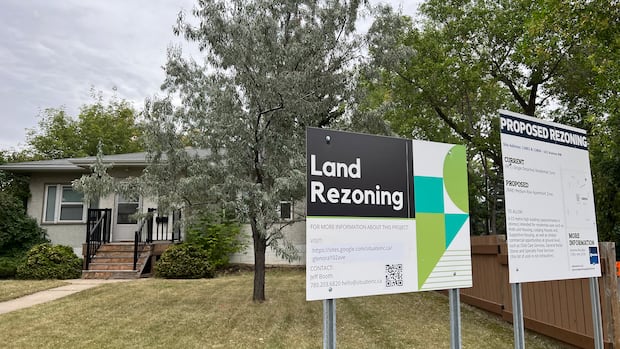
A century-old covenant that restricted how properties could be developed in a central Edmonton neighbourhood has, for the first time, been successfully challenged in court.
Earlier this month, an Alberta judge overruled the restrictions set out by the Carruthers Caveat on a property in the Glenora neighbourhood, located west of Edmonton’s downtown.
In the decision, Court of King’s Bench Justice Ayla Akgungor said the covenant, which dates back to 1911, conflicts with Edmonton’s zoning bylaw and said removing it is in the public interest.
The court challenge had been launched by a numbered Alberta company after a previous one failed. The company’s directors include Edmonton lawyer James Scott and a real estate company with a B.C. address. Both Scott and the law firm that filed the challenge declined to comment.
Previous discussions involved developing a six-storey apartment on the site at 138th Street and 102nd Avenue. The property will be steps from the Valley Line West LRT, which is currently being built on 102nd Avenue.
“This is really a milestone, I would say for the neighbourhood, for housing in Edmonton, for our city as a whole,” said Chelsey Jersak, strategic director of Situate, a development consultant who was hired to do the rezoning application for the site.
What is the Carruthers Caveat?
Created by James Carruthers in 1911, the caveat was intended to create a prestigious subdivision in Old Glenora, allowing only the finest houses for professional and commercial elite, according to affidavits submitted by residents.
Part of the terms of the legal document was that only single family homes or duplexes could be built. The caveat is registered on more than 400 properties in Glenora.
The resulting neighbourhood has historic value as one of the best conserved examples of a “garden city suburb” design in Western Canada.
The Carruthers Caveat helped inspire a more recent wave of restrictive covenants that have been added to properties in Glenora and some other neighbourhoods. These newer restrictive covenants have been seen as a solution by homeowners trying to head-off the construction of large, multi-family buildings, which were allowed after the city did a zoning overhaul in 2024.
Some 65 Glenora homeowners tried to protect the Carruthers Caveat in court.
Wendy Antoniuk, one of the Glenora homeowners involved, wrote in an email to CBC that residents will be seeking an appeal. She said discussing the impact of the decision is premature.
“It is important to note the caveat still applies to over 400 properties in Glenora and fellow Carruthers Caveat property holders intend to uphold it through legal action, if necessary,” Antoniuk said.
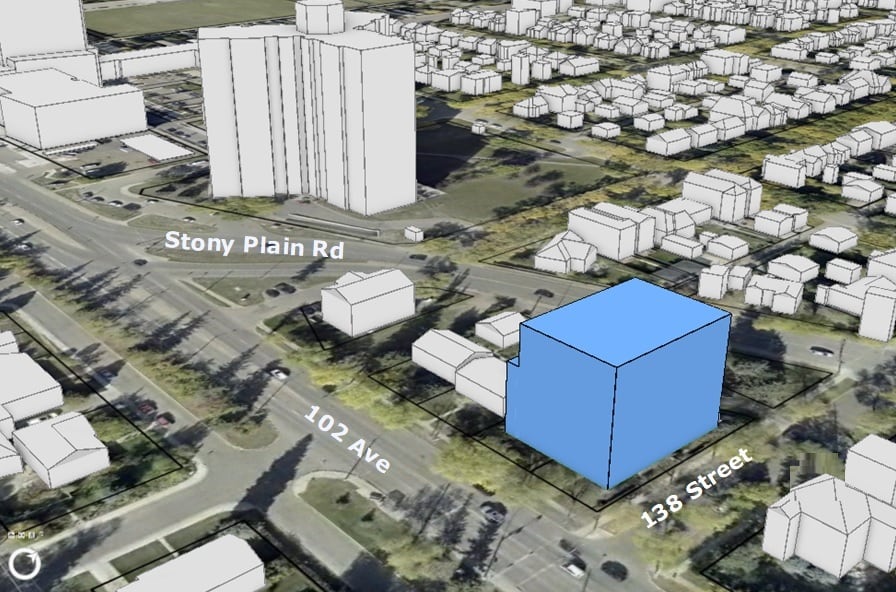 The site is in close vicinity to The West Block development, which is not covered by the Carruthers Caveat. (The city of Edmonton)
The site is two lots with single family homes that have been merged. City council upzoned it to a medium-rise apartment zone in 2022. It is just off an arterial road and is close to two high-rise developments built on lots not subject to the caveat.
The judge determined that this site does not have characteristics of a garden city suburb. Akgungor also noted the site’s location falls within a number of city plans to achieve greater housing density and development.
The site does not yet have a development permit.
Incompatible rules
When the new zoning bylaw came into effect at the beginning of 2024, the lot was rezoned with a minimum density restriction, requiring at least 10 dwellings.
Previously, zoning was cumulative, meaning that if a lot was zoned for up to a certain number of dwellings, you could build that — or less.
However, the Carruthers Caveat stated that the maximum number of dwellings could be two: a single family home or a duplex.
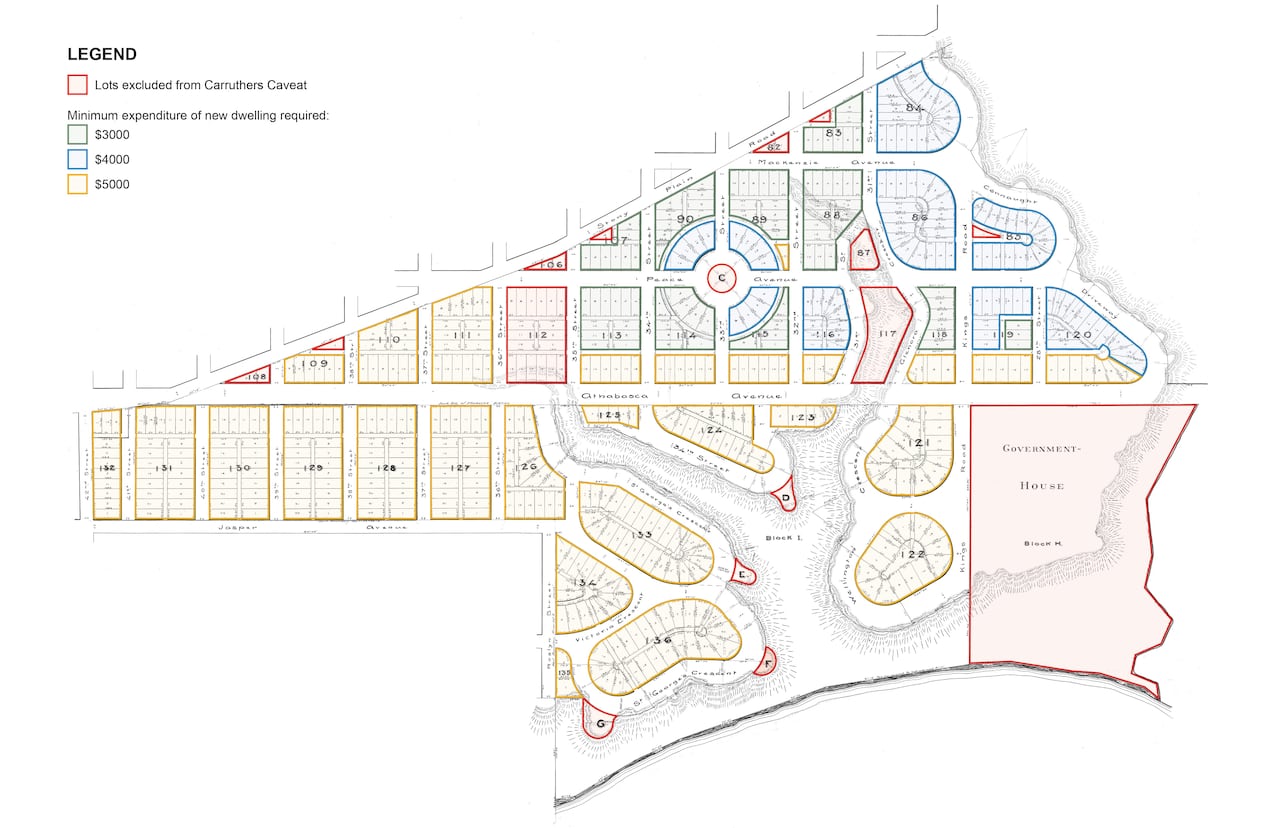 A map of Old Glenora where specific lots are still impacted by the Carruthers Caveat. (City of Edmonton)
The judge ruled that because no new development could comply with both the caveat and the zone, there was irreconcilable conflict, and grounds to remove the caveat.
The judge did not agree with the residents’ argument that a buyer could comply either by doing nothing or by renovating the property.
Eran Kaplinsky, a University of Alberta law professor specializing in property and land use, said that is the part of this decision that is novel.
“The traditional interpretation is that there is no conflict because a developer or landowner does not have to build,” Kaplinsky said.
‘On its own merits’
In her written conclusion, Akgungor addressed the residents’ concerns that the decision “will amount to an opening of the floodgates.”
“I cannot speculate on the outcome of any future application,” Akgungor wrote. “I will state simply that each application for discharge of the caveat must necessarily turn on its own merits.”
Jersak said she doesn’t think this is the end of the road for the Carruthers’ Caveat.
“I don’t think that the complexity will disappear,” she said, noting each time a lot would have to be rezoned to create a conflict, then taken to court.
But she said it does feel like a new chapter.
“This caveat has been seen as untouchable. And I think a lot of people haven’t wanted to try. And now that we have a precedent, I think that there will be more interest in other people doing a similar process.”
Kaplinsky said the implications could be far-reaching.
“I think the decision signals the supremacy of municipal planning and it has the potential to end the use of restrictive covenants as a private means of controlling land.”
He said that could be worrisome because by rezoning and creating a conflict, the city has gained a very powerful legal tool.
“I’m not convinced that it’s ultimately in the best interest of land use planning to have all of the power and authority vested in the municipal decision-makers.”