
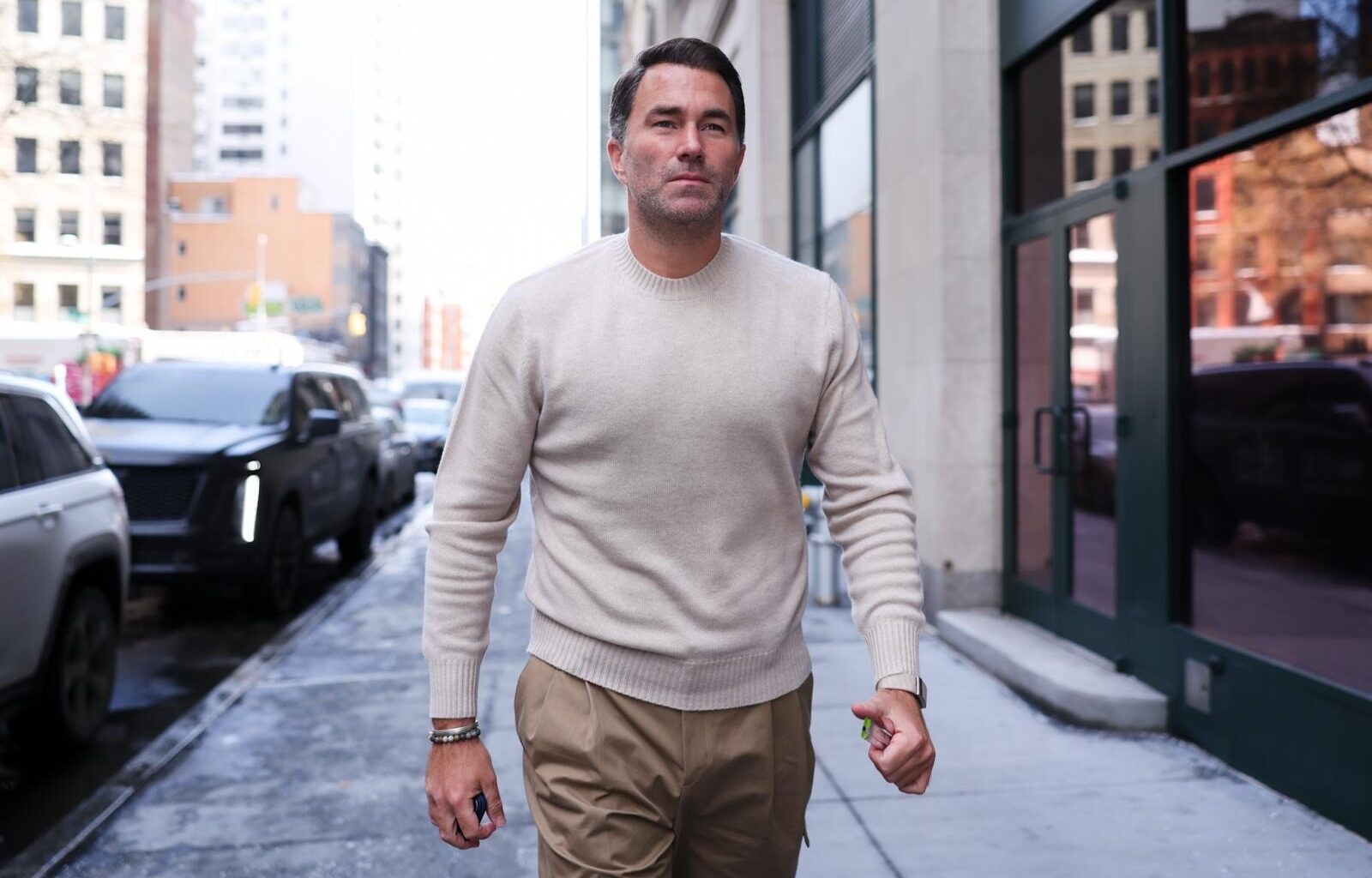
In every era of boxing, it is nearly impossible to think of the sport without recognising the characters who forge its great spectacles. Amongst a litany of legendary fighters who epitomised these eras—the likes of Muhammed Ali, Mike Tyson and Floyd Mayweather—there are also staples in promotion: the key players who curate the bouts that cement legacy and shape the spirit of the sport. Bob Arum, with Top Rank, defined modern-day promotion; Don King, with his flamboyant showmanship, made fights larger than life. Some former champions now run their own promotions—Oscar De La Hoya with Golden Boy, and Mayweather with his own ventures—bringing the insight of the ring to everything that makes a fighter a star.
While the sport has always had its iconic promoters, there’s one man and his company who now stand at the forefront: Eddie Hearn and Matchroom/Boxing. Eddie has become one of the most notable figures in boxing, his extravagant spiel carrying a natural, showmanlike charisma that reels people in to massive occasions. He demonstrates a keen awareness of the period boxing is in—not just from a business standpoint, but as a fan of the sport and the grandeur of its athletes. Having witnessed his father, Barry Hearn, found Matchroom in 1982 and develop it into a top global sports promotional company, it could have been easy for Eddie to live an indolent lifestyle. He has often been tagged as having been fed with a silver spoon. However, a principled upbringing—shining shoes, washing cars and working as a salesman—instilled a hardworking and honest drive that shaped him into the man he is today.
Eddie Hearn’s first major boxing promotion came in 2001 with the WBA Heavyweight Title fight between Audley Harrison and David Haye, an effort to revive Harrison’s fallen gold-medal-winning Olympic career. For many fans, this was the moment Eddie first made his mark on the boxing world. Harrison was by no means a world-class fighter, but after a chance meeting with him at a poker game, Eddie committed to promoting him. He carefully mapped out a plan that included entry into and victory in a Prizefighter event, ultimately setting the stage for an all-British World Heavyweight Title showdown. Eddie’s promotion of the fight was magnetic, bewildering if you knew Harrison’s limits, but heavyweight boxing was in a precarious state, and such an injection was needed.
When David Haye dispatched Harrison in three rounds, many assumed Eddie’s front-facing promotional career was over. However, Haye congratulated him, and the public recognised his talent—he could sell an inhaler to a fish. Soon after, Terry Thompson asked Eddie to promote his son, Kell Brook, followed by Carl Froch and Tony Bellew. Then, in 2013, boxing changed forever with the signing of Anthony Joshua, fresh off his 2012 Olympic gold, forging a grand relationship with Hearn and setting off Matchroom’s era of dominance, coinciding with the meteoric rise of social media.
Thirteen years later, Joshua had become a two-time world champion, with Eddie Hearn at the helm of boxing’s first billion-dollar deal with Matchroom and DAZN. Hearn has also staged some of the generation’s most memorable fights, from Froch vs George Groves II and Joshua’s first world title win over Wladimir Klitschko to his epic bouts with Oleksandr Usyk. He oversaw the Madison Square Garden classic Katie Taylor vs Amanda Serrano, Dmitry Bivol vs Canelo Alvarez, and Bivol vs Artur Beterbiev at the Riyadh Season. Hearn has also promoted domestic showdowns, including Callum Smith vs Joshua Buatsi and the intense rivalries of Conor Benn vs Chris Eubank Jr. Beyond the established stars, he has nurtured the next generation of talent, guiding Dalton Smith and Ben Whittaker as Matchroom’s rising prospects.
In this social media-driven era, sports promotion and conversation are highly accessible. Channels like Boxing Social, Fight Hype, iFL TV and Seconds Out have become cherished spaces for boxing voices. Across these platforms, Eddie Hearn mesmerises the internet with his gift of the gab, hilarious expressions and irresistible promotion of Matchroom’s next big event. After Dalton Smith’s emphatic win, Eddie spoke to Complex UK ahead of two major fights: Bakhram Murtazaliev vs Josh Kelly for the IBF Super Welterweight Title in Newcastle, and Teofimo Lopez vs Shakur Stevenson for the WBO & Ring Magazine Super Lightweight Title.
COMPLEX: You’ve been in and around sports from a young age, witnessing Matchroom’s evolution as a global sports promotional company. What would you say is your first sporting memory?
Eddie Hearn: It probably was around cricket. I played county cricket for Essex from under-11s up to about under-17s. And yeah, I think sport for me has always been a massive part of my education. I actually think that my best qualities come from sport, not education. I think it’s a great educator—life skills more than academic skills, obviously. But it was something in our family that was very, very important. My dad was away a huge amount, but when he was back, he was always in the garden playing football, bowling at me in the garden, playing cricket, diving around trying to beat me at table tennis. Everything was a ‘you win when you’re good enough’ kind of mentality. That’s the same way I am with my kids as well. You never let them win. Never! But if they’re good enough, they’ll beat you. And that time will come. When they win, they’ve really earned it. The satisfaction for them is at a different level; that was what my dad was like. Those were probably my earliest sporting memories.
And what about boxing, since you’ve been around the game for so long?
Boxing was something that I was around. My dad started promoting when I was 8 years old, so I went to a lot of those shows growing up. The boxing world for me was normal at that point. Going to a private school wasn’t, but hanging around at the boxing gym with fighters and people working within boxing was. From the age of 8 or 9, going to these gyms and shows, getting close to the fighters, holding their belts and seeing the development of Chris Eubank, Naseem Hamed, Frank Bruno, Lennox Lewis, Nigel Benn and Steve Collins—all the fighters my dad represented—I never really knew it would become the educator for what I’d end up doing.
I think when I came into boxing about 15 or 16 years ago to promote, people probably underestimated me. That 20 years of education around the game—listening to negotiations, watching sparring, being in the changing rooms, being on the road—every experience I gained during that period was invaluable. Not that I ever thought, “This is great for me because it’s going to take me to where I want to be as a boxing pro.” I never wanted to be a boxing pro; I wanted to be a sportsman, like every kid wants to be growing up. But when you’re not good enough, working in sports is a great alternative.
The first time I saw you was promoting Prizefighter.
Right! In Liverpool.
There comes a point when every sports fan’s relationship with a sport they love evolves. I’ve watched boxing all my life, but around 2010 I began to understand the promotion behind it and what makes a great event. Since then, I’ve seen you do interviews with outlets like iFL TV, Seconds Out, Fight Hub, and many more. How important has it been for you to engage with the evolving independent boxing media as much as you do?
I think it’s a great way to interact with the fans, and we were the first to do it. When I started in boxing promotion, social media was exploding, and no existing promoters had any presence. So we attacked Twitter. Sometimes I see tweets from 15 years ago, like: “Hi guys, what does everyone think of this fight?” It was raw. There were three of us in the boxing department: me, John Wischhusen and Frank Smith. I was designing posters and running social media, Frank was learning TV contracts, and John was dealing with the board. We were trying to take it to another level without the manpower, so we all mucked in. I would be on Twitter all day and night, debating with fight fans. That came with iFL as well. Later, I looked at UFC with Dana White and WWE with Vince McMahon. I realised I needed a presence where people saw me not just as a voice of boxing, but a prominent figure. When there’s an Eddie Hearn or Matchroom show, it feels different. The fights are great, and it gives that big-event atmosphere. That was part of establishing our identity. Back then, there used to be one or two media figures; now there are 50. You want to give your time to newcomers as well as the established, because they were like iFL once. But I’m 500 times busier now. I remember Kugan coming to my house at 6am, and we’d drive to Manchester for a press conference, filming me dancing in the car—we were just kids! It’s been a wild ride, and timing worked perfectly.
Having spoken to Frank Smith recently, I can see that it’s been a perfectly-timed plan that’s worked brilliantly in this era of boxing promotion. Over the past 15 years, seeing how social media has become such a central part of the sport—the moments, the memes, the interviews all coming together—has truly evolved the boxing game.
You know, it’s like your life: you get one shot at it. It’s like a book, right? Or a movie. I know that when I pass—whenever that may be—you can run all this stuff back. Like, you can run back Dalton Smith vs Matias, me diving in the ring. Darren Barker, Kell Brook. Me dancing in a car, the memes—all that kind of stuff. And people will say, “He had a presence.” Do you know what I mean? People will say, “Wow, he did a lot. He was definitely a character.” For me, that’s a great way to be remembered. When it’s all said and done, I want to be remembered as a good person, a great father—a family man. And then, on the business side of things, I want to be remembered as an honest man, one who always delivered for his fighters, and always paid them on time. ‘But he was a character! And a grafter.’ Not everyone’s going to like you, but they’ll have to respect you if you do those things.
When you talk about boxing, it’s like watching a child experience their first trip to Hamleys: your face lights up and you get swept away in a stream of pure appreciation. That excitement was clear in your reaction to Dalton Smith’s emphatic victory over Subriel Matias for the world title. You mentioned that the British public needs to recognise what this man has achieved—could you expand on that?
I think there’s so much going on in the world, and in sport in general, that sometimes achievements like that get overlooked. I mean, we lost that purse bid, so it was on a smaller platform, meaning the audience wasn’t really that big. However, we live in a viral world now. You may lose a couple of hundred thousand viewers on the night, but the reality is tens of millions saw that stoppage and watched the highlights. You want fight fans to go, “He’s a real one.” This guy actually went over to America and beat the monster who’s never lost, hasn’t won a fight except by knockout, in his own backyard, in front of all the Puerto Rican fans. This is right up there with Kell Brook vs. Sean Porter. This is Lloyd Honeyghan vs. Donald Curry. This is John Stracey vs. José Nápoles. This is real stuff. It wasn’t a war cry to drum up interest; that was a genuine, “Guys, you’ve got to give this guy props.” Fight fans are the most vocal fans in any sport. They’re the most miserable—they moan more than anyone, talk trash, and lie. It’s the most toxic world you could imagine. But on the upside, they’re passionate. They care about the sport, about the product, so you can focus on the positive and accept it. You have to appreciate what Dalton Smith has achieved as a boxing fan.
You’ve taken your events around the globe, recently hosting cards in places like Accra in Ghana, and Monte Carlo, Monaco. Which city has stood out as your favorite to visit and host a fight so far?
The American move was a big part of what I wanted to do because my dad never did it. He never really cracked America or landed a big TV deal there. So every time we promote in New York, Brooklyn, or Las Vegas at the Fontainebleau—this weekend, we’re at Madison Square Garden with Teofimo Lopez vs Shakur Stevenson—it’s incredible. Madison Square Garden is steeped in fight history. I’d always choose it over anywhere else. But, of course, Vegas is Vegas! I also enjoy going to new places. We’ve got a couple of young fighters at the moment: Taylor Bevan from Southampton and Tiah-Mai Ayton from Bristol. We’ve never promoted in Southampton before, and I know when you put a boxing fight in a town like that, the whole place comes out. London, Manchester, Liverpool—they see fight nights all the time. But in a new place, everyone shows up, thinking, “We’ve got a boxing event! We’ve never had one before.” I like that—it’s how I feel sometimes when we go to America or other countries. People there are genuinely welcoming.
Lastly, what are the biggest boxing events you’re looking forward to this year?
So, obviously, the upcoming fights—particularly Teofimo Lopez against Shakur Stevenson. The one we’re really aiming to make happen is Boots Ennis against Virgil Ortiz Jr. I think that’s likely to be one of the best fights in American boxing history. Dmitry Bivol is returning, and Jesse “Bam” Rodriguez is going for Undisputed. Then, when the time is right—not just yet—Anthony Joshua will make his return. There’s no doubt about that, but he’s going to need his time, both physically and emotionally.