
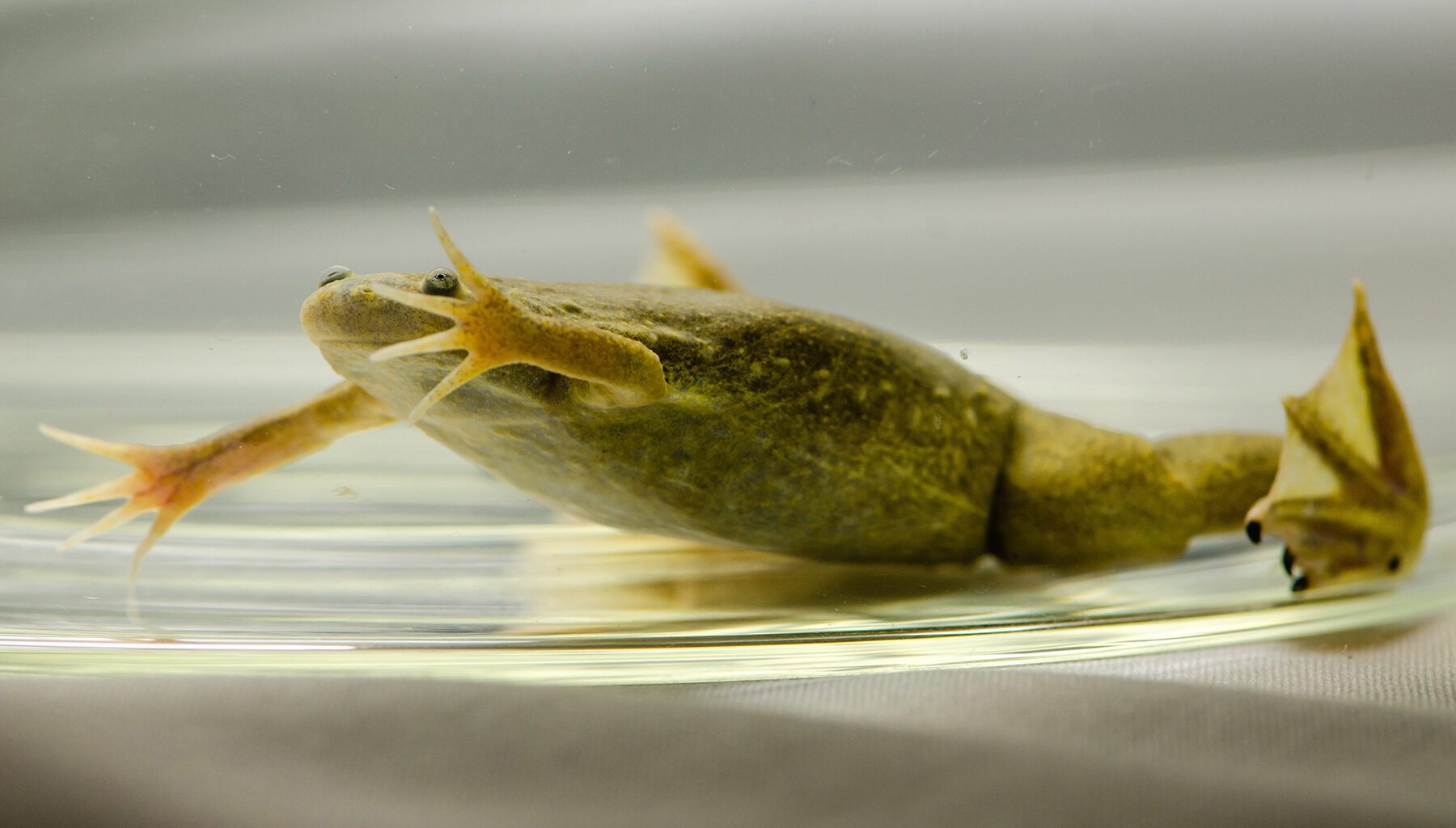
Researchers at McMaster have discovered that a sex-related gene in the African clawed frog underwent strikingly different functional dynamics in males versus females.
This research helps scientists understand how the genetic underpinning of important traits like sex change over time, says Ben Evans, a professor in the Department of Biology and senior author of the study.
“This study shows us that small changes at a biological tipping point can snowball over development into massive differences, such as those between a female and a male body” says Evans.
Researchers examined the function of a gene called “doublesex and mab-3 related transcription factor 1” (dmrt1), which influences sexual differentiation – the process by which an individual develops into a male or a female.
Ancestrally, the dmrt1 gene was essential for females to produce eggs, but when this gene was duplicated, that function was lost in one copy. In males, this gene was initially not essential for creating sperm, but after it was duplicated, one copy became essential for this crucial process.
That means that after this gene was duplicated, one copy became essential for fertility in each sex, while the other became non-essential, and the evolutionary pathways that led to this changed function were different in each sex.
Another gene in these frogs is found only in females and is the trigger for female development. Researchers were surprised to find this female-specific gene is derived from yet another duplication event — of the non-essential version of dmrt1.
“From an evolutionary standpoint, reproduction is one of the most important things an organism needs to do,” says Evans. “I find it surprising and interesting that this crucial process is now orchestrated by a copy of a gene that was non-essential.”
In this evolutionary process, small differences in the amount of the gene end up having a large biological effect, he says: The duplicated non-essential copy of the dmrt1 gene leads to a small change that ends up taking over the entire system.
“Our findings help us understand how you can achieve large differences in adult male and female individuals that mostly share an identical genome. It’s because the function of the same gene can be completely different, depending on whether that gene is in a male or a female individual.”
The study comes just over a year after Evans and his team uncovered eight different sex chromosomes in eleven species of the frog, many or all of which may contain unique and newly evolved genes that trigger male or female sexual differentiation.
This research builds on that previous study, demonstrating that sex determination may function like an assembly line, with small changes along the genetic pathways resulting in major biological changes.
African clawed frogs are one of the most widely studied amphibians because of their external fertilization process, which makes it easier for researchers to observe early development, as well as their historical utility to humans, stemming from them being used as pregnancy assays over a century ago.
Going forward, Evans is interested in getting a richer understanding of the functional evolution of the counterparts of dmrt1 and other similar sex-determining genes.
“We want to get a better understanding of the importance of biological tipping points and what mechanisms actually lead to new genes, and the functions of those genes differ between male and female individuals. We hope that this work will help us better understand sexual development in other species, including humans.”