
One of the toughest aspects when ranking players for fantasy drafts is evaluating those who had unexpected breakouts the year prior. Some breakout players are easy enough to assess. Cal Raleigh had arguably last season’s biggest breakout performance, but you don’t have to see him as a perennial MVP candidate to know he should be the first catcher off the board this year. Should we expect first-half Pete Crow-Armstrong or the slumping second-half version in 2026? As a former top prospect, the Cubs phenom should get some benefit of the doubt, especially since there was far more good than bad in 2025.
But what about the players whose unanticipated strong performances truly seemed to come out of nowhere? Is Brice Turang, who never hit more than 13 home runs in a minor league season, a legitimate major league power threat? Did Nick Pivetta really solve his home run issues in his age-32 season? We’ll look into the sustainability of these and four other 2025 breakout performances and what it means for how to value each of these players for Draft Day 2026.
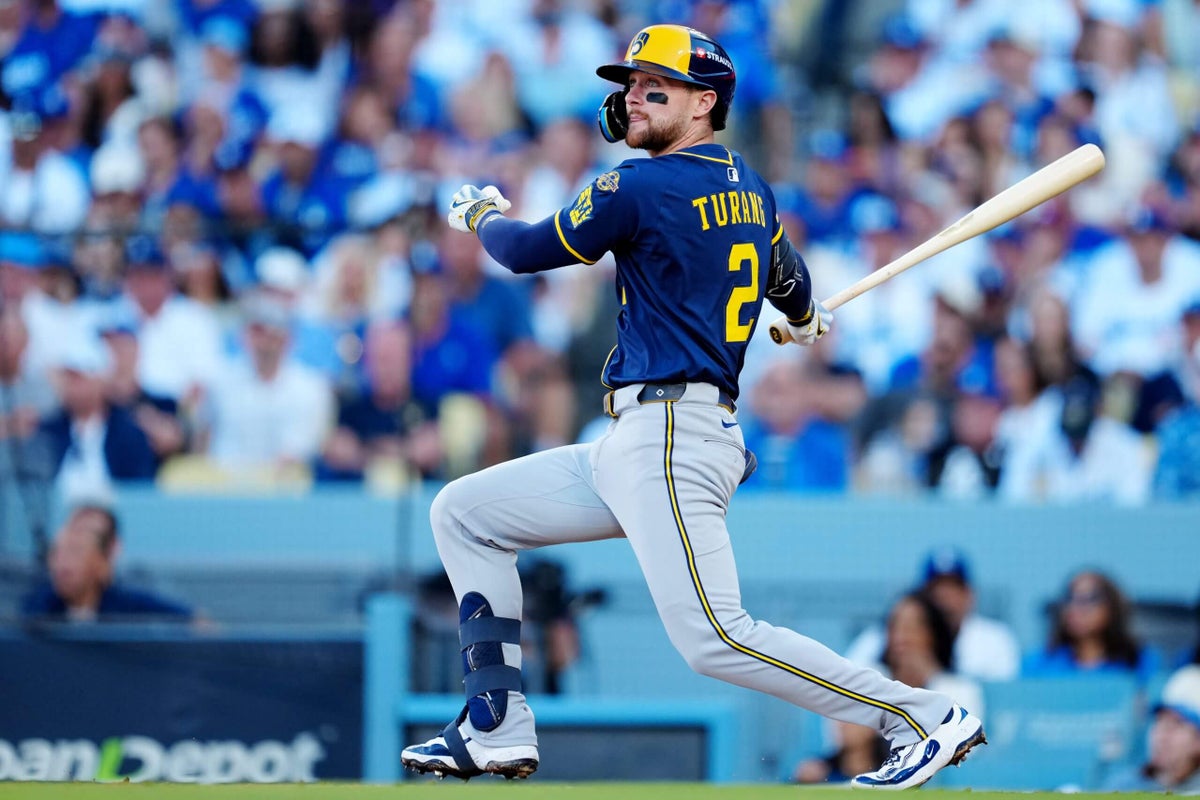
Brice Turang, 2B, MIL
No one broke out in a bigger and more surprising way than Turang did in the latter part of last season. Heading into August, he was on his way to a third straight season with a sub-.100 ISO and a single-digit home run total. A 30-day period — from Aug. 3 to Sept. 1 — transformed Turang’s season, as he batted .340 with 11 home runs, 23 runs, 24 RBIs and three steals. That brief run catapulted Turang to the top of the second base Roto rankings, leaving Jazz Chisholm, Nico Hoerner and Ketel Marte in the dust.
From Sept. 2 forward, Turang notched only one homer. Still, even if he never gets as hot at the plate as he did for that one month, there were signs of progress throughout 2025. Turang became a more selective hitter, chasing just 23.6% of the out-of-zone pitches he saw, and he experienced a true increase in power. Every one of his monthly average exit velocities on fly balls and line drives (EV FB/LD) in 2025 was higher than the ones he recorded for every month of the first two years of his career. Better yet, all were near or above the major league median of 93.9 mph. Turang should exceed 10 homers this year while being on the north side of a .260 batting average, 80 runs and 20 stolen bases. That’s enough to keep him among the top-five second basemen in Roto value.
Geraldo Perdomo, SS, ARI
Heading into 2025, Perdomo had never finished the season as a top-20 Roto shortstop, but an eye-popping .290-20-98-100-27 line last season elevated him to third at the position. In early NFBC drafts, he’s not getting full credit for those stats, ranking ninth with a 78 ADP. But is he still going too early?
Each of the projection systems featured on FanGraphs seems to think so, as none have Perdomo ranked higher than 12th among shortstops. Even some of those rankings could be on the optimistic side. Last season, Perdomo did not hit flies and liners demonstrably harder than in previous seasons, and during his late-season power surge (.218 ISO in August and September), his 87.7 mph EV FB/LD ranked 192nd among the 194 hitters with at least 50 flies and liners combined. During that period, Perdomo compensated for his lack of raw power with a 34.8% pulled fly rate. Unless he carries over that uncharacteristically high rate, Perdomo could struggle to reach double-digit homers in 2026. Even with 20-plus stolen bases and a decent batting average, he might not offer enough to crack the top 15 in a deep pool of fantasy shortstops.
Maikel Garcia, 3B, KC
If there is a player among the six featured here whose 2025 stats are worth taking at face value, it’s Garcia. In boosting his homer total from seven in 2024 to 16 last year, and his doubles total from 27 to 39, it looked as if Garcia had unlocked some untapped power. A simultaneous uptick in EV FB/HR from 92.4 to 93.9 mph appeared to confirm that. It’s actually a skill that Garcia already demonstrated in his 2023 rookie season, when he stung flies and liners for an average of 95.5 mph. Garcia emerged from that campaign with a puny .086 ISO, because just over one-quarter of his batted balls were flies, and he managed to pull just 12.2% of them (placing him in the fourth percentile for pulled fly-ball rate).
In 2025, Garcia hit a lot more flies (37.7%) while pulling them at a much more normal rate of 24.4%. He also became an even more selective hitter while building on his already strong contact skills. Toss in a fourth straight season with 20-plus steals, and you can fully justify drafting Garcia around his current 80 NFBC ADP.
Andy Pages, OF, LAD
In his sophomore season, Pages made substantial improvements in each of the five standard Roto categories. That across-the-board upgrade landed him among the top-20 outfielders in Roto value, even though his barrel, hard-hit, chase rates and average sprint speed all moved slightly in the wrong direction. Pages became a better contact hitter, especially on pitches in the strike zone, and his stolen base attempts shot up from three to 21.
The 25-year-old got an assist from Dodger Stadium, bashing 19 of his 27 home runs at home, and given his relative lack of thump (91.4 mph EV FB/LD), he will need a similar boost to crack the 20-homer threshold again. He wasn’t a particularly efficient basestealer, getting caught on seven of his 21 tries, so look for him to contribute less in that category, too. Pages looks like a poor bet to repeat as a top-20 OF, and so far, NFBC drafters appear to agree. He ranks 30th among outfielders in ADP, and that looks just about right.
Nick Pivetta, SP, SD
After eight consecutive seasons of bloated home run ratios and 4.00-plus ERAs, we could have been forgiven for not chasing after Pivetta’s strikeout potential on draft day a year ago. Those who rostered Pivetta last season got the version that many of us hoped he would be six years earlier, when ERA estimators suggested he could shave more than a run off his previous year’s 4.77 ERA with the Phillies. In his first season with San Diego, Pivetta recorded a 2.87 ERA, 0.99 WHIP and a career-high 190 strikeouts.
Away from Petco Park, Pivetta was arguably a worse pitcher than he had been in his previous two seasons with the Red Sox, with his 3.55 road ERA offset by a normal (for him) 1.14 WHIP and a decidedly lower strikeout rate (23.6%). It was Pivetta’s home stats (2.36 ERA, 0.86 WHIP, 28.6 K%) that lifted him to new heights. He relied on an extremely low BABIP (.216) and HR/9 (0.79) to bring down his home ratios. Pivetta was as prone as ever to hard contact, so expect him to yield more homers in 2026. The move from doubles-haven Fenway Park to doubles-stingy Petco Park likely had a positive impact on Pivetta’s ERA and WHIP. Even with more long balls, park effects should still help Pivetta to find a place once again among the top-30 SPs in Roto.
Trevor Rogers, SP, BAL
It’s more accurate to call Rogers’ sterling 2025 season a resurgence rather than a breakout, given that he was an All-Star and NL Rookie of the Year runner-up with the Marlins in 2021. Still, the Orioles’ lefty appeared to have reached another level by going 9-3 with a 1.81 ERA and 0.90 WHIP over 109.2 innings. Unlike his rookie performance, Rogers’ latest success is owed more to getting harmless contact (i.e., a career-low 15.8% line-drive rate, a career-high 14.7% pop-up rate) than to missing bats (24.3% strikeout rate).
Even if you think Rogers can maintain those trends (which is a sketchy assumption, especially regarding the low line-drive rate), there are a lot of indicators from his 2025 stat line to be skeptical of, including a .226 BABIP, 84.2% strand rate and 0.49 HR/9. Less suspect is his career-low 6.9% walk rate, which he backed up with a personal-best 66.0% first-pitch strike rate. THE BAT X’s projection of a 4.20 ERA, 1.21 WHIP and 21.8% strikeout rate is probably the best reflection of how much regression we should expect from Rogers. Even if we go with THE BAT X’s generous projection of 158 innings, Rogers looks like a poor bet to finish among the top-50 starting pitchers for Roto value, much less the top 20, where he placed in 2025.
Note: ADP data is current as of Feb. 17
Statistical sources: FanGraphs, Baseball Savant, Baseball-Reference