
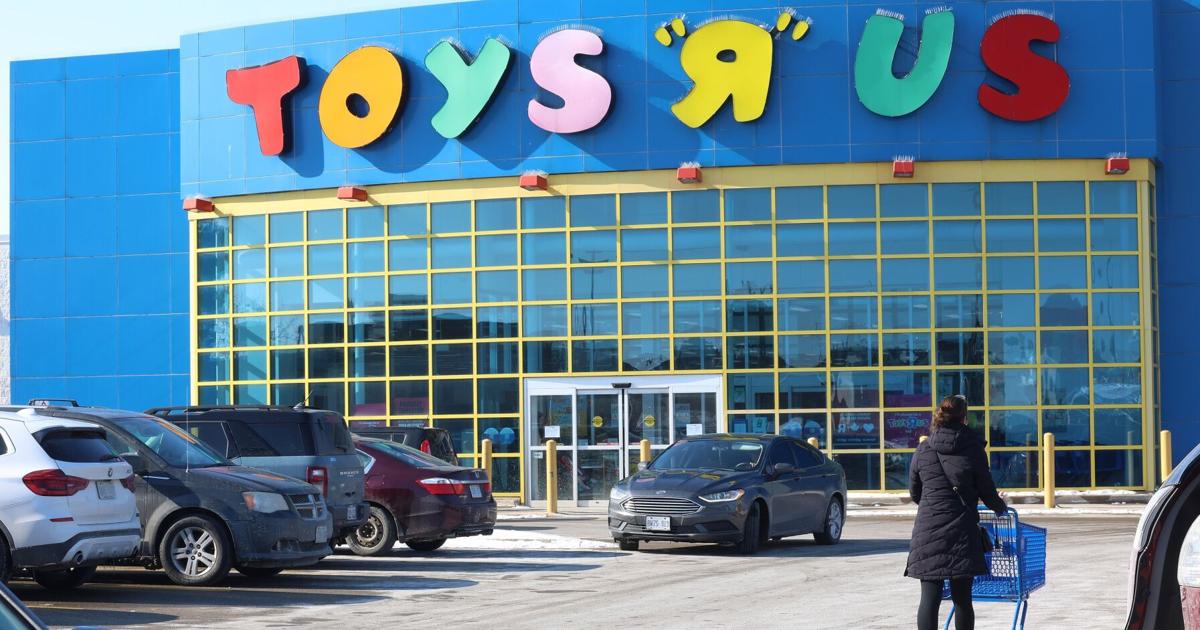
Days after his Ancaster-based investment firm announced the acquisition of Toys “R” Us and Babies “R” Us Canada, Doug Putman was full of optimism.
“We see this as a growth play and a great opportunity,” the then-37-year-old said over a call in August 2021. “We feel really lucky to be a part of this brand.”
And he had ideas to match that excitement.
Putman wanted to enhance the struggling chain’s digital footprint with a more user-friendly website and overhaul its physical presence through new-look attractions: play areas, gift registries for baby showers and children’s parties, food and beverage options like tea time with a princess — all meant to create a consumer experience while leaning into the brand’s nostalgic appeal.

Doug Putman seen here in 2017 following his acquisition of 70 HMV Canada stores.
John Rennison
By 2022, he hoped to add a dozen more locations to Toys “R” Us’ existing fleet of 81.
Today, only about a quarter of those remain — and the number could yet shrink further.
From expansion plans to creditor protection
What began as a “pinch-me” moment for the Hamilton entrepreneur has led the toy retailer to file for creditor protection Feb. 3, citing substantial debts and a series of lawsuits from unpaid landlords.
In court filings last week, Toys “R” Us announced plans to sell 11 of its 22 remaining stores — properties owned by Putman — while shuttering additional leased locations and liquidating their inventory, furniture and fixtures.
It’s unclear if Hamilton’s Toys “R” Us is included in that list of to-be-sold stores. Putman is listed as the property owner of the Upper Wentworth Street location, as well as 12 others in Canada.
“Without immediate relief, the business is at risk of abrupt cessation,” the chain said in its application for creditor protection, which allows companies to temporarily pause debt payments while they reorganize or seek a buyer.
The insolvent toy retailer has racked up some $160 million in debt to more than 500 creditors — about $120.9 million of which is owed to vendors and landlords.
Court records show it also faces at least eight lawsuits, collectively valued at around $35 million, from landlords who’ve terminated Toys “R” Us leases and accused the company of not paying rent.
An empty rack seen recently at the Toys “R” Us on Upper Wentworth Street. After filing for creditor protection earlier this month, the famous toy retailer paused its e-commerce business and stopped accepting gift cards on Feb. 17.
Sebastian Bron/The Hamilton Spectator
Over the past two years, Toys “R” Us has closed 53 stores, laid off staff, negotiated with suppliers and explored other revenue sources to cope with significant revenue shortfalls, but the moves weren’t enough to stabilize its finances, according to documents related to the creditor protection.
The company attributes rising labour costs, inflation, supply-chain disruptions and a shift toward e-commerce to its financial troubles.
Inside the financing structure
Financial experts say these are risks any buyer of a distressed retailer face today.
But the acquisition of Toys “R” Us in 2021 hardly came as a surprise — and there were reasons to be bullish.
By the time Putman acquired Toys “R” Us from Fairfax Financial Ltd., he had already built a reputation for buying distressed retail brands and attempting turnarounds.
Sunrise Records grew from five Canadian locations when Putman bought it in 2014 to 85 by 2021, including former HMV stores. In 2019, British media dubbed him a “saviour” after he scooped up 100 bankrupt HMV stores. He also acquired former DavidsTea locations to launch T. Kettle.
“Definitely, there are some people who will look at me sideways,” Putman told The Spectator in 2021. “Brick-and-mortar isn’t something a lot of people are focused on, but we don’t see it going away.
“We feel really good about it.”
Putman declined to comment for this story.
According to a court record filed Feb. 2, Putman didn’t pay Fairfax the full purchase price for Toys “R” Us upfront. Instead, parts of the price — which was never revealed — were structured as deferred monthly payments over an extended period, secured by the retailer’s intellectual property.
The record also shows that, one day before creditor protection filing, a numbered company owned by Putman bought the remaining payment obligations owed to Fairfax for an undisclosed amount and assumed its rights and interests in the intellectual property.
This made the company Toys “R” Us’ largest secured creditor with about $76 million owed. The only other secured creditor? Another Putman-owned company that’s owed around $15 million.
“It was prudent on his part,” Marvin Ryder, a business professor at McMaster University, said of Putman making his own companies Toys “R” Us’ only secured creditors. “This is probably going to minimize some of his personal losses.”
Toys “R” Us is obligated to pay back its secured creditors first and then allocate remaining funds from the sale of inventory or business assets to its unsecured creditors.
Ryder added Putman “will likely still take a hit,” however.
Strains across the retail empire
“Oftentimes, there’s not enough cash generated through a liquidation process to even pay back the secured creditors — let alone the unsecured creditors,” Ryder said. “This is a way to put (Putman) further up the line, but even then, he may not be made whole throughout this process.”
Toys “R” Us’ creditor protection — which a judge extended last week until May — is the latest fracture in Putman’s retail empire.
In August 2023, he scooped up 21 properties left vacant through Bed Bath & Beyond’s bankruptcy and planned to turn them into a new home goods chain, Rooms + Spaces. A press release at the time announced Rooms + Spaces would soon have 24 locations. Today, it has no stores and its website is inactive.
Meanwhile, T. Kettle, the beverage purveyor Putman ran out of some of the 45 DavidsTea locations he acquired in 2020, quietly closed its remaining two stores last December.
The latter shutdown came a few months after Everest Toys — the Ancaster-based toy producer Putman’s parents founded in 1992 — was forced into receivership with about $25 million owed to TD Bank. Putman is listed as vice-president of the company.
In court documents filed last August, TD Bank said receivership was necessary as Everest faced “deteriorating financial circumstances,” had seen its entire board resign and had failed to satisfy the terms of its lending agreements.
“It is rudderless and is no longer able to meaningfully work with the bank toward a mutually beneficial outcome,” the bank said in a factum filed in August.
The business listed its 94,176-square-foot warehouse on Cormorant Road for $29 million in early 2025, according to a since-scrapped real-estate listing. The second floor of the massive building has been up for lease for more than two months.
Everest Toys is owed more than $15 million from Toys “R” Us, according to court documents. Other Putman family-affiliated businesses listed as unsecured creditors include Putman Investments at around $8.4 million, Sunrise Records at $4.7 million and Famous Toys at $2.2 million.
Toys “R” Us’ recent financial turmoil — it recorded losses of $170.4 million over the past 10 months and $55 million in 2024 — didn’t stop Putman from acquiring more belly-up brands.
Records and CDs are a common fixture at Toys “R” Us locations. Since acquiring the now-insolvent retailer in 2021, Doug Putman has used his toy stores to market merchandise from other brands he owns, such as Sunrise Records and Northern Reflections.
Sebastian Bron/The Hamilton Spectator
In January 2025, Putman Investments purchased women’s clothing retailer Northern Reflections Limited in a deal that saw it assume 134 stores and more than 860 employees. The terms and structure of the acquisition weren’t disclosed.
A month later, in February 2025, the firm’s apparel holdings deepened with a roughly $12.8 million, court-approved acquisition of Ricki’s and Cleo.
Court records tied to the sale indicated the struggling clothing businesses — previous owner Comark filed for creditor protection a month earlier — would continue under Putman and Northern Reflections with a “reduced footprint.”
Whether these recently-acquired clothing companies — or any other Putman ventures not tied up in court proceedings — are financially healthy is unclear. His conglomerate of retail companies is privately held and there’s no way to independently verify.
Blending brands under one roof
But buying struggling-but-recognizable retail brands isn’t necessarily uncommon.
“This is the whole philosophy of entrepreneurship,” said Ryder, who works at McMaster’s DeGroote School of Business. “Someone boldly goes where others fear to tread, someone sees something someone else doesn’t.”
Doug Putman.
Tim Fryer
Ryder said there’s nothing wrong with finding a company in distress and trying to turn it around. In fact, he said, it makes sense when the brand involved still has equity in the minds of consumers.
“But I don’t really understand the strategy here,” he added. “Just picking one distressed brand and turning it around, that would be nothing short of a miracle. Why are you loading up with so many? Each of whom have different kinds of demands and a different skill to make happen.”
Despite the eclectic variety of holdings — toys, clothing, music, at one point tea and home goods — some of Putman’s still-operational ventures are today marketed alongside each other.
For example, in a recent visit to a Hamilton Toys “R” Us location, Barbie dolls and toy trucks were stocked on shelves near half-priced Northern Reflections hoodies and records of the Beatles. At the Sunrise Records shop in Lime Ridge Mall, those same hoodies were hung next to CDs and records of rock bands. Meanwhile, in early 2024, Rooms + Spaces products were marketed at Toys “R” Us locations.
This is known as multibrand integration — and it’s not new or unusual. Department stores have been doing it for years, said Lisa Hutcheson, a retail strategist with JC Williams Group.
“A lot of it is traffic optimization approach, to extend dwell time in a store. It is also a way to test brands in a marketplace without going into a full-line store,” she said. “There’s reasons for doing it.”
Northern Reflection apparel seen at a Toys “R” Us in Hamilton. Both brands — the latter of which recently entered creditor protection — are owned by Hamilton entrepreneur Doug Putman.
Sebastian Bron/The Hamilton Spectator
But for cross-pollination to be a success there has to be a strategy behind it, Hutcheson said. “Is it intentional? Are they complementary?” she said, pointing to something like Joe Fresh at Loblaws and Superstores, or Indigo introducing home products such as candles or blankets alongside books.
“But if it’s just sort of an afterthought and racks filling space, if it’s not well executed, then people sort of say, ‘Hmm, why is this here?’”
—With files from The Canadian Press and Toronto Star