
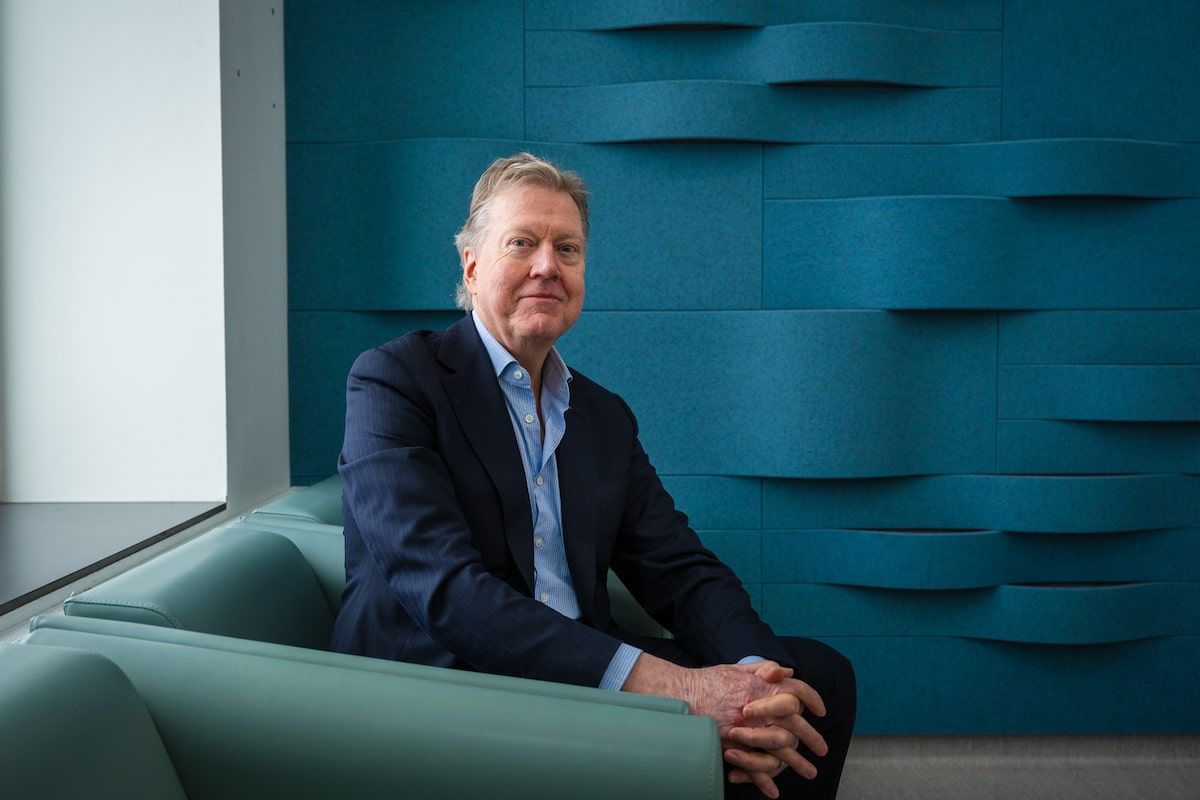
Brian Reeve, a private equity investor and lawyer, at Sunnybrook Hospital in Toronto on Wednesday. Mr. Reeve has made a $10-million donation to Sunnybrook’s OCD treatment centre, where he himself received treatment for four months.Laura Proctor/The Globe and Mail
Like anyone, Brian Reeve has a morning ritual: he wakes up, heads into the bathroom, and pops in his contact lenses. Then he gets on with his day.
But for Mr. Reeve, 69, the simplicity of this daily ritual is a hard-earned triumph. For decades, the Toronto lawyer and private equity investor struggled with obsessive-compulsive disorder (OCD), a mental health condition that compelled him to spend hours every day performing anxiety-fuelled rituals – for example, repeatedly removing and reinserting his contacts until they felt “right.”
Today, Mr. Reeve’s OCD is in remission and he is finally able to enjoy a life without constant anxiety, thanks to an intensive treatment program at Sunnybrook’s Frederick W. Thompson Anxiety Disorders Centre – the first and only facility of its kind in Canada.
It changed his life so much that he is investing in its future. On Thursday, Sunnybrook Health Sciences Centre announced that Mr. Reeve is making a $10-million donation to improve and expand the Thompson facility and its treatment program, while also funding future research and training for OCD and related disorders.
“You’ve got 400,000 Canadians with some degree of OCD,” Mr. Reeve said. “This is an investment in the future, in a totally underfunded area where there is a huge opportunity to help.”
Opinion: Confessions of a nail biter
OCD is a neuropsychiatric disorder characterized by obsessions – which are intrusive and unwanted thoughts – and compulsions, where sufferers engage in repetitive acts to try and alleviate their fears and anxieties.
The condition affects 2.5 per cent of the population, or about 1 in 40 adults, making it twice as common as conditions like bipolar disorder or schizophrenia. OCD affects people in different ways but at its most extreme, it can be debilitating, according to Peggy Richter, the inaugural head of the Thompson Centre and an internationally-recognized expert in OCD.
One former patient, who shared his story on Sunnybrook’s website, developed 100 daily rituals that made him effectively housebound; another described taking four-hour showers owing to an obsession with contamination.
Dr. Richter recalls a client whose OCD revolved around thoughts of inadvertently travelling between parallel universes. “OCD can really be anything the mind can think of,” she said. “At the most profound end, we have extremely ill people who really are unable to take care of their daily needs without ongoing or near-constant family support.”
In Mr. Reeve’s case, his perfectionist OCD didn’t stop him from achieving his life’s goals. He is a happily married father of two and a former corporate lawyer with Cassells Brock & Blackwell; today, he is the founder shareholder and chair of a private equity firm.
“The biggest thing I’ve lost is time,” he said. “And the ability to be in the moment, particularly with my kids.”
Mr. Reeve’s symptoms first emerged when he was a 20-something articling student. What began as practical actions – for example, double-checking his alarm clock, or ensuring his contact lenses were properly set – gradually spiralled into dysfunctional repetition.
In the early years, his treatment options were limited. “I went and saw psychiatrists at CAMH and they all said the same thing: take some Prozac and go back to your family doctor.” For three decades, Mr. Reeve coped by attending weekly therapy sessions and avoiding OCD triggers, which sometimes prevented him from participating in social activities, or helping more with his children.
In 2019, his family doctor learned of the intensive OCD treatment program at the Thompson Centre, which was established in 2012. Mr. Reeve spent four months in the program, undergoing therapies like exposure and response prevention (ERP) – an approach where patients are forced to confront their triggers and resist doing compulsions.
The program transformed Mr. Reeve’s life and his OCD has been in remission for two years. He has become a passionate advocate, joining the centre’s patient and family advisory council, participating in OCD fundraising walks – and now, making a major donation.
How high-tech mental-health gadgets are helping millions feel better
Mr. Reeve’s $10-million gift will fund an endowed chair position, fellowships and the relocation of the OCD treatment unit into a permanent home at Sunnybrook’s Bayview campus, where it will be renamed the Reeve OCD Centre (the treatment unit was previously located a kilometre away in rented space).
The new location will include improved amenities, closer collaboration with the hospital’s brain sciences program, and greater capacity. Currently, the unit can treat about a dozen patients at a time, with a waitlist of up to 12 months for some Ontario patients, according to Dr. Richter.
Mr. Reeve said he sees his donation as more of an investment. He wants to help build a “centre of excellence” for OCD research, education and treatment – one that he wishes he had access to back when he was first diagnosed.
“If I had the access back then [to the] Thompson Center, you know, I would have had quite a different life.”