
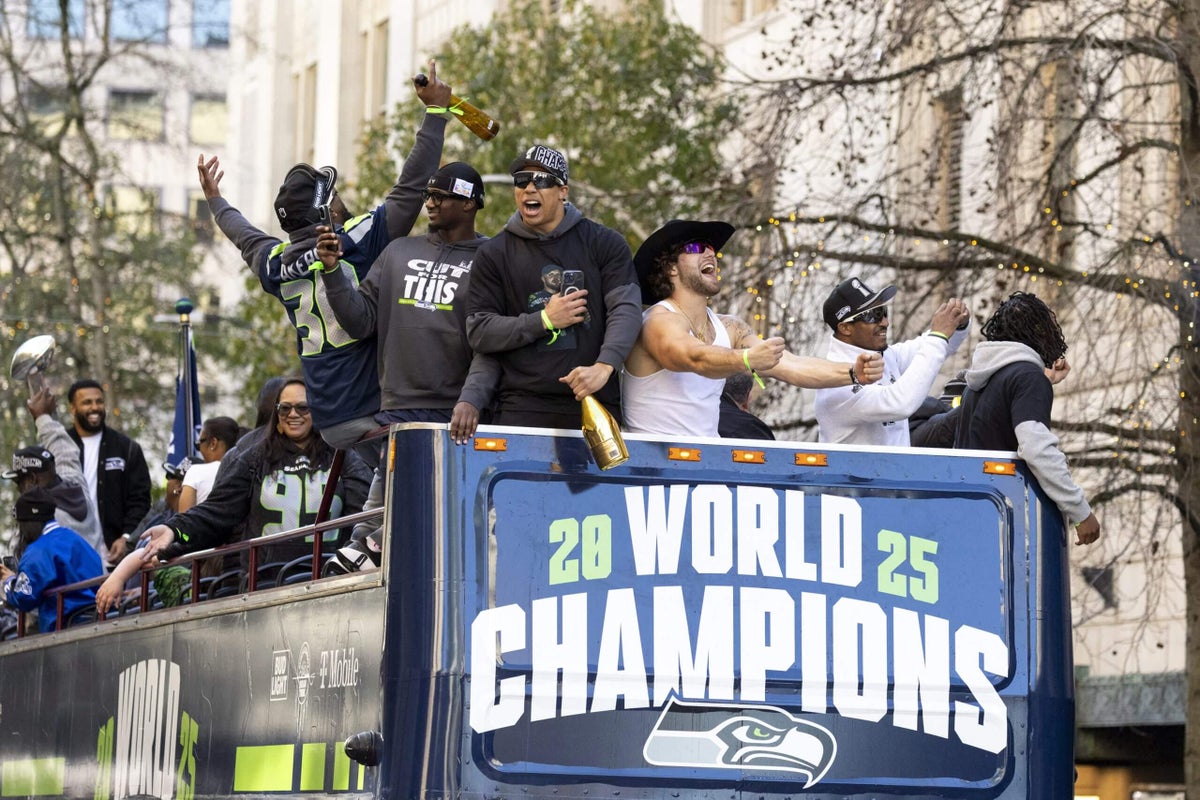
The estate of late Seattle Seahawks owner Paul G. Allen announced on Wednesday that it plans to sell the franchise, an inevitability after Allen died in 2018 and placed the team in a trust with the stipulation that it and his other sports assets would eventually be sold, with the proceeds put toward philanthropic endeavors.
This was always the plan.
What wasn’t planned, however, was that Jody Allen — his sister, who has served as the team’s chair and the executor of his estate since his death — would be hoisting the Seahawks’ second Lombardi Trophy just days before the announcement.
The Seahawks’ 29-13 win over the New England Patriots in Super Bowl LX added a new layer to what some believe will be a record deal for an NFL franchise, surpassing the $6.05 billion that Josh Harris paid for the Washington Commanders in 2023.
But if the Seahawks command more than that in the coming months, it probably won’t be because of their latest title, multiple experts said. Any benefits from that victory would likely be felt more in the long term, such as with new sponsorship deals or an uptick in ticket sales and suite rentals.
“It’s not going to hurt, but I don’t think it’s going to be something that has a huge impact on the valuation,” said Sal Galatioto, the president of Galatioto Sports Partners who has been an adviser in multiple pro sports ownership transfers.
The potential sale’s timing comes after the 2024 expiration of a clause in the team’s agreement with the state of Washington, stipulating that 10 percent of the proceeds of a sale go back to the state, which provided the majority of funds to build Lumen Field and owns the stadium.
But the real reason the Seahawks have a chance to top the Commanders’ price tag is because of the NFL’s economics and its massive TV rights deal, which could soon expand even more.
“The number seems to go up every time (an NFL team is sold), and I would not be surprised if this sets a record,” said Irwin Kishner, a partner at the law firm Herrick, Feinstein LLP and co-chair of its sports law group.
The Seahawks aren’t the first pro sports franchise to go up for sale after a championship. The NBA’s Boston Celtics sold for $6.1 billion in 2025, a year after winning their 18th title. That deal marked a massive 1,700 percent bump in value from the $360 million the team sold for in 2002, clearly suggesting that the championship played a part.
But NBA teams drive a larger share of their revenue from in-arena sales and the marketability of their active stars when compared to the NFL.
Numerous factors play into determining an NFL franchise’s value — and various publications use different methodologies — but the primary drivers include: revenue, historical and projected sales, the team’s stadium situation (is the venue owned outright and in need of major repairs, is it leased, does it have a reliable financial structure in place?), the strength of a team’s brand, its debt burden and the league’s current and future economics.
The average NFL team is worth $7.13 billion, according to Sportico’s 2025 valuations. That’s up 20 percent from 2024’s average — which was up 15.4 percent from the year before. The sports business website estimates the Seahawks’ value to be $6.59 billion, the 14th-highest in the NFL and up 18 percent from the team’s estimated value in 2024. After winning the previous Super Bowl, the Philadelphia Eagles’ value increased by 25 percent, according to Sportico.
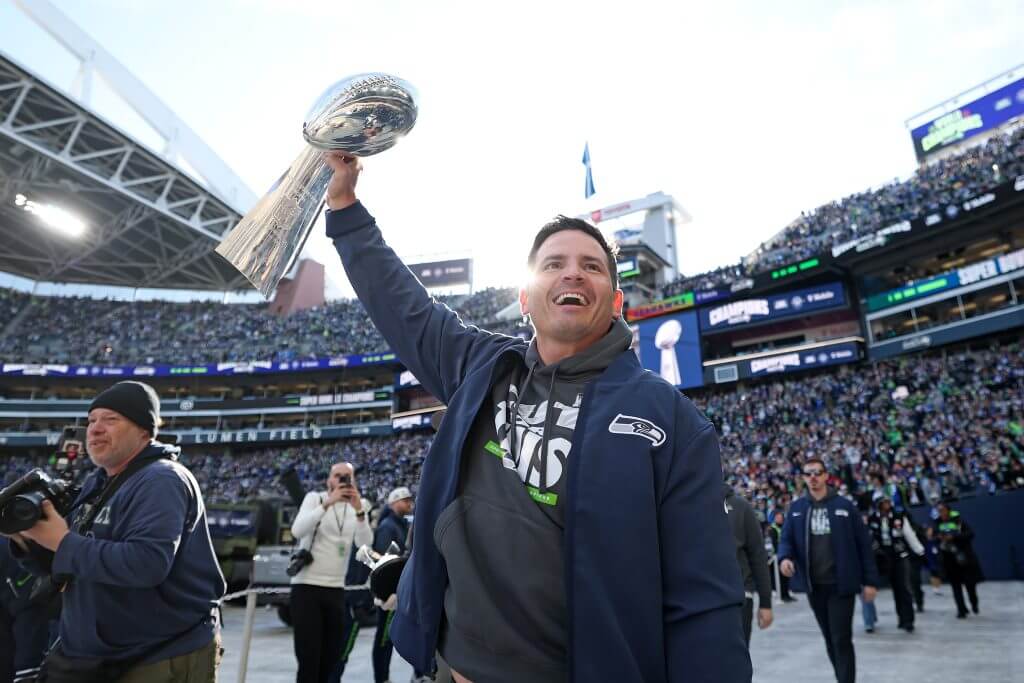
Coach Mike Macdonald and the Seahawks brought the Lombardi Trophy back to Seattle. (Steph Chambers / Getty Images)
Indeed, NFL franchises are money machines practically guaranteed to not lose value.
They’re also scarce.
There are 31 privately owned teams, with only the Green Bay Packers publicly owned, and rarely do they come available.
There have been multiple sales of minority interests in NFL franchises in recent years. But over the last decade, only three — the Carolina Panthers in 2018, the Denver Broncos in 2022 and the Commanders in 2023 — changed controlling owners. David Tepper, the billionaire hedge fund manager and former Pittsburgh Steelers minority owner, bought the Panthers for $2.28 billion after former owner Jerry Richardson was accused of sexual misconduct and subsequently fined $2.75 million by the NFL. The Broncos, like the Seahawks, were held in a trust established by a former owner, Pat Bowlen, before they were sold to the Walton-Penner family for a record $4.65 billion.
Not only did each sale set a new record, but its new owners did too. Tepper was the league’s wealthiest controlling owner before Rob Walton and his estimated $58 billion at the time joined the league. (Tepper’s net worth is now $23.6 billion, while Walton and his family are worth around $144.8 billion, according to Forbes’ real-time billionaires list.)
All North American pro sports leagues have some form of revenue sharing. But the NFL’s model splits revenue from the league’s national TV rights deals, sponsorships and licensing equally among its 32 teams. That shared revenue accounts for more than 60 percent of teams’ total revenue, according to Sportico.
The biggest chunk of that revenue is also the primary reason NFL values have soared — and will increase even more in the near future. The NFL’s current 11-year media rights deal, which includes the major broadcast networks as well as streaming platforms, totals more than $110 billion and includes a 2029 opt-out, with Commissioner Roger Goodell suggesting last year that negotiations could begin as soon as 2026.
“The reason why we felt so strongly about the option is the landscape is changing,” Goodell told CNBC in August. “It could be a long-term deal with the benefit of having that stability and security of it. But I think the reality of it is it changes so quickly that you want to have the ability to move. I think those options are going to give us a lot of flexibility to potentially go earlier.”
The NFL has even more added value on the horizon. Owners haven’t hid their desire to expand the regular season to 18 games, although that would have to be collectively bargained with players. The league has also made it clear it wants to transform into a global enterprise; the NFL will play a record nine international regular-season games spread across four continents in 2026, and Goodell has suggested even more international expansion is possible.
“You can think of expansion as the number of teams, or you can think of expansion as us playing in international markets and reaching in different areas,” Goodell said in a recent interview with Westwood One.
The ballooning values of NFL franchises seem to have no ceiling, but those price tags also limit the pool of prospective buyers to the super rich. Unlike other pro leagues, the NFL requires an individual — not a group or an institution — to own at least 30 percent interest for control. It also limits the number of minority owners to 24. (For family owned teams, the threshold for control is only 1 percent, but the family collectively must own at least 30 percent.)
Should the Seahawks sell for $8 billion and set a new record for an NFL franchise, the controlling owner would need to put down at least $2.4 billion and then find as many as 24 other investors who are willing to pony up a total of $5.6 billion — without having voting interest. It’s a tall ask, and it can quickly turn an already complicated deal into a lengthy process since every new owner, be it for controlling or minority interest, must be approved by at least 24 of the 31 other team owners.
And because the Seahawks are held in a trust, like the Broncos were, it’s Jody Allen’s fiduciary duty as executor of the estate to maximize the franchise’s value in a sale.
“There’s a limited universe, as these valuations keep on going up and up, of individuals who can actually afford to have that 30 percent of equity,” Kishner said. “So, I do think that that’s ultimately going to evolve. And one of the ways it will evolve is either that (requirement) goes down, or there’s more relaxing of how you get to that 30 percent and what you control and what you don’t control.”
Galatioto, however, believes there’s just one scenario in which the NFL decides to lower the 30 percent threshold for control.
“I think the only way that would happen is if it had a failed sale, and I don’t think they’re anywhere near that,” he said. “I don’t think they believe they need to, and nor do I at this point. Because, again, if you lower the threshold, you make it even more difficult, because now you’ve got to raise 80 percent of the equity instead of 70 percent of equity.”
Yet Kishner and Galatioto both believe the NFL’s team values won’t level off.
The league has remained steadfast in its desire to keep one person with voting interest in a franchise. But it has taken some steps to reduce the financial burden, lowering the threshold for controlling ownership from a previous minimum of 51 percent, increasing the debt limit (up to $800 million now, with new buyers able to take on an additional $700 million), and allowing minority ownership by some league-approved private equity firms.
The investment bank Allen & Company and the law firm Latham & Watkins will lead the Seahawks sale process, which is expected to continue through the offseason.
The Allen estate is in the process of closing a sale of the NBA’s Portland Trail Blazers to a group led by the owner of the NHL’s Carolina Hurricanes, Tom Dundon, for approximately $4.25 billion. The estate still retains a minority ownership stake in Major League Soccer’s Seattle Sounders.
Paul Allen, the co-founder of Microsoft, purchased the Seahawks from Ken Behring for around $200 million in 1997, saving the franchise from leaving Seattle. During the Allen family’s 29 seasons of ownership, the Seahawks had a winning record 20 times, made the playoffs 17 times and won 11 divisional titles, four NFC championships and two Super Bowls.
Paul Allen hoisted the team’s first Lombardi Trophy after the Seahawks’ lopsided win over the Broncos in Super Bowl XLVIII, in February 2014. He died nearly four years later from complications of non-Hodgkins lymphoma at age 65, and Jody Allen took over as chair of the Seahawks and trustee of her brother’s estate.
After nearly three decades of mostly stability and success, the Seattle Seahawks now face an uncertain future — but one that will likely set a new floor for NFL franchise values.
“I mean, what are you actually getting by holding on to it?” Galatioto said. “You already won a Super Bowl. Ain’t gonna get better than that.”