
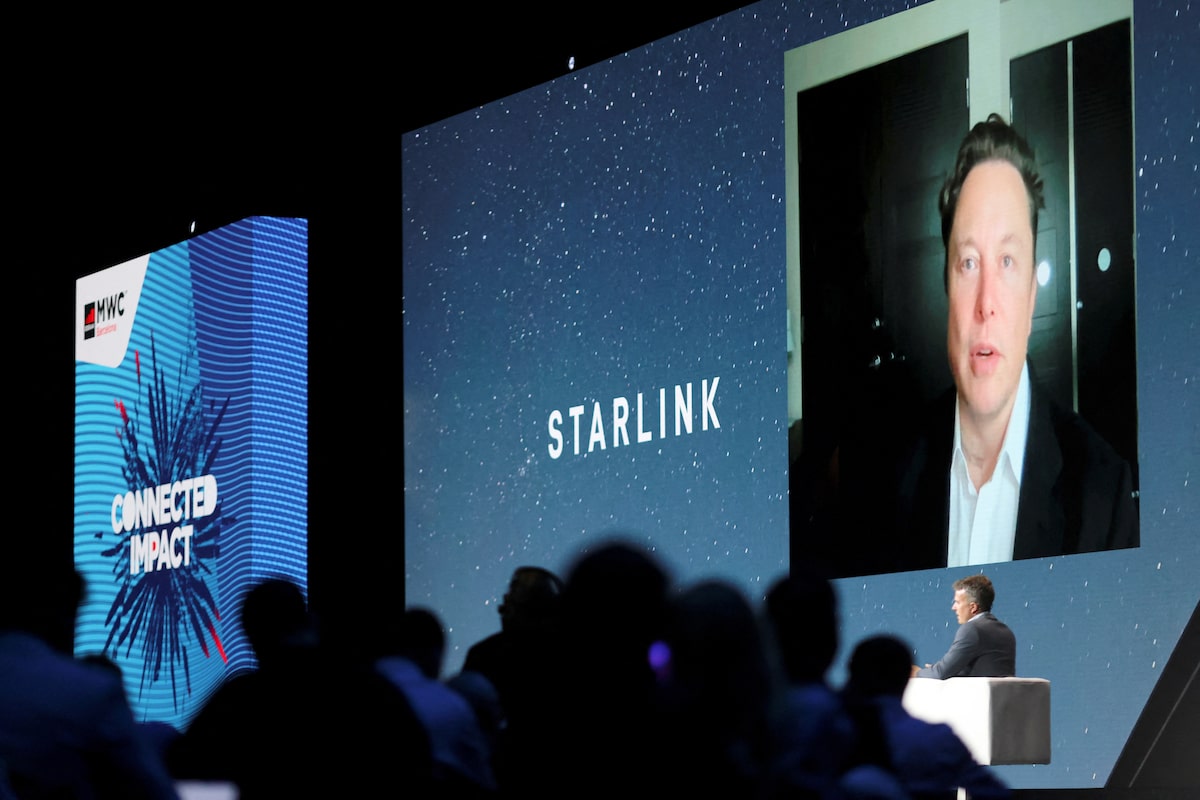
SpaceX founder and Tesla CEO Elon Musk speaks on a screen during the Mobile World Congress (MWC) in Barcelona in June, 2021.Nacho Doce/Reuters
Billionaire tech mogul Elon Musk’s campaign to bring his Starlink internet service to the country of his birth, South Africa, has ignited a furor across the country, provoking strong support from some factions and fierce opposition from others.
Just north of the border, however, Mr. Musk and his SpaceX satellite company have found success in an unexpected market: Zimbabwe.
In a country where the long-ruling regime is quick to blame U.S. policies for its economic woes, the American tycoon has seen his satellite service expanding rapidly in schools, offices, homes and even taxi cabs. Tens of thousands of Zimbabweans have joined Starlink’s 10 million global users.
The sharply contrasting outcome in the two African countries has exposed how divisive Mr. Musk has become in his South African homeland – and how quickly his satellite offering can conquer a less-developed market.
Paris prosecutor’s cybercrime unit searches X platform’s office, Musk summoned for hearing
Zimbabwe has been ruled for 46 years by ZANU-PF, the liberation party of former president Robert Mugabe and his successor, President Emmerson Mnangagwa. The party has been staunchly socialist for most of its history.
But despite Mr. Musk’s close links to U.S. President Donald Trump’s administration, which has maintained sanctions on Zimbabwe’s top political leaders, the former liberation fighters of ZANU-PF have welcomed the internet service that the billionaire offers from his low-earth orbit satellites.
“Starlink is a revolutionary service which we have embraced as we are a party that acknowledges the importance of technology in the attainment of our goals,” ZANU-PF information director Farai Marapira told The Globe and Mail.
“Starlink has enabled affordable internet to be accessed in any part of our country, making our communications with our grassroots heightened in efficiency,” he said.
Starlink’s sales in Zimbabwe are booming. Within a year of its 2024 launch in the country, it had more than 50,000 customers and was providing 80 per cent of Zimbabwe’s use of international internet bandwidth.
Francis Chikwari, a businessman in Zimbabwe’s construction sector, says he has saved money by paying US$50 monthly for unlimited internet on a Starlink unit that he shares with 15 families. “I know it’s an American company, but what’s wrong with that?” he asks.
The Zimbabwean government announced in January that it is distributing 8,000 Starlink units to schools across the country. State-controlled media portrayed it as a generous gift by the government, but local Starlink officials declined to say whether the company had donated the school units – an offer it has made to other African governments.
Perhaps the most visible use of Starlink is at a high-profile ride-hailing company, Tap & Go, which has installed the units in its entire fleet of cars, with satellite receivers perched on their roofs. The company is owned by Paul Tungwarara, a prominent local investor and ZANU-PF insider. It offers free Starlink internet to its passengers, who pay as little as US$2 for rides in the centre of Harare, the capital.
“Starlink has changed my life,” says Linet Chimhanda, a 29-year-old computer technician and regular Tap & Go customer. “I can ride a taxi and use their internet at any time – isn’t that efficient?”
Across the border in South Africa, however, Starlink is much more controversial – and still not officially licensed to operate, although thousands of people have illegally hooked up to it.
South African farmers and rural residents have agitated for the government to approve Starlink. In their remote locations, no other internet providers are feasible. Some farmers, hobbled by poor cellphone signals, are obliged to drive several kilometres just to send an e-mail or get access to market data.
To sweeten its offer, Starlink says it would provide free connectivity to 5,000 South African schools. But this hasn’t impressed the government. According to its legislation, any foreign telecommunications company must be at least 30 per cent owned by historically disadvantaged South Africans if it wants an operating licence.
Mr. Musk refuses to comply. He claims to be a victim of racial discrimination. “Starlink is not allowed to have an internet provider licence in South Africa for the sole reason that I am not Black,” he said last month. “This is not ok.”
Elon Musk merges SpaceX with xAI in record-setting deal valuing new company at $1.25-trillion
South Africa sometimes allows an “equity equivalent” investment as an alternative to a direct 30-per-cent ownership share in foreign companies. Under this arrangement, a company that invests in programs that benefit black South Africans – such as training or infrastructure – can be deemed to fulfill the ownership requirements. Some politicians argue that Starlink’s offer of free internet to 5,000 schools could satisfy this goal, possibly with the help of a regulatory or legislative amendment.
But others are adamantly opposed, especially because Mr. Musk has been a vociferous critic of his former homeland.
“We’d be stupid to have that Starlink thing here,” said Songezo Zibi, a member of South Africa’s parliament.
“Elon Musk has declared himself, through his actions, as an enemy of South Africa’s constitutional order, and an enemy of social justice and redress for racial inequality,” Mr. Zibi said in a video posted on Mr. Musk’s social-media platform, X.
“He uses misinformation and disinformation to spread lies in the United States that are damaging to South Africa, including the lie about ‘white genocide.’ It would be dangerous to have Elon Musk own a technological ecosystem in South Africa.”
A firebrand left-wing politician, Julius Malema, goes even further. Mr. Malema, who leads one of South Africa’s biggest political parties, alleges that Mr. Musk and other foreigners would use Starlink to destabilize the country. “They’re coming to create regime change,” he said.