
A new review study examines the current research regarding the risks that various geoengineering approaches pose to marine ecosystems.The study looked particularly at a range of marine carbon dioxide removal (mCDR) methods, along with solar radiation modification (SRM) technologies, and found that some approaches carry fewer risks than others.Electrochemical ocean alkalinity enhancement and anoxic storage of terrestrial biomass in the deep ocean (utilizing crop waste, for example) carry fewer risks to marine ecosystems than some carbon dioxide removal methods, such as those that would add nutrients to seawater to promote major plankton growth.However, better models, increased field testing, and better geoengineering regulatory oversight are needed to fully assess potential geoengineering marine ecosystem impacts, especially if commercialization proceeds. Public fears over field testing also need to be allayed.
See All Key Ideas
Science has made it clear: The prospect of heat waves without end, increasingly destructive floods, relentless drought, rapidly rising sea levels, and the risk of “point of no return” tipping points require humanity to swiftly stop burning fossil fuels to avoid catastrophe.
But with political will and action lagging, some researchers say now is the time to evaluate the safety and feasibility of geoengineering. These are a suite of proposed technologies that could potentially delay the worst warming or sequester carbon, thus buying civilization time as it struggles to slash fossil fuel emissions.
One place scientists are looking for geoengineering solutions is the world’s oceans, which store vast amounts of carbon, including about a quarter of anthropogenic emissions. Some researchers are especially interested in a set of geoengineering methods collectively dubbed marine carbon dioxide storage (mCDR). Still others are looking at ways to artificially cool the Earth by reflecting sunlight into space, especially above oceans.
One major concern with all these untried technologies is that, if widely implemented, they could profoundly impact marine ecosystems, says Kelsey Roberts, a research associate at the University of Massachusetts Dartmouth in the U.S.
In a recent Reviews of Geophysics paper, Roberts and co-authors examined eight geoengineering interventions most likely to directly impact marine ecosystems, identifying knowledge gaps and risks.
“If we implement some of these insane science fiction-sounding technologies, what would happen to the fish? What would happen to the megafauna … and particularly, [what’s] the importance for global food security?” Roberts asks.
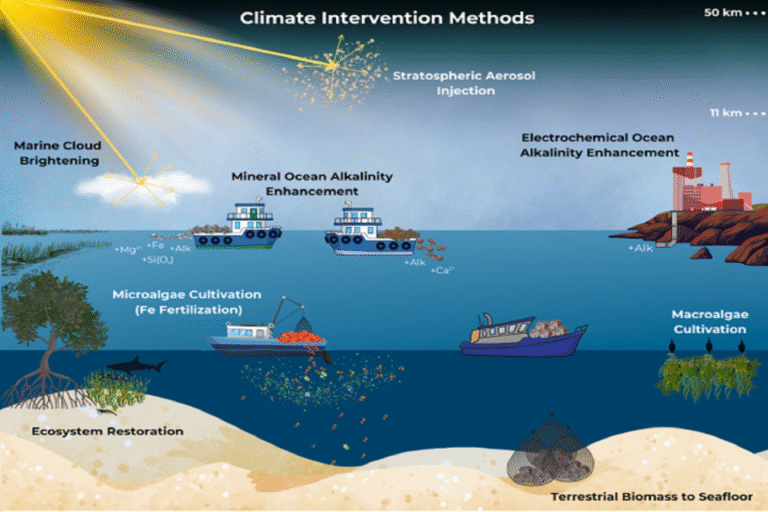 Illustration of proposed marine carbon dioxide removal and solar radiation management interventions examined in the recent Reviews of Geophysics study. Image by Vanessa van Heerden at LA Sea Grant via Roberts et al., 2026.
Biotic marine carbon dioxide removal (mCDR)
Biotic mCDR technologies use photosynthesis to capture carbon, then store it in the ocean’s depths when the biomass sinks. One such approach is microalgae fertilization, where ships would add growth-promoting nutrients, such as iron, to surface seawater to turbocharge phytoplankton growth. Another option is artificial upwelling, an unproven method of piping deep nutrient-rich seawater to the surface, to boost phytoplankton growth.
Still another mCDR approach, macroalgae cultivation, would farm seaweed (sargassum or kelp, for example), with the carbon-rich decomposing biomass descending — or sunk — into the deep sea.
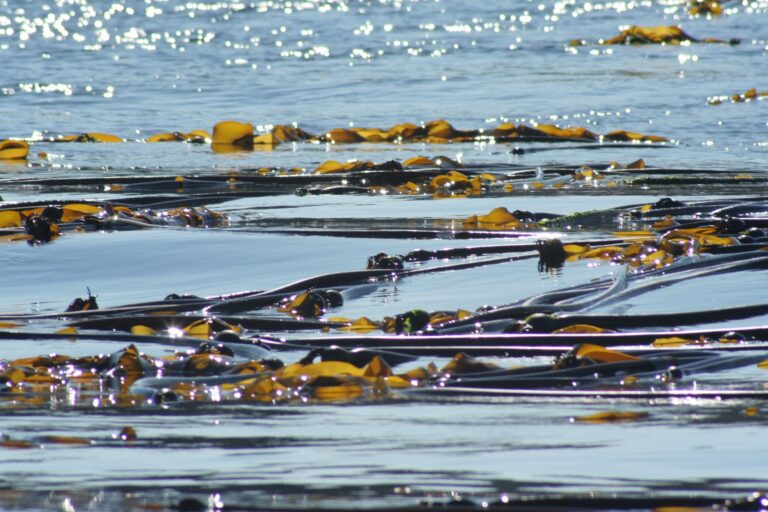 Macroalgae cultivation is a proposed marine carbon dioxide removal method. Ecosystem-wide impacts could depend on how nutrients are delivered and where the biomass breaks down. Image by dnorton via Flickr (CC BY-ND 2.0).
But technical questions abound for all of these methodologies, including uncertainties over how much captured carbon would be stored, and how to measure it.
There are also concerns about ecosystem impacts. Massive nutrient additions to seawater could potentially alter the balance between primary producers at the base of the food chain, including phytoplankton and zooplankton; shift nutrient availability from one ocean area to another; or influence where plankton-feeding predators, fish or megafauna congregate. Such alterations could impact ocean fisheries and risk food security.
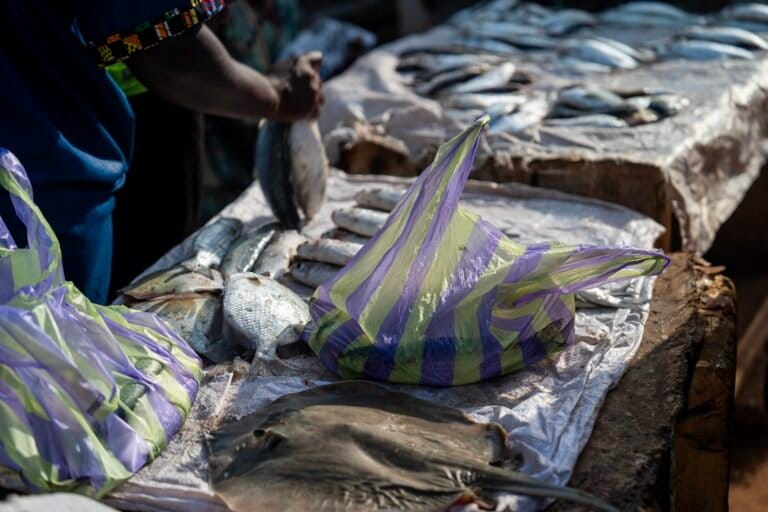 A fish market in Bubaque, Guinea-Bissau. Millions of people rely on fish as a primary source of protein. Some proposed geoengineering climate interventions, if not properly regulated and managed, could impact marine ecosystems and global fisheries. Image by Olivia Rempel/GRID-Arendal via Flickr (CC BY-SA 2.0).
Dense blankets of micro- or macroalgae could create new surface habitats, blocking sunlight from reaching deeper waters, or transporting unhealthy hitchhiking microbes. Also, as large volumes of biomass break down, oxygen will be consumed; that could lead to hypoxic or anoxic ocean areas, meaning less habitat for fish. Likewise, macroalgae descending to the ocean floor could smother benthic organisms.
“When we do [comparable work] on land, forestation sounds very great, people love it. But the ocean is a bit more complicated [and] interconnected,” says study co-author Tyler Rohr, a lecturer at the University of Tasmania in Australia — and unforeseen impacts could result.
Another mCDR technique: Grow or gather terrestrial biomass, such as crop residue, and then sink it to the deep ocean or seafloor. Marine storage of terrestrial biomass would avoid some of the problems related to growing micro- or macroalgae in the ocean, and give more control over where organic matter breaks down. But decomposing terrestrial biomass could still create low-oxygen zones, or change nutrient balances, impacting marine fisheries. Also, deep-sea organisms are slow-growing, making them particularly sensitive to ecological changes.
One of the lower-risk mCDR ideas, according to the authors, is storage of terrestrial biomass in anoxic basins (the Black Sea, for example). This would allow for slow decomposition, though there’s a risk of toxic sulfide being produced during anaerobic respiration.
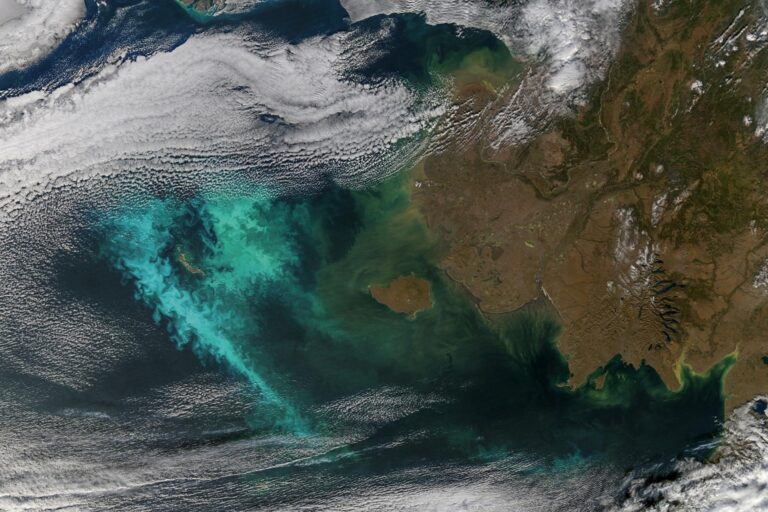 Large blooms of phytoplankton surround the 51-kilometer-long (32-mile) St. Matthew Island in the Bering Sea in October 2014. Microalgae fertilization is a suggested marine CDR method that could capture carbon by adding nutrients to the ocean to create phytoplankton blooms. But this technology could have wide-ranging ecosystem impacts. Image courtesy of NASA/Goddard/Aqua/MODIS.
Ocean alkalinity enhancement, an abiotic mCDR method
Alkalinity, naturally added to the world’s oceans via rock weathering, allows seawater to react with CO2 and store carbon over the long term as bicarbonate or carbonate. Ocean alkalinity enhancement mimics that approach, and is an mCDR technique that would purposely add extra alkalinity to seawater.
In itself, adding pure alkalinity on a small experimental scale would likely have nearly negligible marine life impacts, Rohr says; after an initial pH increase, seawater would rapidly achieve equilibrium. Plus, the neutralizing effect of alkalinity would allow a boost in carbon storage without worsening ocean acidification, a major benefit over biotic methods. The tricky part, Rohr says, is finding a benign alkalinity source.
One of the least risky options is electrochemical ocean alkalinity enhancement, where an electric current separates seawater into alkaline and acidic streams, the study notes. However, this process is energy-intensive (so would need to be powered by solar, wind or other fossil fuel alternative), and the resulting waste acid would need to be neutralized or disposed of properly.
Crushed carbonate rock is another alkalinity source, but the many environmental impacts of mining could negate some climate benefits. Still another option would be to use crushed silicate rock, or even existing mining waste. The risk here is inadvertently adding toxic materials or extra nutrients to seawater, potentially detrimental to marine ecosystems.
The researchers also looked at proposed solar radiation modification interventions that would reflect sunlight back into space and cool the planet, employing such techniques as stratospheric aerosol injection (SAI) and marine cloud brightening (MCB). Both approaches could have profound global or regional impacts on climate and precipitation patterns, Roberts says. Plus, neither intervention would alleviate ocean acidification.
There’s some scientific interest in using cloud brightening to shade coral reefs during marine heat waves, protecting sea life; but that could cause changes in primary production, Roberts warns.
All these proposed geoengineering interventions would incur additional ecosystem impacts from increased shipping, new coastal infrastructure, and more.
“Do the benefits outweigh the risks? That’s the big question,” Roberts asks.
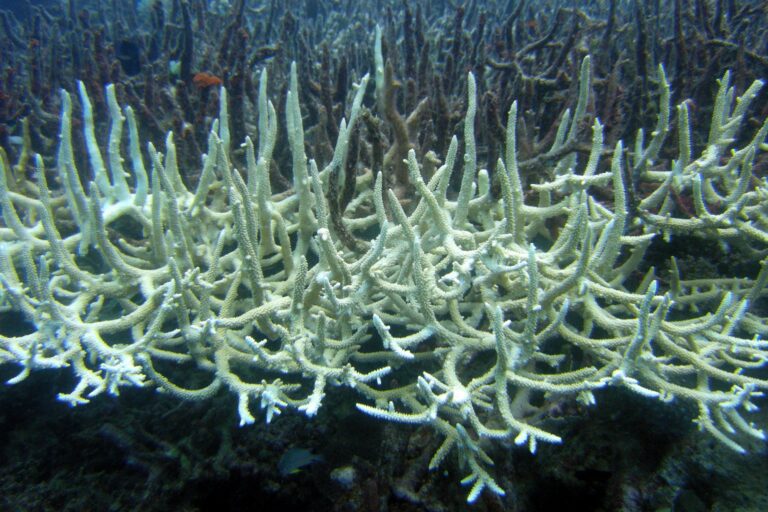 Bleached staghorn coral, Great Barrier Reef, Australia. The reef has experienced five major bleaching events since 2016, and in 2024 experienced the most extensive bleaching ever recorded. Some researchers are exploring the use of marine cloud brightening to shield reefs during heat waves, but this could have unintended knock-on impacts on marine ecosystems or weather patterns. Image by Matt Kieffer via Flickr (CC BY-SA 2.0).
Need for better modeling and field tests
To date, researchers have primarily used models to understand the likely ecological outcomes of geoengineering. But past models were too coarse, and didn’t necessarily include all the parameters relevant to mCDR and other technologies or ecosystems, says Chris Vivian, co-chair of the Joint Group of Experts on the Scientific Aspects of Marine Environmental Protection (GESAMP), Working Group 41. The models are getting better, but more improvements are needed, he says, particularly in terms of resolution and the ability to understand what might happen over large areas.
“[W]e need to know a lot more, particularly if we’re going to do anything at a big scale that may affect large areas of the ocean and potentially could affect things like fisheries or marine life,” Vivian says, also highlighting the need for geoengineering governance, since policy has lagged behind the pace of climate change and commercial interests in geoengineering.
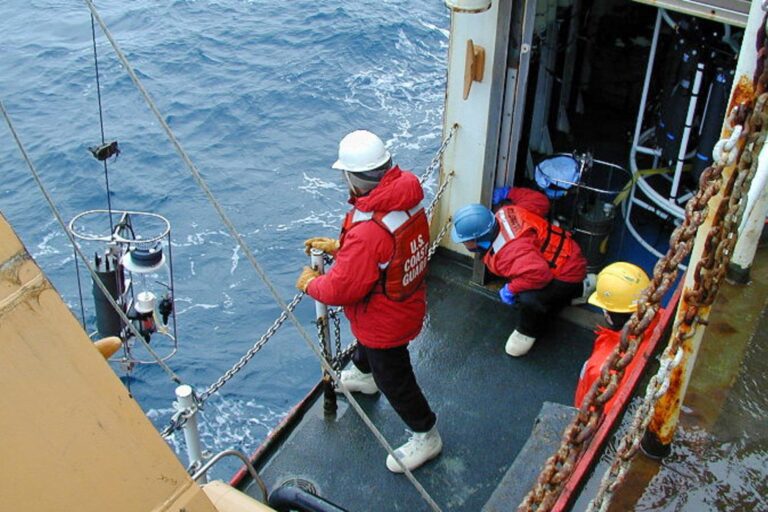 Geoengineering researchers deploy a water filtering pump during the Southern Ocean Iron Experiment (SOFeX) in 2002. The SOFeX was a multiagency research project aimed at understanding how iron fertilization affects productivity in the Southern Ocean. Field research into ocean iron fertilization (OIF) stalled for many years, but in 2024, in a Frontiers in Climate perspective article, a group of researchers laid out a research plan to evaluate OIF’s potential as a CDR method. Image courtesy of Ken Buesseler.
More field testing is needed too, to observe and analyze complex systems, says Adam Subhas, associate scientist at the Woods Hole Oceanographic Institution (WHOI) in the U.S., and project lead on WHOI’s LOC-NESS project (Locking Ocean Carbon in the Northeast Shelf and Slope). The LOC-NESS team has spent a lot of time working with the public and specific stakeholder groups to counter the public opposition many geoengineering field tests have faced.
In August, the LOC-NESS team conducted the first ocean alkalinity enhancement (OAE) field trial in U.S. waters, releasing sodium hydroxide (lye) in the Gulf of Maine over a six-hour period — an experiment previously delayed by worried commercial fishers and coastal communities. Preliminary results indicate that enhanced surface water alkalinity was achieved within safe, reasonable levels, with the researchers able to monitor changes over a long period, Subhas says. These small-scale field tests are part of understanding if OAE or other technologies could be scaled up, and what the risks — or rewards — might be.
“In terms of relevance to society, and questions of can these technologies and approaches actually scale [up],” Subhas notes, “these next sets of questions about the food web response [and] higher trophic levels are very much top of mind.”
Subhas also stresses that the LOC-NESS project is a purely scientific endeavor, not affiliated with industry or the carbon market. Fossil fuel companies have long embraced geoengineering and funded its research in the hopes of curbing climate change while allowing their industry to continue thriving. But Subhas, Rohr and others are very clear that mCDR cannot replace emissions reductions. With mCDR already being commercialized, scientifically rigorous and independent research needs to keep pace, they say.
“What I’m the most fearful of is [that] we fail to reduce emissions,” Rohr says. “Twenty years pass, we hit some sort of climate tipping point … and then all of a sudden, governments are pressed to do some sort of climate intervention at scale without having done the research.
“So, to not miss this opportunity to actually do the research incrementally — and in a slow, steady, safe, controlled way before there could be anything that pushes anyone to want to scale [up] — I think is quite important.”
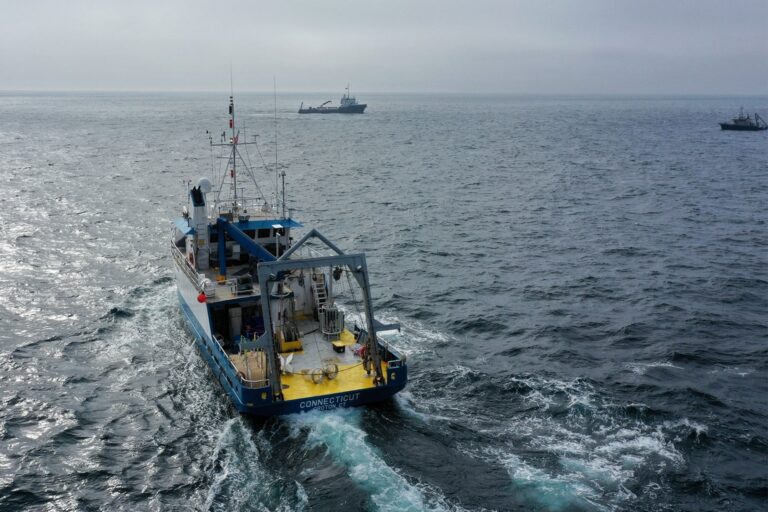 Three ships were part of the successful completion of a U.S. EPA-approved, small-scale environmental research trial of ocean alkalinity enhancement (OAE) in the Gulf of Maine as part of the LOC-NESS Project, in August 2025. That project was delayed at times by public concerns about geoengineering. Image by Daniel Cojanu/Undercurrent Productions © Woods Hole Oceanographic Institution.
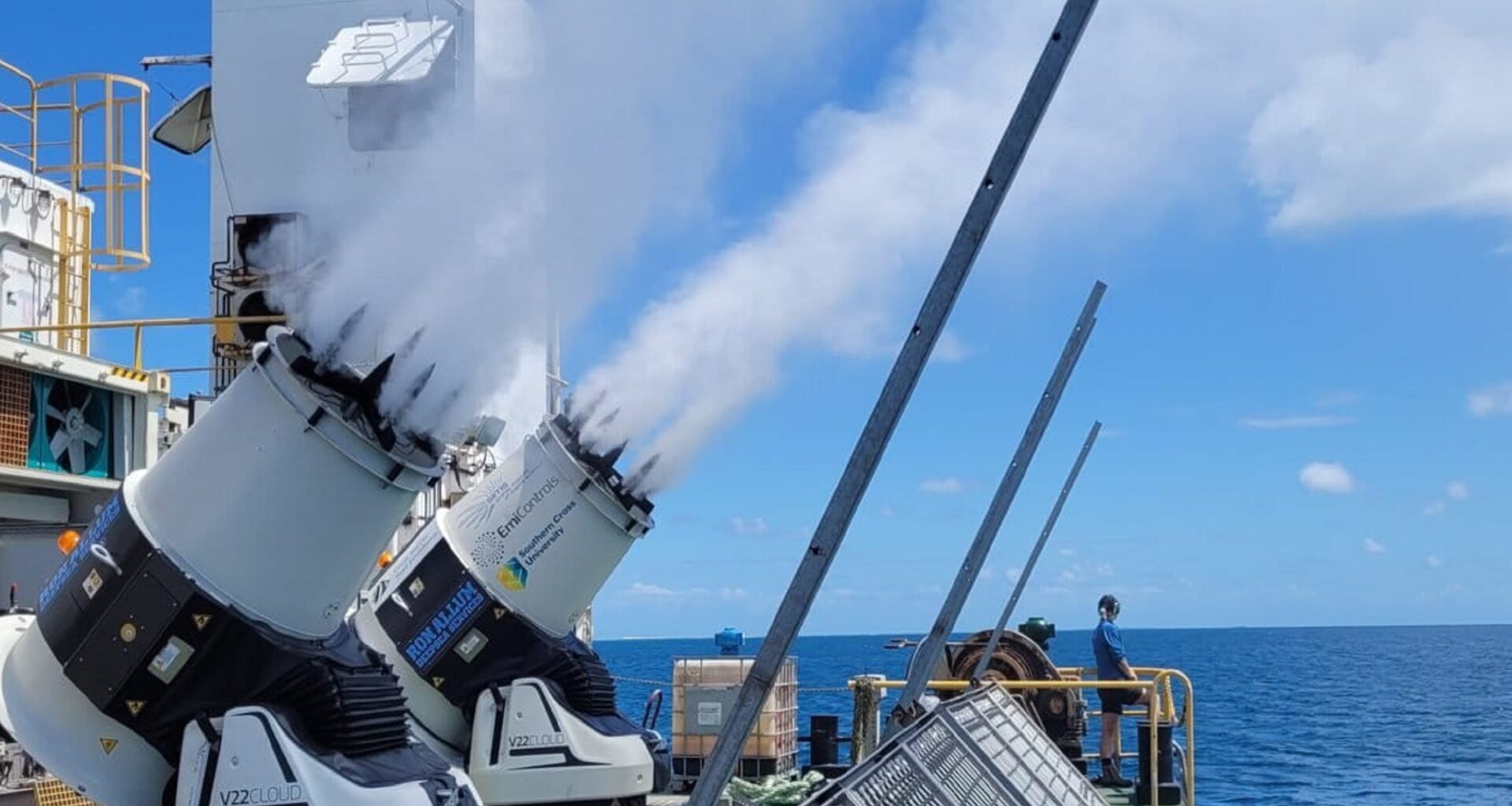
Banner image: Marine cloud brightening generators operate during field testing on Australia’s Great Barrier Reef in 2023. This marine geoengineering project is still several years away from deployment. Current small-scale experiments are conducted under a very strict permit regime. If scaled up, a different governance strategy will be required. Experts say global regulation is needed for geoengineering technology, given the potential harmful effects of large-scale deployment. Image courtesy of Southern Cross University.
Citations:
DeVries, T. (2022). The ocean carbon cycle. Annual Review of Environment and Resources, 47(1), 317-341. doi:10.1146/annurev-environ-120920-111307
Roberts, K. E., Rohr, T., Raven, M. R., Diamond, M. S., Visioni, D., Kravitz, B., … & Harrison, C. S. (2026). Potential impacts of climate interventions on marine ecosystems. Reviews of Geophysics, 64(1), e2024RG000876. doi:10.1029/2024RG000876
Raven, M. R., Crotteau, M. A., Evans, N., Girard, Z. C., Martinez, A. M., Young, I., & Valentine, D. L. (2024). Biomass storage in anoxic marine basins: Initial estimates of geochemical impacts and CO2 sequestration capacity. AGU Advances, 5(1). doi:10.1029/2023av000950
Buesseler, K. O., Bianchi, D., Chai, F., Cullen, J. T., Estapa, M., Hawco, N., … Yoon, J.-E. (2024). Next steps for assessing ocean iron fertilization for marine carbon dioxide removal. Frontiers in Climate, 6, 1430957. doi:10.3389/fclim.2024.1430957
FEEDBACK: Use this form to send a message to the author of this post. If you want to post a public comment, you can do that at the bottom of the page.
