
For decades, the primary challenge of the satellite industry was simply getting hardware off the ground. Now, as constellations multiply in orbit, the focus is undergoing a massive shift from “rocket science to data science.”
The new frontier is no longer just about creating data in space, but managing that information and bringing it directly into operational systems to make faster, more reliable decisions. Enter the “space data layer”—a foundational infrastructure designed to transform space from a collection of isolated platforms into a seamless extension of the global IT network. By integrating edge computing, artificial intelligence, and multi-path communications directly on orbit, this emerging space data layer aims to turn raw pixels into real-time, actionable insights before they ever reach the ground.
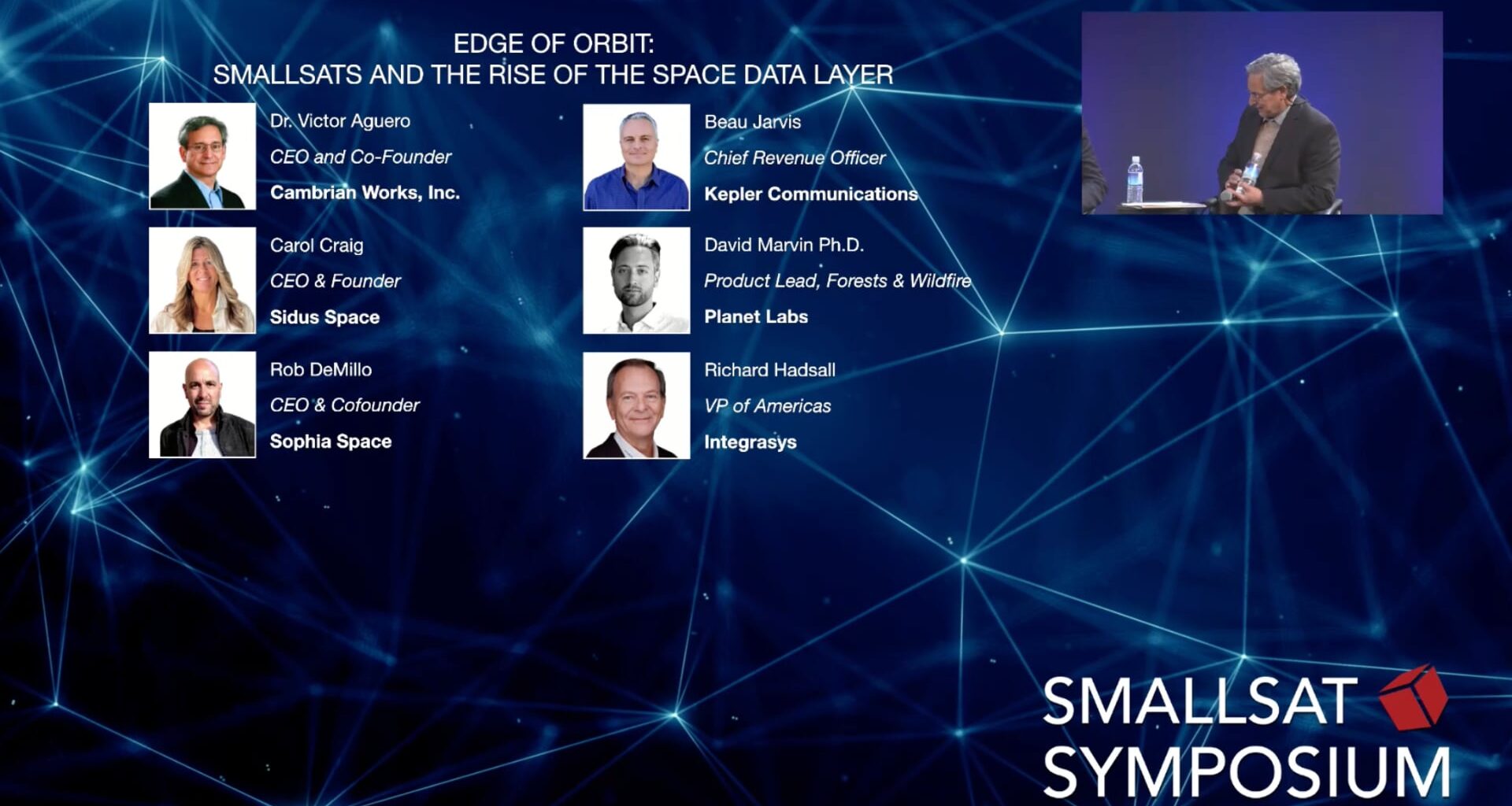
During the Edge of Orbit: Smallsats and the Rise of the Space Data Layer panel at the SmallSat Symposium in Silicon Valley, CA organized by Satnews Events on Tuesday, Feb. 10, 2026, executives detailed the rapid evolution of the space data layer, which promises to connect isolated satellites through optical relays and on-orbit compute capabilities. However, the path to a fully realized orbital network hinges not just on advanced hardware, but on fierce competitors becoming “competitive mates” who champion open standards and zero-trust security.
The panel was moderated by Dr. Victor Aguero (CEO and Co-Founder, Cambrian Works, Inc.) and panelists included Carol Craig (CEO & Founder, Sidus Space), Beau Jarvis (Chief Revenue Officer, Kepler Communications), David Marvin (Product Lead, Forests & Wildfire, Planet Labs), Rob DeMillo (CEO & Cofounder, Sophia Space), and Richard Hadsall (VP of Americas, Integrasys).
The shift to data science
The defining sentiment of the panel was captured by Victor Aguero, CEO of Cambrian Works, who noted that the industry is “moving away from rocket science to data science.” While building space systems and scaling constellations remains difficult, the focus has shifted from merely getting assets into orbit to integrating them into the global IT infrastructure. Space is no longer going to be separate, Aguero noted, emphasizing that the new space data layer must offer the same speed and trust as terrestrial networks.
Redefining “real-time”
For years, the term “real-time” in Earth observation has been a well worn word, often meaning a delay of thirty minutes or even two hours. Beau Jarvis, Chief Revenue Officer at Kepler, pointed out that true real-time literally means real-time, such as routing data through an optical network in under a second.
David Marvin, Product Lead at Planet, illustrated the stakes with a wildfire scenario. Instead of downlinking gigabytes of raw images for ground processing, onboard edge computing could process the data instantly, sending only the critical vector data—like fire lines and safe evacuation routes—to incident commanders within a minute.
“Competitive Mates” and interoperability
Despite technological progress, the panel warned that silos remain a major threat to the space data layer. Carol Craig, CEO of Sidus Space, argued that for the ecosystem to mature, companies must become “competitive mates” rather than pure competitors, because everyone needs to learn from each other’s data.
Jarvis agreed, noting that Kepler adheres to open standards like the Space Development Agency (SDA) and ESA protocols to ensure interoperability. “We can’t build a bunch of siloed systems,” Jarvis stated.
Congestion and security
While optical communications are seen as a major enabler for this layer due to high security and bandwidth, Richard Hadsall of Integrasys provided a reality check regarding the radio frequency (RF) spectrum. Hadsall noted that with more constellations going up, RF interference and spectrum congestion are constant threats.
Furthermore, as space systems become heavily software-defined, they become vulnerable to cyberattacks. “Zero trust is something that just has to happen,” said DeMillo, emphasizing that interconnects between satellites require robust security architectures from day one.
While isolated nodes and “islands of compute” exist today, a fully interconnected, multi-vendor space data layer is still years away with estimates ranging from 3 to 10 years.
Related