
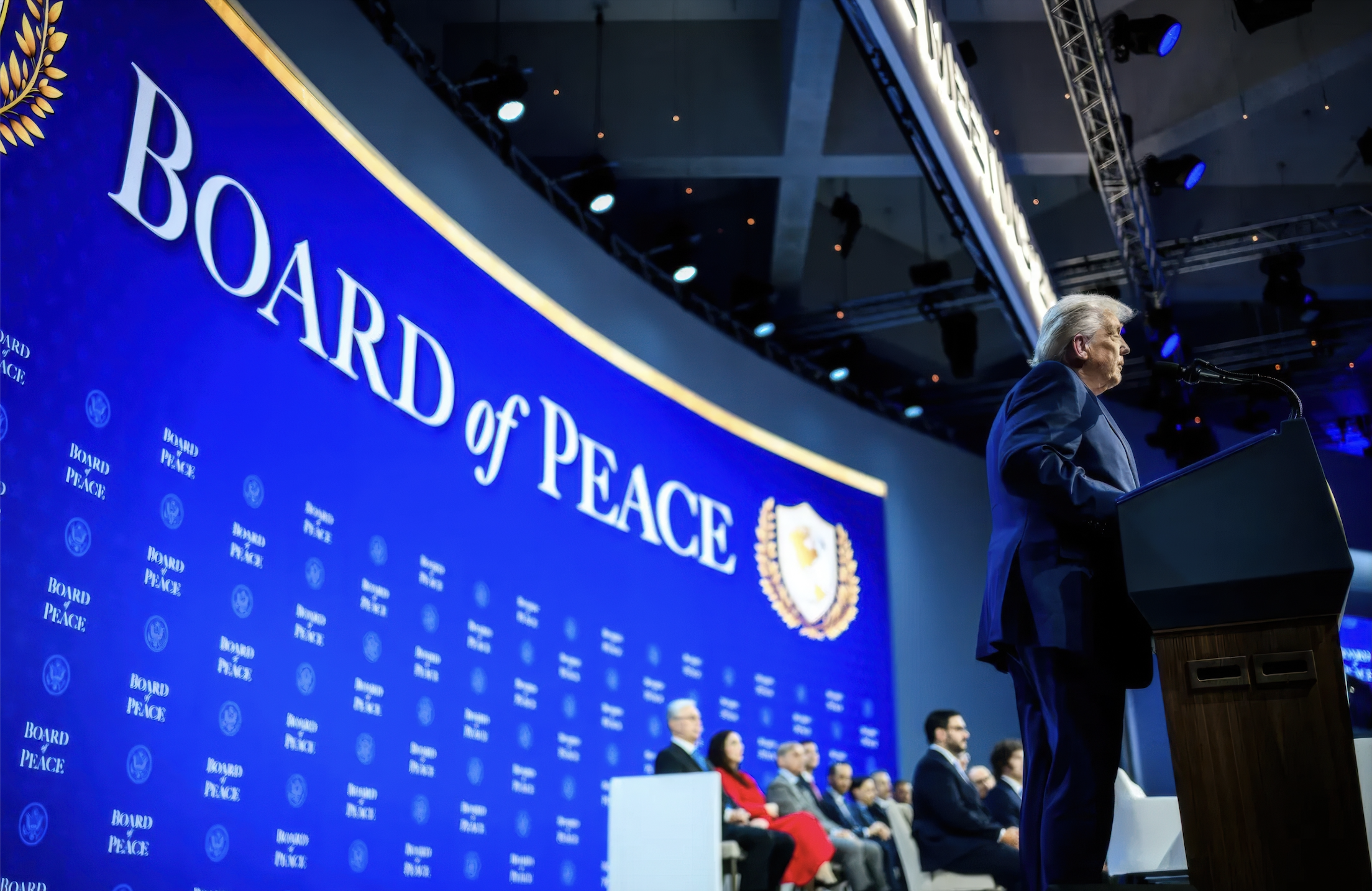
 Donald Trump unveiling his Board of Peace at Davos, January 22, 2026/Shutterstock
By Hon. Perrin Beatty
February 19, 2026
When President Donald Trump personally extended his invitations to join what he calls “the Greatest and Most Prestigious Board ever assembled at any time, any place,” they were designed to be the sort of offer, to quote a different Don, one can’t refuse.
After French President Emmanuel Macron decided to pass on the Board of Peace, Trump threatened a 200% tariff on French wine.
Invitations reportedly went to about 60 leaders, but most members of NATO, the G7 and the UN Security Council have either turned them down or say they are still considering the offer.
The Vatican revealed Tuesday that Pope Leo XIV had passed on the opportunity. Canada is unique because Trump withdrew his invitation after Prime Minister Carney’s speech in Davos, possibly having taken the speech as a de facto decline.
Other than perhaps former U.K. Prime Minister Tony Blair, who can at least rationalize his participation as the former envoy of the Middle east “Quartet”, few of the leaders who attended Thursday’s first meeting at the Donald J. Trump Institute of Peace (yes, formerly known to Policy readers as the United States Institute of Peace) in Washington could be easily identified by people outside of their own countries.
Still, Trump told the meeting, “Almost everybody’s accepted, and the ones that haven’t will be. Some are playing a little cute. Doesn’t work. You can’t play cute with me.”
The reluctance to join on the part of reasonable leaders is understandable, given the uncertainty about the organization’s purpose, and the likelihood of that uncertainty presaging volatility, disruption or worse given the temperament of its chairman-for-life.
The board’s mandate has morphed since the United Nations Security Council endorsed it in November as a transitional administration to oversee the Gaza Peace agreement.
While Gaza may be the first item of business and the reason a number of regional players signed on, its charter doesn’t mention Gaza, and there is no Palestinian representation on the board.
Instead, its scope extends to the whole world, which has raised concern that Trump established it with no lack of irony as an ultimate replacement for the UN.
Trump’s lack of interest in organizations he does not dominate has proven costly for the rules-based international order. He recently ordered US withdrawal from 66 international organizations, including 31 associated with the UN.
As Trump told the press on January 20, he saw no need to seek the UN’s help with the eight wars he claims to have ended. Nor did he seek the UN’s approval before sending a team into Venezuela to capture its president or before threatening military force to seize Greenland. And his national security strategy unapologetically proclaims American hegemony in the Western Hemisphere.
In early February, the United States was more than $4.5 billion in arrears in its payments to the United Nations. The $2.19 billion it owed for the organization’s regular budget represented more than 95% of the UN’s total arrears. It also owed another $2.4 billion for current and past peacekeeping missions. On Thursday, the UN confirmed that the U.S. paid about $160 million of that money last week.
Trump’s lack of interest in organizations he does not dominate has proven costly for the rules-based international order. He recently ordered US withdrawal from 66 international organizations, including 31 associated with the UN.
Asked whether the board might replace the United Nations, he replied, “It might,” before promising at the launch that it would work with the UN: “Once this board is completely formed, we can do pretty much whatever we want to do and we’ll do it in conjunction with the United Nations.”
Perhaps. His record suggests otherwise.
A second reason for concern is the role of Trump himself. He is explicitly named as the board’s chairman, not in his capacity as president of the United States, but as an individual. His term as chair does not end when he leaves the White House.
Barring his incapacity or death, he stays in the job until he decides to leave, and he has the exclusive right to name his successor. He decides who will be invited, excluded or expelled, creates or dissolves entities, approves charter revisions, appoints and removes members of the executive board, and adopts resolutions or directives.
Board decisions require Trump’s approval; he can issue policy decisions on behalf of the board and he is the final authority on the interpretation and application of the charter.
Invitations to join are for an initial three years, but countries can buy a permanent seat by paying $1 billion to a fund controlled by Trump. The finances are overseen by the seven-member Executive Board, itself appointed by Trump.
Trump’s son-in-law, Jared Kushner, his secretary of state, Marco Rubio, and Steve Witkoff, the real estate developer who serves as Trump’s special envoy, are among the initial members.
A seat on Trump’s Board of Peace is the diplomatic equivalent of a membership at Mar-a-Lago. Each comes with a pricey initiation fee, and the primary benefit of each is to spend time with Donald Trump. Just don’t think that becoming a member gives you a role in running the place.
At this point, Donald Trump isn’t inviting Canada to join either club. Despite how little cause he has given for Canadians to be grateful to him over the past year, that is something for which we should be deeply thankful.
Hon. Perrin Beatty, PC, OC, is the former President and CEO of the Canadian Chamber of Commerce. He served as a cabinet minister in seven different portfolios, including Treasury Board, national revenue, solicitor general, defence, national health and welfare, communications and external affairs. He is Co-Chair of the Expert Group on Canada-US Relations and a frequent contributor to Policy.