
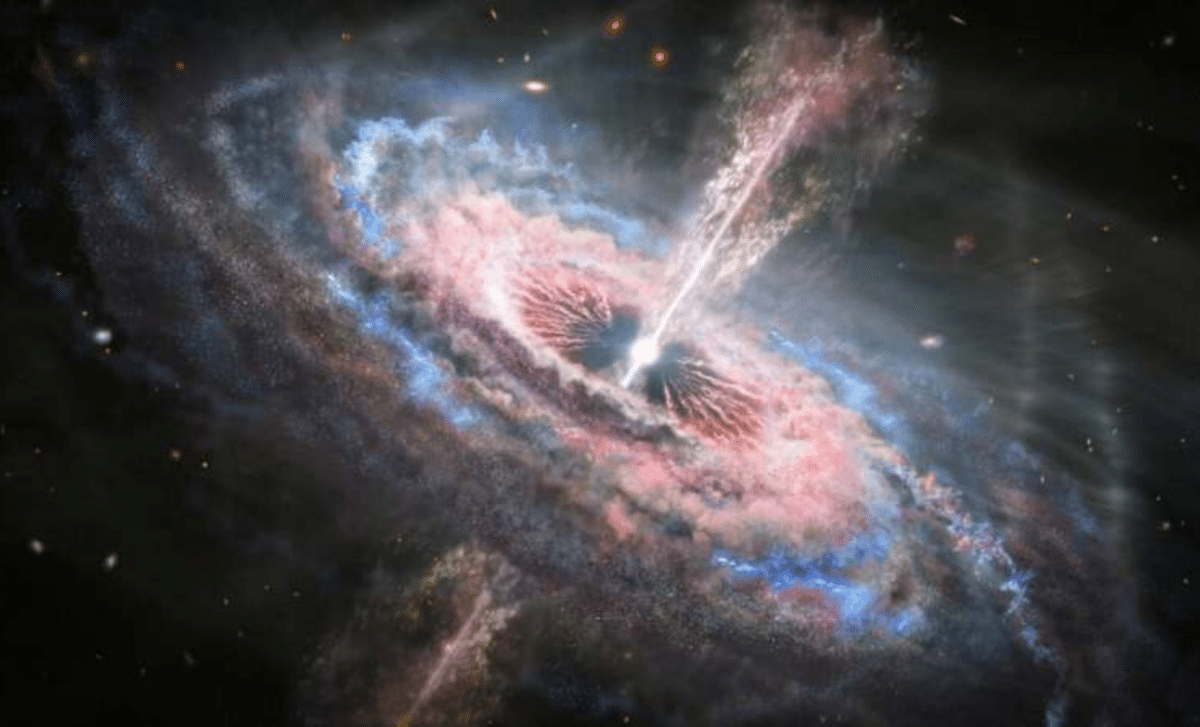
Supermassive black holes, the enigmatic cosmic giants residing at the centers of most galaxies, have long been regarded as destructive forces. However, a recent study published in The Astrophysical Journal Letters uncovers a stunning revelation: these black holes don’t just affect the galaxies they reside in, but can also have a profound impact on neighboring galaxies, suppressing their star formation across millions of light-years. This study, led by postdoctoral researcher Yongda Zhu at the University of Arizona, suggests that the evolution of galaxies might be more interconnected than previously thought, with supermassive black holes acting as cosmic predators in a larger, interconnected “galaxy ecosystem.”
The “Galaxy Ecosystem”: Supermassive Black Holes as Cosmic Predators
Traditionally, astronomers have assumed that galaxies, being separated by vast distances, evolve largely on their own, independent of one another. However, the groundbreaking findings of Zhu and his team, published in The Astrophysical Journal Letters, challenge this view.
“Traditionally, people have thought that because galaxies are so far apart, they evolve largely on their own,” said Zhu. “But we found that a very active, supermassive black hole in one galaxy can affect other galaxies across millions of light-years, suggesting that galaxy evolution may be more of a group effort.”
This idea of galaxies being part of a larger interconnected system, much like an ecosystem on Earth, revolutionizes our understanding of cosmic evolution. Zhu likens an active supermassive black hole to a “hungry predator dominating the ecosystem,” influencing not only its own galaxy’s development but also the growth of stars in neighboring galaxies.
Supermassive black holes in their active quasar phase are capable of releasing enormous amounts of energy. As these black holes consume surrounding matter, they emit intense radiation and winds, which have a destructive impact on their environment. In the case of nearby galaxies, this energy can inhibit star formation by disrupting the conditions needed for stars to form in the first place.
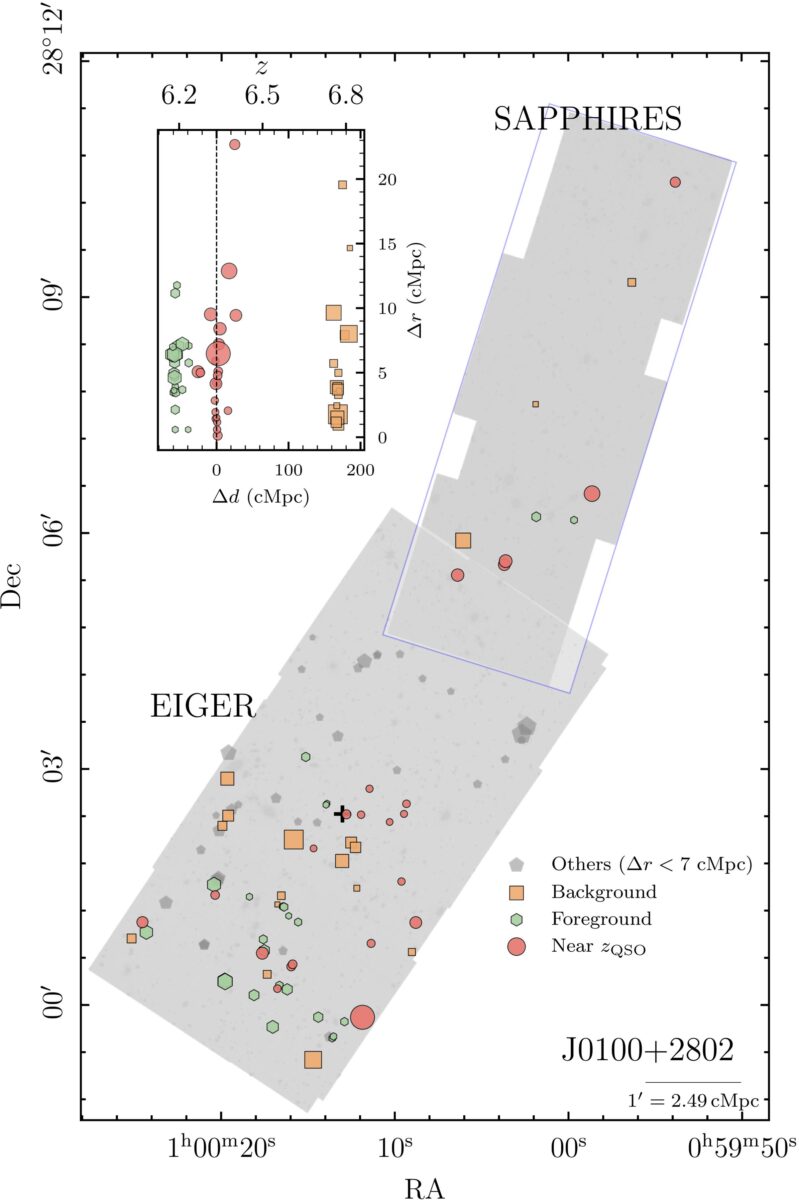 Sky map of the J0100+2802 field, combining NIRCam F356W mosaics from SAPPHIRES (top) and EIGER (bottom). Galaxies at z ≈ 6.3 (near the quasar redshift; red circles), z ≈ 6.2 (foreground; green hexagon), and z ≈ 6.8 (background overdensity; orange squares) are shown with symbol sizes scaled by their observed [O iii] λ5008 luminosities. The black cross marks the quasar position. We also show other galaxies with transverse distance from the quasar Δr < 7 cMpc on the sky map just for reference. The inset shows the projected distribution along the line of sight, with transverse separation Δr plotted against line-of-sight distance Δd from the quasar.
The Role of Radiation in Suppressing Star Formation
One of the key discoveries of this study lies in understanding how the radiation from active supermassive black holes, known as quasars, can suppress star formation not only within their host galaxies but also in galaxies located millions of light-years away.
“Black holes are known to ‘eat’ a lot of stuff, but during the active eating process and in their luminous quasar form, they also emit very strong radiation,” said Zhu. “The intense heat and radiation split the molecular hydrogen that makes up vast, interstellar gas clouds, quenching its potential to accumulate and turn into new stars.”
Stars are born from cold, dense clouds of molecular hydrogen gas, and this raw material is essential for star formation. However, the powerful radiation from quasars can disrupt these gas clouds, breaking apart the molecular hydrogen and preventing new stars from forming. The study shows that this phenomenon extends beyond the host galaxy, affecting the star formation potential of nearby galaxies as well. This marks a significant shift in our understanding of the power and influence of supermassive black holes across vast cosmic distances.
Discovery of Quasar-Driven Star Formation Suppression
The study’s breakthrough was made possible by the James Webb Space Telescope (JWST), which allowed scientists to observe the early universe with unparalleled clarity. By measuring the emission of O III, a specific gas used to trace recent star formation, the team discovered that galaxies within a million-light-year radius of the quasar J0100+2802, one of the most luminous quasars ever observed, showed weaker O III emissions. This suggested that star formation in these galaxies was suppressed due to the radiation from the quasar.
“We were puzzled,” said Zhu. “Was the expensive JWST broken?” he added with a laugh. “Then we realized the galaxies might actually be there, but difficult to detect because their very recent star formation was suppressed.”
This insight led to a revolutionary conclusion: the powerful radiation from quasars is not just limited to quenching star formation in the host galaxy, but it extends to neighboring galaxies within a significant radius. “For the first time, we have evidence that this radiation impacts the universe on an intergalactic scale,” said Zhu. “Quasars don’t just suppress stars in their host galaxies, but also in nearby galaxies within a radius of at least a million light-years.”