
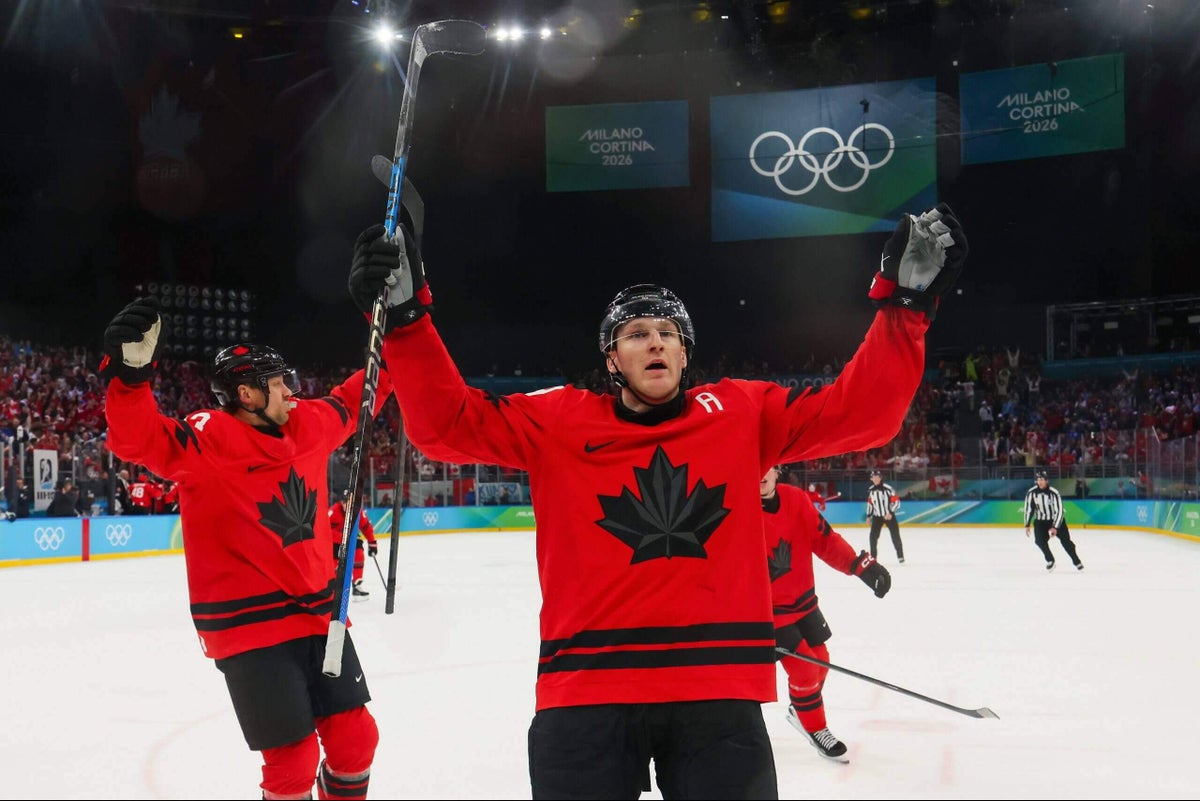
MILAN — It was a goal a year in the making, a goal that did not come out of thin air, that was not merely the combination of the best player in the world setting up the second-best player in the world.
No, when Nathan MacKinnon one-timed a Connor McDavid pass past Juuse Saros and into the back of the net with 35.2 seconds on the clock to give Canada a 3-2 lead, that goal was the culmination of hours of work in the most sophisticated hockey lab imaginable.
That lab opened its doors at the 4 Nations Face-Off, when McDavid, MacKinnon, Cale Makar, Sam Reinhart and Sidney Crosby were first united on Team Canada’s power play. In the 12 months since, each of those players has been intensely focused on their NHL selves, their different teams, their day jobs.
But in the back of their minds, the lab work was getting done. Conversations were taking place and solutions were being found on how the most lethal power play this game has seen in decades could somehow become even more lethal.
“It was built through a lot, a lot of conversations over the course of a year, starting back at 4 Nations,” said McDavid, who became the highest-scoring NHL player in Olympic history with his 12th and 13th points of the tournament. “We’ve worked on this power play a lot, it’s something we’ve talked about a lot, and we do it for these big moments.
“We found a way to score a big one in a big moment.”
As much skill as it took for McDavid to find MacKinnon through a tight seam in the Finnish penalty kill and for MacKinnon to one-time that saucer pass, the whole play began with a very workmanlike effort from MacKinnon on the half wall.
When McDavid first tried that seam pass a few moments earlier, Finland’s Teuvo Teräväinen grazed the puck with his stick, leading it to bounce away from MacKinnon and to the boards. Teräväinen and Rasmus Ristolainen gave chase, and MacKinnon was able to fend them both off long enough for Reinhart to arrive and sweep the puck behind the net, where it eventually found McDavid again in the right circle and wound up on MacKinnon’s stick for the game-winner.
After MacKinnon got done giving everyone else credit for his goal, Canada coach Jon Cooper felt the need to interject.
“He got rewarded for the wall battle right before that,” Cooper said. “It had been a long shift for the guys. A long way to go on the change. But he won that wall battle and kept everything alive. And you know, eventually it gets around to McDavid, and throws it around again. (MacKinnon)’s not giving himself enough credit.’’
It says something about Canada’s ridiculous depth that with Crosby absent due to an injury he suffered in the second period of the quarterfinals against the Czech Republic, his replacement on that power-play unit was Macklin Celebrini, the fourth-leading scorer in the NHL, who played a team-high 25:53 in the game and had eight shots on goal.
Not a bad pinch-hitter.
But Crosby’s absence was most definitely felt and served as added motivation for Team Canada to reach Sunday’s gold medal game and give him an opportunity to suit up after doing everything in his power to face Finland on Friday.
McDavid wore the captain’s “C” in Crosby’s absence, but made sure to note he hoped it was very temporary. Cooper said after the game that Crosby is not ruled out to play Sunday.
“Just keeping the seat warm for Sid,” McDavid said. “Hopefully we can see him back here on Sunday. I’m sure it wasn’t easy for him to miss tonight, and I’m sure it was a long game to watch. I know that for a fact. But it means a lot to represent our country here as a team, in a sport we love.”
The reason McDavid knows that for a fact is that Crosby was around the team before, and — perhaps more notably — during the game, in the room at intermissions trying to help Canada find solutions for Finland’s trademark stifling defensive style.
“He obviously has a great hockey mind,” McDavid said. “He’s watching the game closely and trying to dissect what they’re doing. Giving out little pointers here or there of what we can look for. He was definitely there and having those conversations.”
Finland coach Antti Pennanen challenged MacKinnon’s goal for an offside on the entry, creating a nervy moment in the building, but the goal was confirmed on review.
“From our side,” Pennanen said, “it was offside.’’
Cooper said he immediately spoke to his video coach after the entry because he, too, thought it might be offside, and it took five seconds to get an answer that the entry was fine. So he had that answer before MacKinnon eventually scored.
As for the high-sticking penalty MacKinnon drew on Finnish defenseman Niko Mikkola with 2:35 to play, Hockey Hall of Famer Teemu Selänne tweeted after the game that it was embarrassing to see two Canadian referees — NHL officials Eric Furlatt and Dan O’Rourke — calling that penalty that late in the game.
Pennanen had no issue with the Canadian referees, saying postgame that Team Canada was a very good team that deserved to win.
For a second consecutive game, Canada had to come from behind in the third period to continue its gold medal quest. Finland got a power-play goal from Mikko Rantanen and a short-handed breakaway goal from Erik Haula to jump out to a 2-0 lead a little more than three minutes into the second period.
And the biggest source of Cooper’s concern was Saros.
“The way he tracks pucks and the way he moves, I don’t know if there’s a goalie in the league that does it better than he does,” Cooper said. “So you’re down 2-0, and you’re thinking, OK, we’ve got to pierce Finland’s stout defense, but honestly the big worry for me is how are we going to get to Saros?”
But Finland seemed content to sit on that lead the rest of the period, and Canada eventually broke through when Sam Reinhart — who was the source of the Haula short-handed breakaway when he got pushed off the puck by Joel Armia — tipped home a Makar shot at 14:20 of the second period. Shea Theodore scored on a one-timer from the point at 10:34 of the third period to tie it up, rewarding Canada for the extent to which it carried play from the moment Haula scored at 3:26 of the second period to make it 2-0.
With an assist on the Reinhart goal, Connor McDavid earned his 12th point of the tournament, setting a new Olympic record for an NHL player, one better than the 11 points Selänne and Saku Koivu had for Finland in 2006.
McDavid wore the captain’s “C” in the absence of Sidney Crosby, who injured his right leg in the second period of the quarterfinal overtime win against the Czech Republic. Crosby took to the ice Friday morning in an attempt to get into this game, but was ruled out roughly 80 minutes before puck drop.
Down 2-0 in the second period, Canada coach Jon Cooper went back to his emergency top line, moving MacKinnon to the wing with McDavid and Macklin Celebrini. No Canadian skater played more than Celebrini through two periods, and the 19-year-old San Jose Sharks phenom finished with a game-high eight shots on goal, though for the first time in these Olympics, he did not score.
“I like a lot of the way we look when we are balanced. This just gives us a different look,” Cooper said after practice Thursday. “You can’t sit here and say because we put those three guys together, the rest of the team is not worthy. Look at what happened in that game, you got a huge goal from Suzuki that tied it and another from Marner to win it. So, I don’t know, to me I’m calling that balance as well. Maybe it’s just a different look.”
Third-period adjustment by Canada
Down 2-1 and looking for offense, Team Canada made a tangible adjustment to open the third period. With Finland collapsing down low so much while protecting the net, the Canadians started using their point men more, looking for point shots to get tips or rebounds. It finally led to Shea Theodore’s blast from the point getting through and beating Saros top corner to tie the game 2-2.
“We talked about it,” Team Canada winger Mitch Marner said. “They do a good job of packing it tight and making it hard to get to that slot. We have so many skilled guys at the top, too, that can get shots through and make plays. Massive goal by Theo there. Some big plays by Cale, Tows and the list goes on.”
Added Team Canada defenseman Thomas Harley: “They were collapsing really hard, taking away anything in the slot, so you just have to get it to the point and get it through and work from there.”
Morrissey out again
Josh Morrissey was ruled out again for Team Canada, and it can’t be understated what a loss that’s been for the team in this tournament. He’s their second-best defenseman after Makar. His loss has hampered what was supposed to be Canada’s shutdown pair again with Colton Parayko, as it was at the 4 Nations Face-Off last year. Morrissey went the full hour at practice on Tuesday on the eve of the quarterfinals and it sure appeared as though he was on the mend. But he missed that game, then skipped Thursday’s optional practice before once again being scratched for Friday’s semifinal. Not ideal.
Team Canada has rotated a few defensemen with Parayko since his absence. It was Harley’s turn Friday, which really makes the most sense as Harley and Morrissey share a similar skill set. That left Travis Sanheim and Drew Doughty as the third pairing for Friday’s game. Sanheim pinched in a couple of times in the opening period to create some looks for Canada.
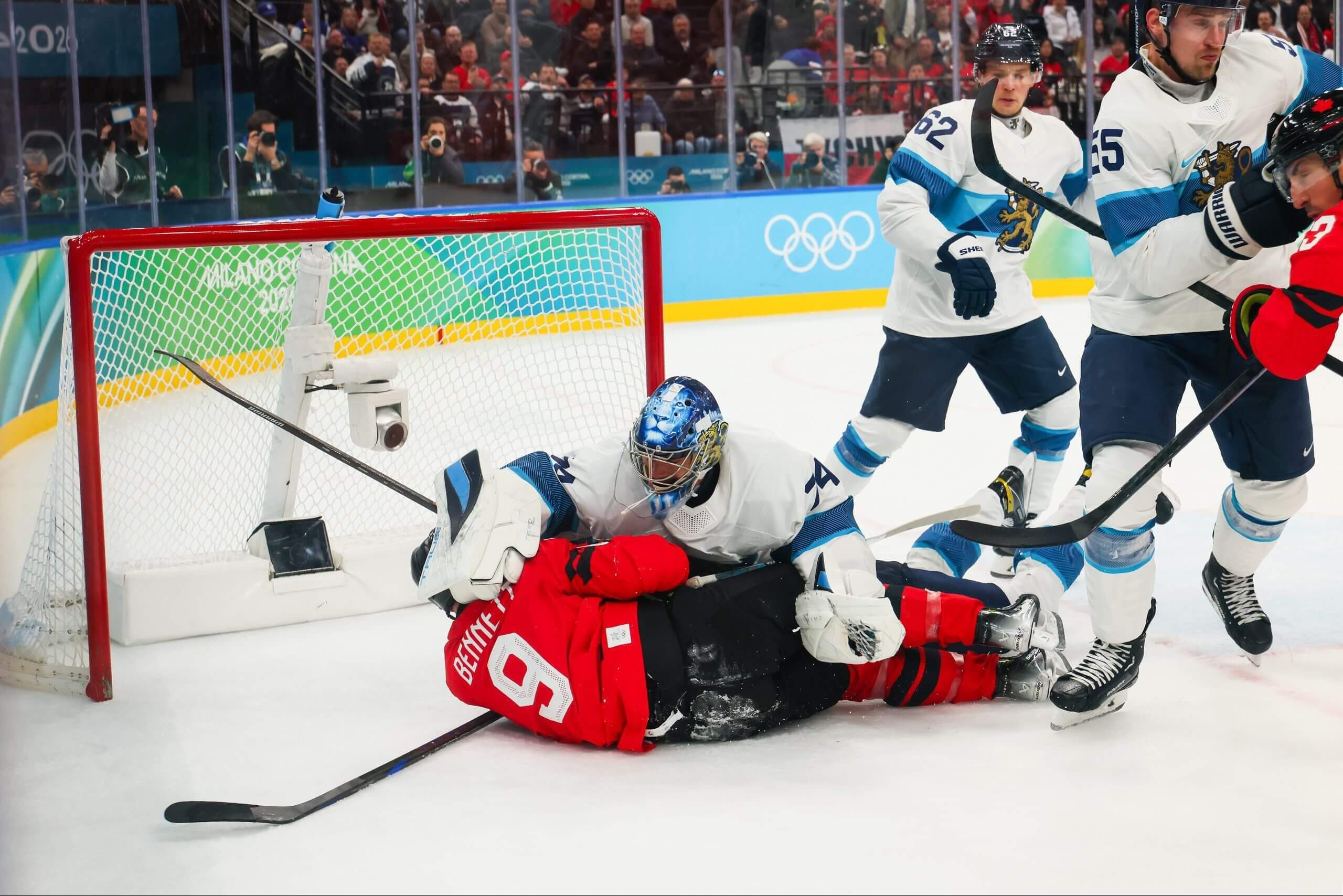
Canada’s Sam Bennett collided with Finland goaltender Juuse Saros in the first period. (Bruce Bennett / Getty Images)
The costly Bennett penalty
Sam Bennett has been known to collide with the odd NHL goalie. Sorry, Maple Leafs fans, we had to. But his goalie interference penalty in the opening period was ill-advised. Discipline is paramount at this stage of the Olympic tournament. One single penalty could be the deciding factor in a close game. With Bennett in the box after he collided with Saros, Rantanen ripped a one-timer top corner for a 1-0 Finland lead. So it was indeed a costly penalty.
“Obviously I’m not trying to take a penalty in a game like that,” Bennett said postgame. “I know how important it is to stay out of the box. The ref saw it a little differently.”
Horvat’s expected role on the penalty kill has waned
Bo Horvat began the tournament on Canada’s top penalty-killing unit with Brandon Hagel. The rationale at the time was that Horvat had Canada’s best faceoff numbers in the NHL this season, he played well on the penalty kill with the New York Islanders this season, and with Anthony Cirelli’s late injury, Canada needed a partner for Hagel.
“He’s our best faceoff guy on both sides of the ice,” Canada assistant coach Pete DeBoer, who runs the penalty kill, said just before the tournament. “He’s done a really good job on the Island. I talked to Bob Boughner and he’s been very good there the first half, so we’re going to start with that. But Hagel and Cirelli were two of the best in the world; they had great chemistry. So I don’t know if we can rebuild that, but we’re going to start with that.”
Horvat entered this game with a team-best 61 percent success rate in the faceoff circle, so in that sense, he was living up to the coaching staff’s expectations. But Nick Suzuki has essentially replaced Horvat as Hagel’s primary penalty killing partner and on Finland’s first power play of the game, Horvat did not touch the ice.
When Bennett took his goalie interference penalty, however, it was Horvat jumping over the boards with Hagel, despite the faceoff being on the right side. Horvat not only lost the faceoff to Sebastian Aho, but he lost it totally clean, allowing the puck to get to Rantanen quickly and his one-timer beat Jordan Binnington just as clean as Aho’s faceoff win.