
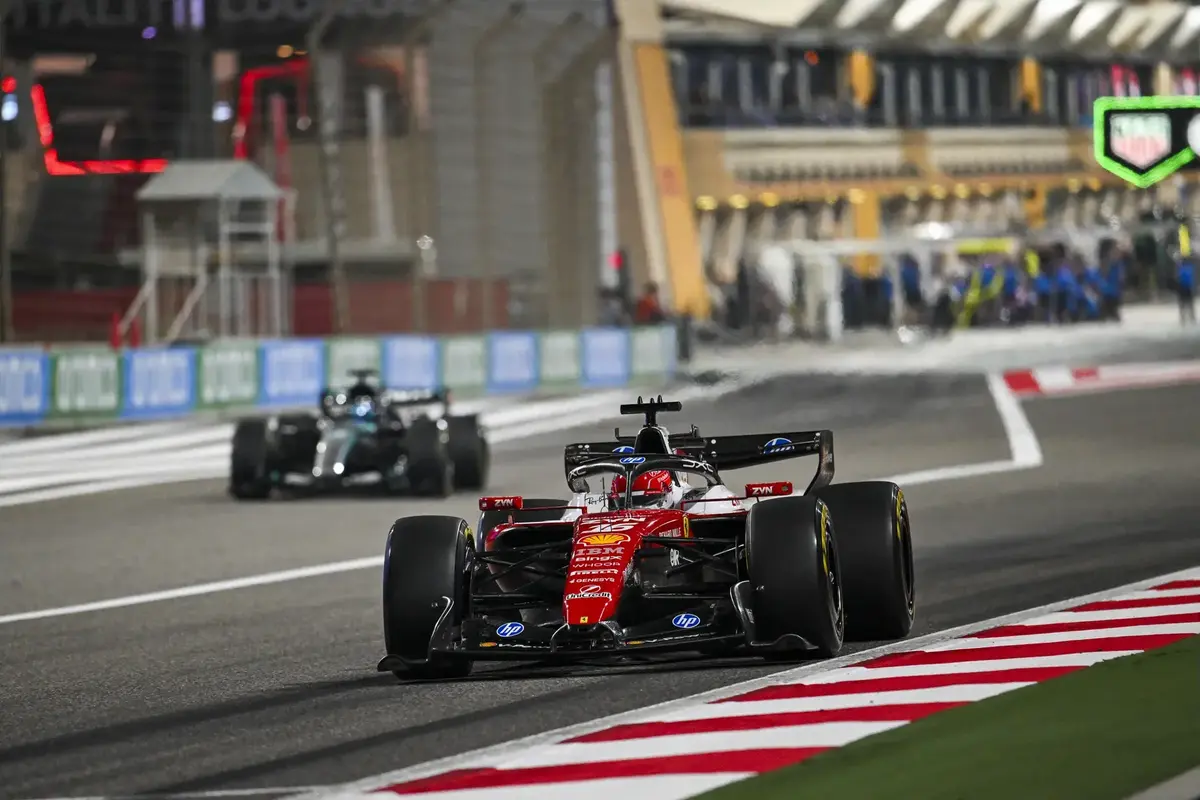
Whilst the W17 did not appear dominant in Bahrain, rivals still anticipate the German team to contend in 2026.
Mercedes are competitive in the high-fuel runs, and have clearly held back during shorter stints.
With that said, there is no longer a belief that Mercedes will blow other teams out of the water. In particular, the Brackley outfit’s power unit is not expected to have the advantage that was initially forecast.
Reigning Champions McLaren are also in the lead group, though the MCL40 perhaps hasn’t shown the same peak performance as some of the other teams.
Moreover, McLaren’s rivals are expected to introduce transformative updates in round one – having opted to run more basic specifications in pre-season tests.
Meanwhile, the MCL40 in Australia is not anticipated to be significantly different from the one seen this week in Bahrain.
Still, the main conclusion regarding the top teams is that – for the time being – they all appear in reasonable shape. Only when the season officially commences can differences between these front-runners be reliably observed.
The best of the midfield
Further down the timing sheets, some teams will be satisfied with their performance in testing. Possibly the stand-out in the midfield has been Ayao Komatsu’s Haas F1 Team.
Once again, Haas look to punch above their weight and compete for points. In a field that is seeing more teams with substantial financial firepower, the VF-26 has looked bulletproof over the past few weeks.
The durability of the Ferrari engine has undeniably been a help, giving the US team a strong foundation to build upon. Still, the VF-26 looks to be an aerodynamically sound machine, having shown reasonable performance and predictable behaviours in Bahrain.
Race simulations suggest Haas should be one of the stronger midfield teams, with Bearman and Ocon holding their own on high-fuel runs.
Alpine are also one of the happier midfield outfits. The Mercedes-powered A526 has suffered a few mechanical and hydraulic hiccups in testing, but nothing to cause major alarm.
Whilst not showing the raw speed of the big teams, Flavio Briatore’s personnel are confident they will have a significantly better campaign than 2025.
The sentiment from the Enstone camp is positive, though still measured, ahead of their first season as a customer team.
Lower midfield teams
Red Bull-powered VCARB have expressed their gratitude for the horsepower and reliability shown by their new power unit. The early promise of Red Bull’s 2026 engine has given the Faenza-based operation hope they can be in the fight for points.
The VCARB 03 has not shown anything exceptional, but it certainly hasn’t shown the handling difficulties or energy harvesting deficiencies that have plagued some other teams.
Speaking of difficulties, Williams have compensated for the mileage lost due to their absence from the Barcelona shakedown. With that said, the FW48 still has its deficiencies.
Though nowhere near the worst car seen in testing, the Williams car has not impressed.
Excess weight will provide an automatic handicap in the opening rounds, whilst the delays in the team’s winter preparations seem to have created a very immature package – which requires upgrades and refinement.
Carlos Sainz and Alex Albon were happy to get some laps on the board in Bahrain, but the general sense is that the FW48 lacks the mechanical grip and stability under braking to repeat the team’s 5th place finish in 2025.
A team who deserve credit for their efforts in pre-season are Audi. (cont. on next page)