
On the surface, February in Canada’s capital is about what you’d expect: grey, slushy and cold. I lived there for five years, long enough to speak with a modicum of authority on this subject: Winter in Ottawa is, by and large, the worst.
But – perhaps out of necessity – the city’s theatre scene has a habit of kicking into gear right when the local community needs it most. The Great Canadian Theatre Company (GCTC) usually includes deep-winter programming in its roster of shows, and Undercurrents, the Ottawa Fringe’s off-season live performance festival, runs most Februarys at Arts Court Theatre. (The National Arts Centre’s English Theatre, meanwhile, just transferred its production of Copperbelt to Toronto, and will present After the Rain in a few weeks.)
This year, Undercurrents presented seven projects across two weekends: I caught three shows, two of which ought to enjoy revivals in Toronto and beyond. I also managed to catch the final weekend of The Piano Teacher, a Governor-General’s Literary Award-winning script given a feel-good production by Thousand Islands Playhouse and presented by GCTC.
Here’s the work that impressed me most on my midwinter Ottawa theatre binge.
A harrowing call to action for Iran
Sound, performed in Ottawa and co-directed by Alavi and Caity Smyck.Undercurrents/Supplied
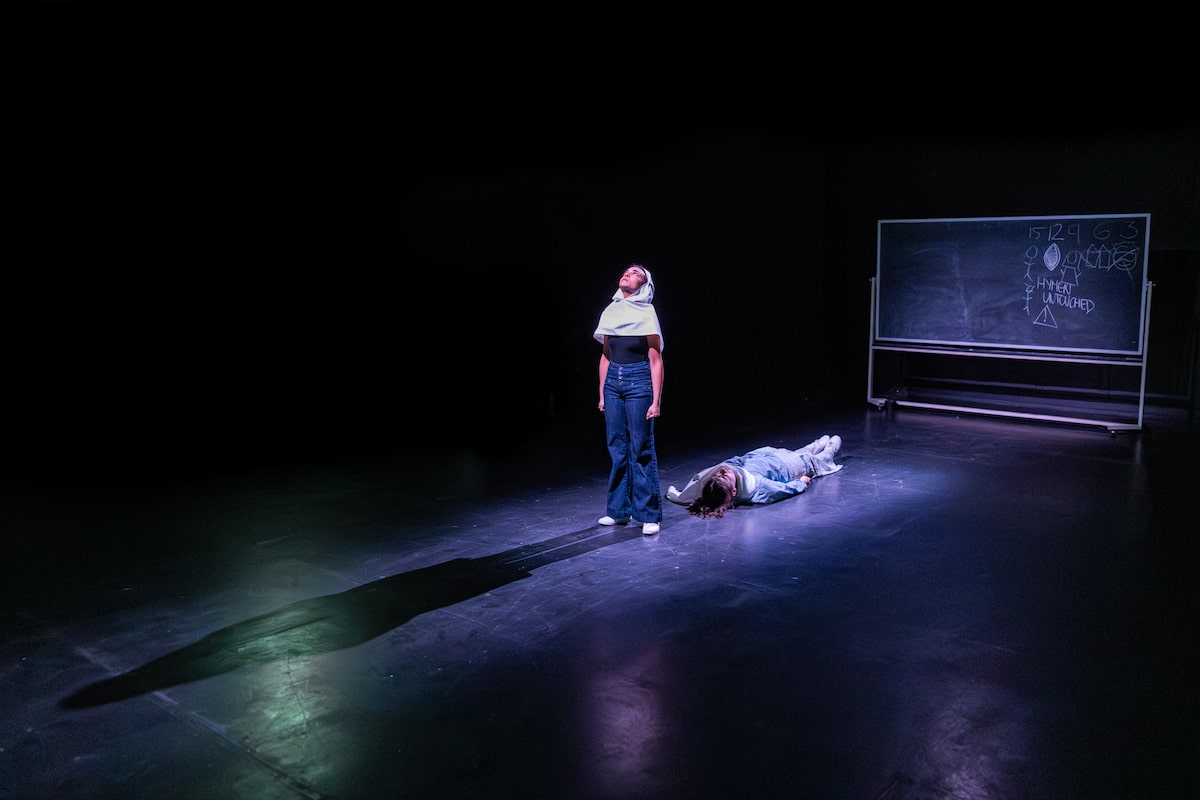
When playwright, actor and director Ava Alavi first steps onstage, chalk in hand, she’s smiling, dressed in stylish, form-fitting clothes. Her hair is loose and wavy against her shoulders, without a hijab in sight. She’s apologetic as she begins to make a call from her phone, a projection of which is displayed on two screens above her head: She’s calling her best friend, she tells us, a young woman in Iran who she hasn’t heard from in 40 days.
If her friend picks up, she tells us, she’ll stop the show to talk to her – we understand, right? But for now, she says, she’ll just let it ring, desperately hopeful that wherever her friend might be, she’s safe – and alive.
Review: Some Like It Hot is fun, airy and just as memorable as its Hollywood version
Sound – the literal translation of “Ava” – isn’t exactly a pleasant night at the theatre. But as more people wake up to the humanitarian crises in Iran – as more cities, including Toronto, stage record-breaking rallies in solidarity with protesters a world away – the play feels urgent, a call to action brought to life onstage with a heart-wrenching blend of poignance, anger and hope.
Alavi, playing herself, walks us through the most important beats of her childhood: the day she wore her first hijab (despite coming from a secular family), and the ways she played with boys before coming of age as a nine-year-old. The older she gets, the more sour her memories become – before long, she tells us about learning how to survive acid attacks.
Her story, along with an efficient overview of modern Iranian history, unfolds with the help of two chalkboards, upon which Alavi scrawls in Farsi, her notes dotted with smiley faces.
Alavi’s not alone onstage: She’s joined by another actor (at Undercurrents, Laurence Gallant), who helps tell the lighter chapters of our narrator’s story, splitting Alavi into two distinct halves and creating even more friction between her joint nostalgia and outrage.
The Undercurrents production, co-directed by Alavi and Caity Smyck, was just the kind of gem you hope to find at these sorts of festivals – personal, a little scrappy and massively creative in its writing and dramaturgy. With its multiple climaxes, some more effective than others, there’s room for Sound to tighten, but Alavi is magnetic onstage, a gifted storyteller with a razor-sharp understanding of her play’s stakes and aesthetics.
It’s my hope that the material of the play will become less relevant in the coming years – that Alavi receives proof of life from her friends and family at home, and that Iran becomes more hospitable to its women and girls. But, assuming progress continues to stall, Sound ought to be programmed across Canada. The work is unflinching in its politics and impressively restrained in its staging, a powder keg stuffed with the endless possibilities of chalk.
An even-handed examination of wind turbines in Southwestern Ontario
Wind, a new verbatim play by Cullen Elijah McGrail performed in Ottawa.Undercurrents/Supplied
Wind, a new verbatim play by Cullen Elijah McGrail, has its work cut out for it: The piece, using protagonist Will as its entry point, attempts to mediate a debate about the perils and possibilities of wind turbines in Southwestern Ontario, giving similar amounts of airtime to both sides of the issue.
The result is a play not unlike The Master Plan, in which Michael Healey explores the various layers of Canadian bureaucracy, or Jonathan Spector’s Eureka Day, which offers a surprisingly balanced interrogation of the value of vaccines.
McGrail, himself a native of rural Chatham-Kent, Ont., doesn’t give the audience a villain to pooh-pooh, or a hero to root for: In the end, we come to realize, capitalism comes for us all, and polarizing social issues will only ever sow division in our communities if we don’t learn how to listen to each other.
It’s an impressive script, ostensibly sourced from interview transcripts and spring-loaded with salient points about social media and its capacity to radicalize men across the spectrum of age.
There’s plenty of room for McGrail to further explore how the wind turbine issue might intersect with other conspiracies – given the play’s frequent references to Ottawa, I was surprised Wind didn’t reference the so-called Freedom Convoy, even in passing – but the verbatim conceit somewhat limits Wind’s potential. (Will, a playwright, more or less approximates McGrail himself; at present, the scenes about the mechanics of verbatim dramaturgy are Wind’s least engaging sequences.)
With rewrites, Wind, tightly directed by Nicholas Leno for Undercurrents, could be a dark horse of Canadian playwriting: Much like Sound, the play’s central conflict is unlikely to become any less topical, and McGrail boasts a solid understanding of his characters, the rural world in which they live and the claustrophobia that can accompany life in a small town.
A solid, subscriber-friendly drama at the Great Canadian Theatre Company
Elisa Moolecherry, left, and Karin Randoja in The Piano Teacher.James Paddle-Grant/Supplied
Dorothy Dittrich’s The Piano Teacher won the Governor General’s Literary Award for Drama in 2022, and, after seeing Thousand Islands Playhouse’s production, presented by GCTC, I’m surprised the play hasn’t been produced more across Canada: The work is sentimental and well-paced, a deeply human dive into grief and its capacity to haunt the psyche.
Evalyn Parry’s no-nonsense production highlighted the play’s strengths, mostly through a stellar cast: Karin Randoja, who played titular teacher Elaine; Elisa Moolecherry, who played Erin, a widowed concert pianist; and Eric Davis, who portrayed Tom, a kindhearted contractor.
The Piano Teacher isn’t an especially revolutionary script – it’s a well-made play which, in Parry’s production, quite literally revolved around a kitchen sink. (Jawon Kang’s naturalistic set fit somewhat awkwardly on the GCTC stage, particularly when Dittrich’s writing switched focus to Erin’s newly empty home.)
But despite the recent production’s occasional kinks, The Piano Teacher is an unfussy script that’s likely to resonate with older audiences, and, indeed, with patrons uninterested in some of Canada’s edgier new plays. In the dead of winter, sometimes the best programming is a tight, simple drama: The Piano Teacher was that and more, and, judging by GCTC’s close-to-full auditorium at the performance I attended, Ottawa audiences thought so, too.