
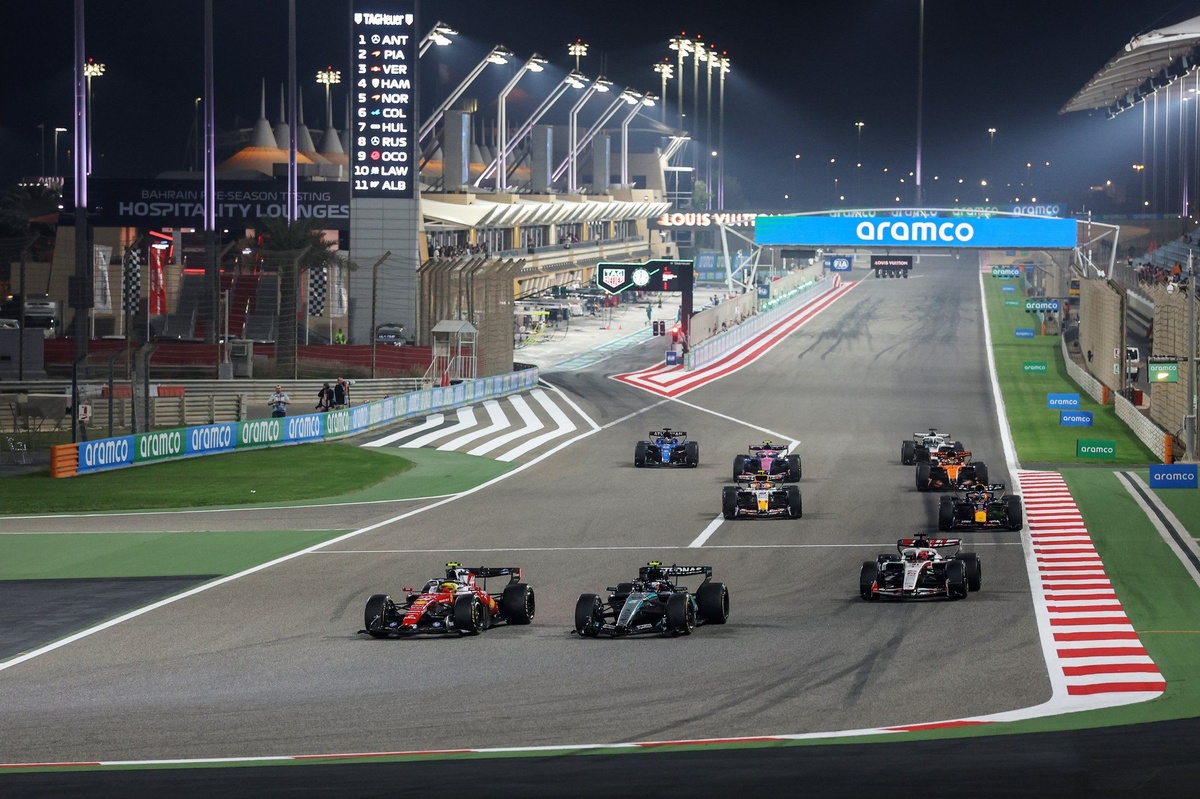
With half an hour left before Formula 1’s pre-season testing came to a close, a colossal “ooh” rocked the media centre at the Bahrain International Circuit. After setting a string of purple sectors, Charles Leclerc threw down the gauntlet with a 1m31.992s on a set of C4s, the fastest time of the test thus far – over eight tenths clear of Kimi Antonelli‘s benchmark from the second day of the second week.
The Monegasque had another couple of tries at beating his best effort, throwing the remainder of the C4s that Ferrari had brought to the test at going quicker, but could only knock off the best final sector without overhauling his own headliner overall.
And so concludes testing ahead of the Melbourne curtain raiser in March. For the grid, getting on top of these 2026 F1 cars has been a bit of a mission, such was the cataclysmic scope of the upheaval presented by the new regulations. Of course, there were complaints to be had, as the senior figures at each team sought to carve out more favourable conditions for their own outfits, and it’s still uncertain what brand of racing we’ll get at the Australian Grand Prix. But we don’t have to worry about that just yet.

Watch: Autosport Explains: F1 Testing Day 6
Unsurprisingly the times picked up a bit in week two, in line with the teams’ own data-gathering exercises – plus the reduced level of wind overall as Bahrain presented particularly gusty environs across the opening week. Luckily, sunglasses prevented too much sand from being spattered into one’s eyes.
The drivers also had to get acquainted with the new driving experience. Although they could generally approach Bahrain ‘as normal’ owing to the opportunities to harvest energy in the slower corners, putting the car into first gear during the longer runs was an unsettling experience in the opening days. Eventually, everyone got used to it – even if they didn’t love contending with the extra torque at low speed – and some teams had been able to rework their approaches to find a similar level of harvesting in second gear.
Despite the uncertainty heading into the tests, particularly in the court of public opinion, many in the paddock have considered it a much more serene experience compared to the last time F1’s engine formula was overhauled back in 2014. “I think it’s just the maturity of the teams,” Haas’ Ayao Komatsu suggested, comparing 2026’s testing to the comparative hellscape he’d faced with Lotus in 2014. “Teams are not the same as in 2014. We’ve got a lot more understanding, processes are better, refinement is better, how people work together, just everything. Formula 1’s amazing thing is the learning rate. It’s so fast. You learn within two or three months, but companies in the normal industry learn over two or three years. I think it shows how impressive all the Formula 1 teams are, actually.”
Ferrari has pace, but Mercedes long runs look effective
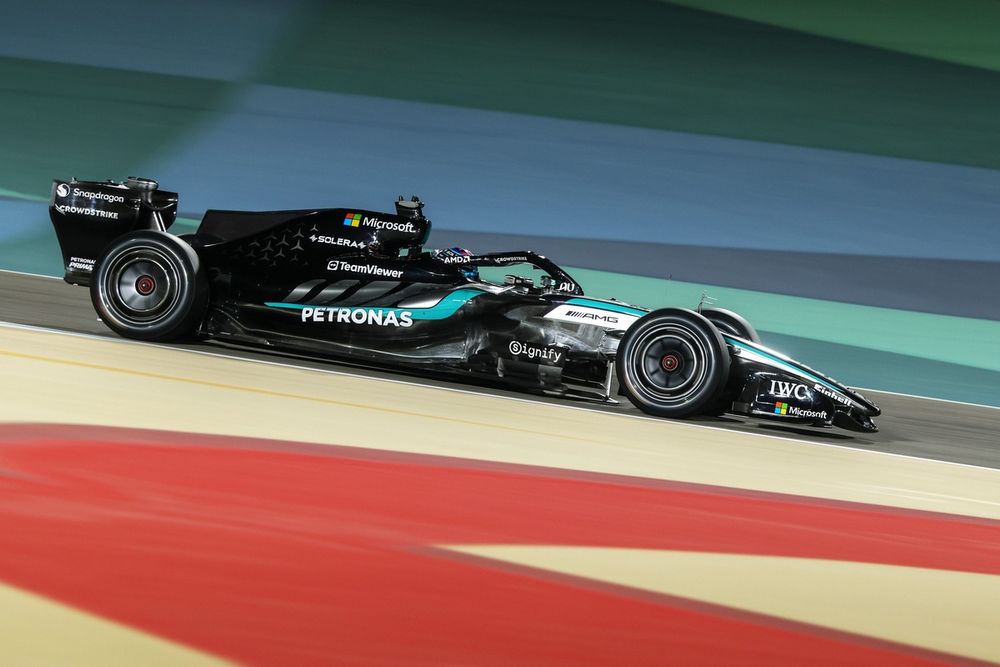
Indications point to Mercedes leading the way in Melbourne – but Ferrari will also be a factor
Photo by: Steven Tee / LAT Images via Getty Images
When Leclerc scorched to the fastest lap of the test, you could be forgiven for assuming that someone might fancy trying to topple him off his perch on a set of soft tyres. There was no such riposte. The team expected to be Ferrari’s closest rival in 2026, Mercedes, was too busy being ensconced in its own run-plan, one slightly derailed by the pressure drop that curtailed Antonelli’s running in the morning.
That, and Mercedes hadn’t bothered to ask for any C4 tyres to match Ferrari, presumably feeling that the softer rubber was superfluous given that Bahrain tends to swing towards the harder grades of tyre.
Headline times aside, Mercedes appears to have the legs over Ferrari over the course of a race distance. Over their equivalent race stints on Thursday, Antonelli was comfortable logging times between the 1m36s-1m37s bracket on the C3s while Hamilton took the C2s into a consistent run through the 1m38s, but the shorter stints exhibited by Antonelli suggested that the Mercedes was slightly lighter on fuel. Hamilton enjoyed a phase towards his final stint sitting within that 1m36s-1m37s bracket, while Antonelli tended towards the other direction as his tyres were starting to feel the pinch with degradation.
The bulletproof reliability seen from Mercedes at Barcelona hadn’t quite emerged in Bahrain. Sure, it logged the most laps in week two despite the pressure drop on Friday, but a longer layoff in the first week forced a power unit change, as did a suspension issue which restricted Antonelli to just 94 laps over the first three days.
Until Leclerc made his play for the top of the timing board, Ferrari had been quietly getting along with its programme. Despite some grievances about the between-tests drive for a revised starting procedure, having felt that its turbo design had correctly anticipated the spool-up process being complicated by the removal of the MGU-H, the team had otherwise let Mercedes and Red Bull slug it out in the media and instead put the focus on its own running.
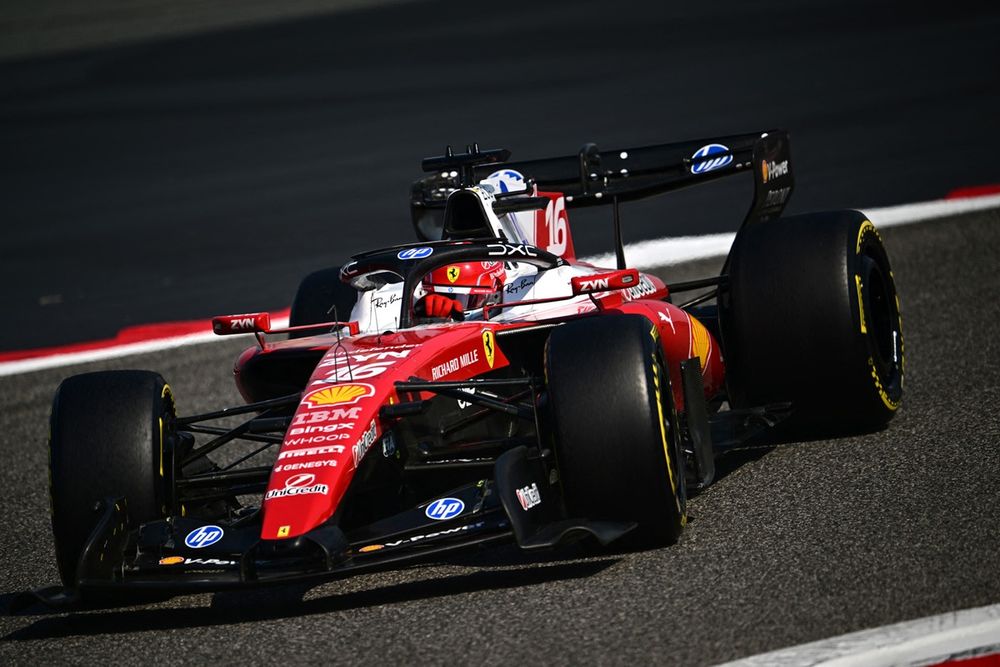
Leclerc set the fastest time across the two Bahrain tests – a 1m31.992s
Photo by: Giuseppe Cacace – AFP – Getty Images
With 421 laps in the first week at Bahrain, Ferrari was just one tour short of serial mile-gatherers Williams and McLaren; although there were a few more problems to uncover over the second week, it was all very routine. There were no nasty surprises in the SF-26.
Ferrari was also conspicuous in its desire to innovate, demonstrated by its gearbox-mounted winglet placed aft of the diffuser to convert the jettison of exhaust gas into downforce, plus the lesser-spotted rotating active aero device on the rear wing.
Read Also:
The team had made sufficient progress from Barcelona to Bahrain; while it could still snap at the rear end if put under too much load, Leclerc demonstrated that the neck of the SF-26 is eminently wringable on a hot lap. It should be a car much more befitting of Hamilton’s palate too, given his distaste for the previous ground-effect machines.
By comparison, the Mercedes had been relatively tidy on-track – but we’ve not seen the W17 pushed towards the very limit on low fuel. Melbourne, then, should be an entertaining introduction to the Mercedes at full tilt.
McLaren and Red Bull set for battle over third
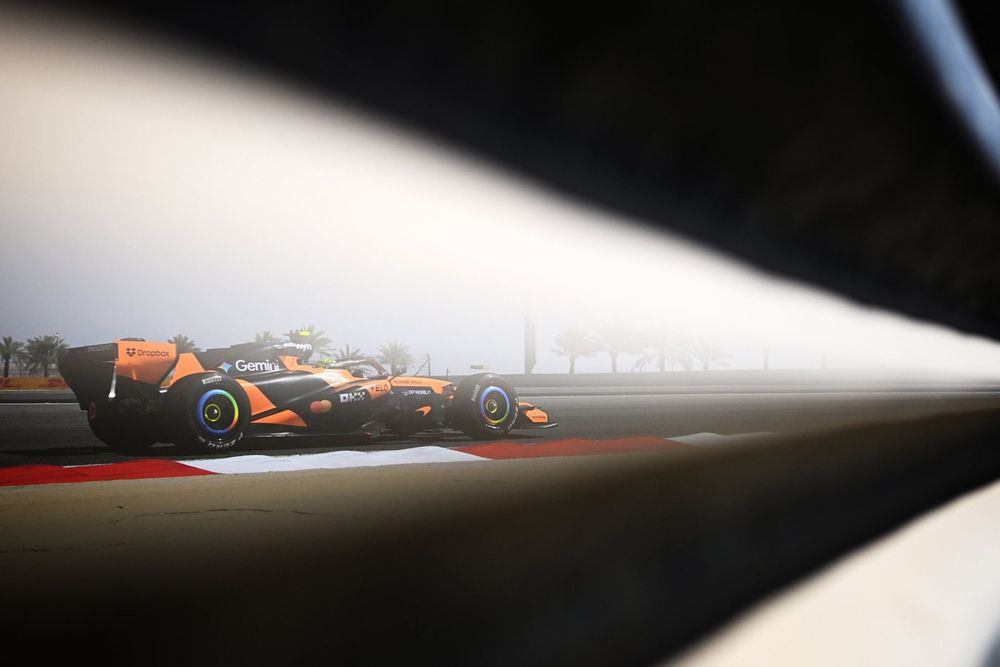
Race simulations put McLaren and Red Bull neck–and-neck
Photo by: Guido De Bortoli / LAT Images via Getty Images
Although it quickly became clear that F1’s ‘Big Four’ would retain their positions in the 2026 leading pack, it took a few days for the expected order to settle down. The paddock consensus seems to be that Ferrari and Mercedes had been able to stretch their legs at the head of the field, and Mercedes’ precipitous pace on the longer runs suggests that it’ll be a force to be reckoned with.
But there’s a fierce battle emerging – and McLaren and Red Bull seem to be pretty much neck-and-neck if testing pace is anything to go by. As it stands, McLaren has demonstrated a small edge in terms of one-lap pace, but Max Verstappen‘s best lap from Thursday evening – when compared to the 1m32s set by Piastri and Antonelli – arrived much earlier in the post-lunch session. That said, he’d been fractionally behind Lando Norris after the morning session – so it depends which way you cut it.
The key indicator of the McLaren vs Red Bull pace also emerged on Thursday evening, as Verstappen and Piastri set pretty much equivalent long runs on equivalent fuel loads. There was variation in tyre strategy as both drivers ran to a ‘two-stop’ race simulation: Verstappen went C3-C2-C2 in his tyre selection, while Piastri drove with a C3-C2-C1 progression.
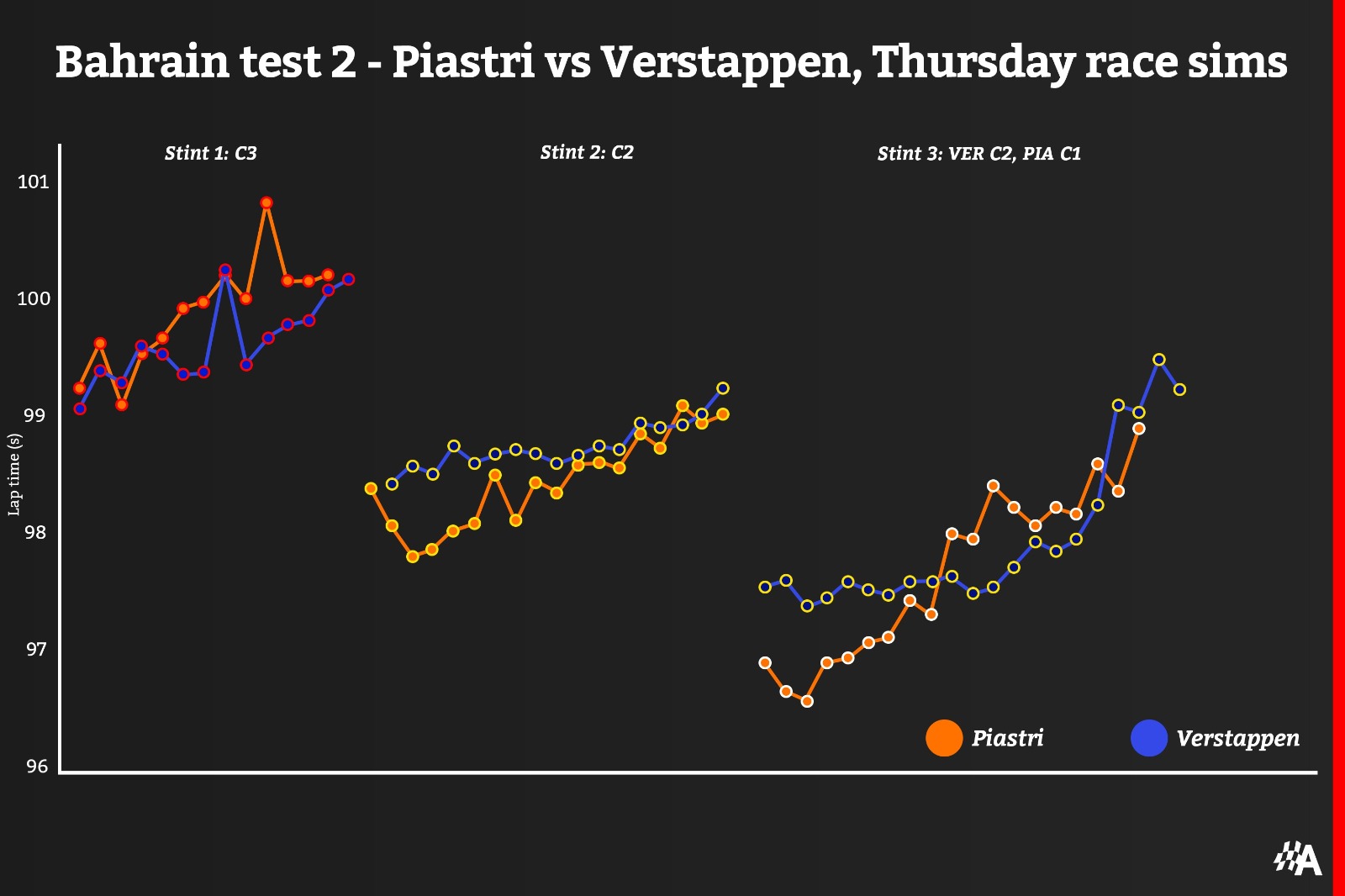
Week two, day two long runs between Piastri and Verstappen
Verstappen enjoyed a stronger average lap across the C3 stints – a 1m39.6s versus Piastri’s average at 1m39.9s, but Piastri was marginally quicker across the two stints on the harder tyres – particularly when both ran C2s. Piastri was ahead in this stint, averaging a 1m38.4s while Verstappen ran to around 1m38.7s. Across their final stints, both sat at around the 1m37.7s average mark; Piastri was marginally quicker and on the harder tyre as Verstappen used his second set of C2s to end the race simulations.
One comparable race simulation isn’t much of a sample size, granted, but the equivalency in fuel to get through the stints reduces the variables seen between the teams. Andrea Stella also noted that McLaren had taken interest in that particular race simulation, since “it happened at a similar time of the day, and it was a similar pace”.
It’s hard to compare that with Ferrari and Mercedes, since they produced shorter stints at a similar point in the afternoon session, but the two teams expected to lead the early rounds could be anywhere up to a second per lap clear. That said, we don’t know what fuel loads they were on at the time…
Is the midfield ready to rumble?
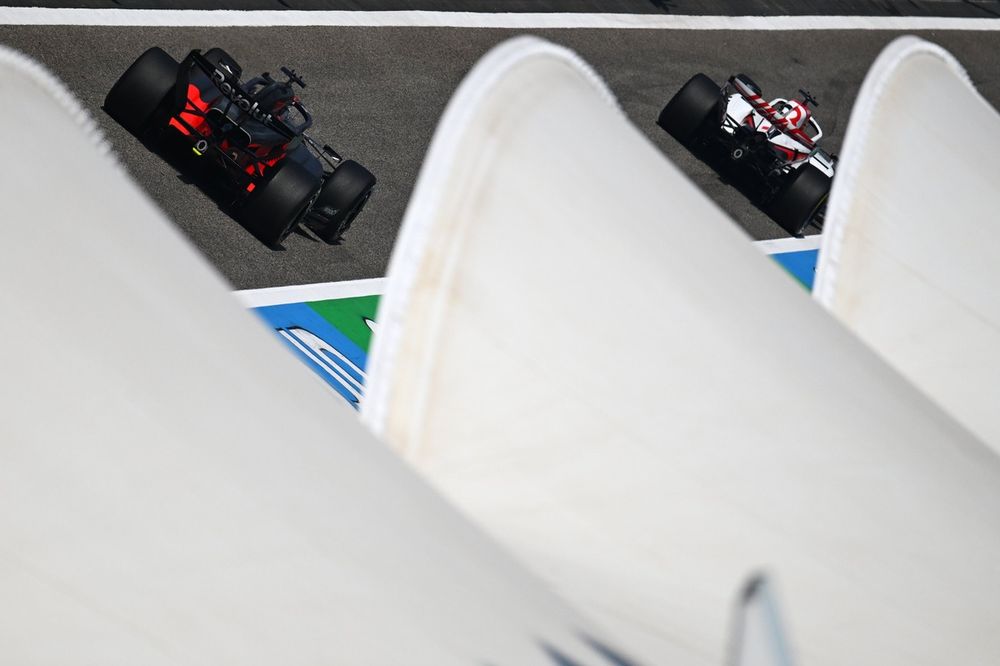
Haas and Audi are expected to be in the midfield mix with Alpine, Williams, and Racing Bulls
Photo by: Guido De Bortoli / LAT Images via Getty Images
Behind the front four, there’s a gap of around a second per lap, give or take a couple of tenths depending on the circuit and the conditions. After that, we have the potential for a five-way midfield scrap – perhaps not initially, but later into the season as those equipped with new powertrains and those who missed testing time have the opportunity to catch up.
Alpine and Haas have looked like the strongest of the five thus far; Franco Colapinto‘s longer runs on Thursday on the harder compounds sat consistently within a 1m39-1m40 bracket, and the speed in the car has also looked handy over a single lap thus far.
When Colapinto took a tilt on a C5 lap on Thursday evening, he looked his usual lively self at the wheel – perhaps bordering on ragged through the lap when the soft tyres became oversaturated. Bahrain’s abrasive track surface and rear-limited nature has often necessitated the use of the hardest compounds, and thus it was not a surprise to see Colapinto run out of tyre life with the C5 towards the end of the lap.
Esteban Ocon‘s longer runs on the C2s were also competitive, running in the 1m38s and 1m39s, but one suspects that the brevity of that stint suggests that he was on a lower fuel loads; Haas had been testing a few set-up changes through the day, in response to the week two updates that Ocon believes have made the car handle better across his exploratory laps. Either way, the Haas looks to be a well-handling car; with the Ferrari powertrain in the back, it’s also been pretty impressive off the line.
Racing Bulls and Williams are the jokers in this pack, in that they’ve been difficult to read. Arvid Lindblad‘s long runs on the C3 tyres on the second week’s Wednesday running produced a series of times within the 1m39s-1m40s, while Liam Lawson‘s efforts on the harder compounds on the subsequent days strayed into the 1m41s as degradation began to play into the spread of laps.
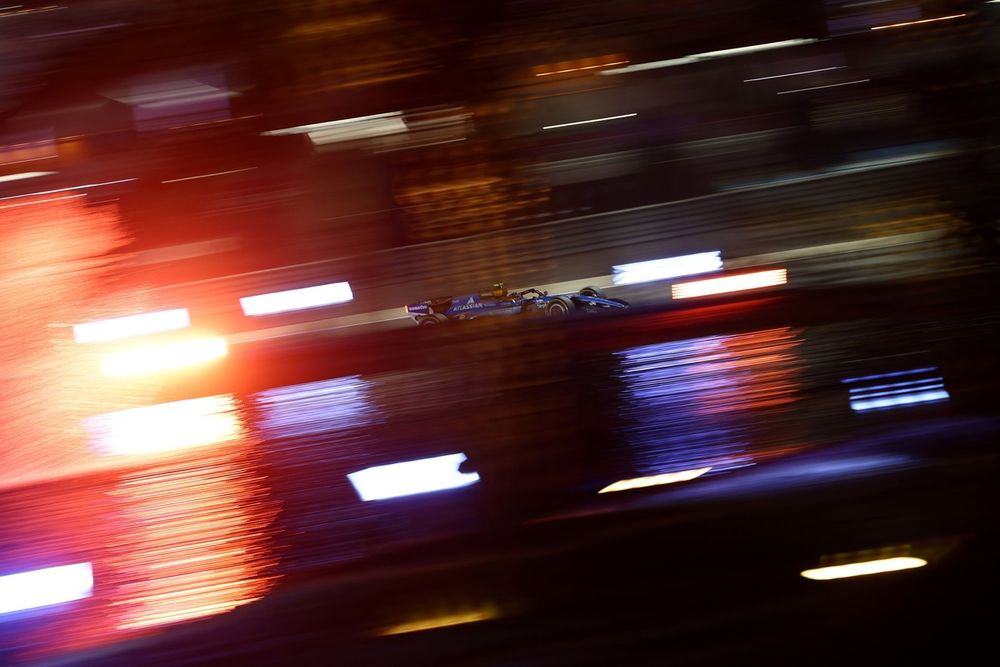
Williams has some weight to shed before it can start to show its true pace
Photo by: Zak Mauger / LAT Images via Getty Images
Alex Albon’s long runs on the C3 on Thursday were not very impressive, sitting within a 1m41s-1m43s window, but Williams had already logged a more representative run on the final day of the first week which was more in line with Racing Bulls’ efforts from this week. Despite running reliably, Williams still feels it is behind everyone else after missing the Barcelona shakedown – so it’s had to cram in nine days’ worth of work into six.
Of the two cars, the Racing Bulls had looked slightly more wayward during the first week; the VCARB 03’s rear end seemed particularly difficult to nail down in the slower corners, but this was dialled in over the test and seemed to improve. Williams, meanwhile, might need to slim its car down before it can start to make overtures towards the top of the midfield – but the drivers scarcely looked uncomfortable with the car, even if it has its limitations.
“I think what we needed over the last few days was recover the time lost in Barcelona by adding a lot of mileage to the car,” Carlos Sainz reckoned. “I think we’ve managed to do that well and the car is running reliably from the beginning. That’s allowing us obviously to find out the limitations and the areas where we have to improve, which unfortunately there are quite a few. But as I said, the main thing last week was mileage, and then this week we are finally starting to try and find a bit of lap time and performance out of it.”
Audi shouldn’t be far off either, and might even nudge ahead of Williams in the early rounds. Although early performance suggested that the team formerly known as Sauber would be operating as a bridge between the midfield and the back, its second week running puts it in an arguably brighter light and it should have a part to play in the midfield battle as the season goes on.
Nico Hulkenberg‘s long runs on the C2 on Thursday evening ranged from the 1m40s-1m41s on the opening stint, then consistently into the 1m39s on his second stint. Were this to carry over, this would put the silver machines into the mix with the Racing Bulls and Williams drivers – an impressive feat, given that Audi has been through a protracted transition from a customer to manufacturer team.
Aston Martin: Vanquished?
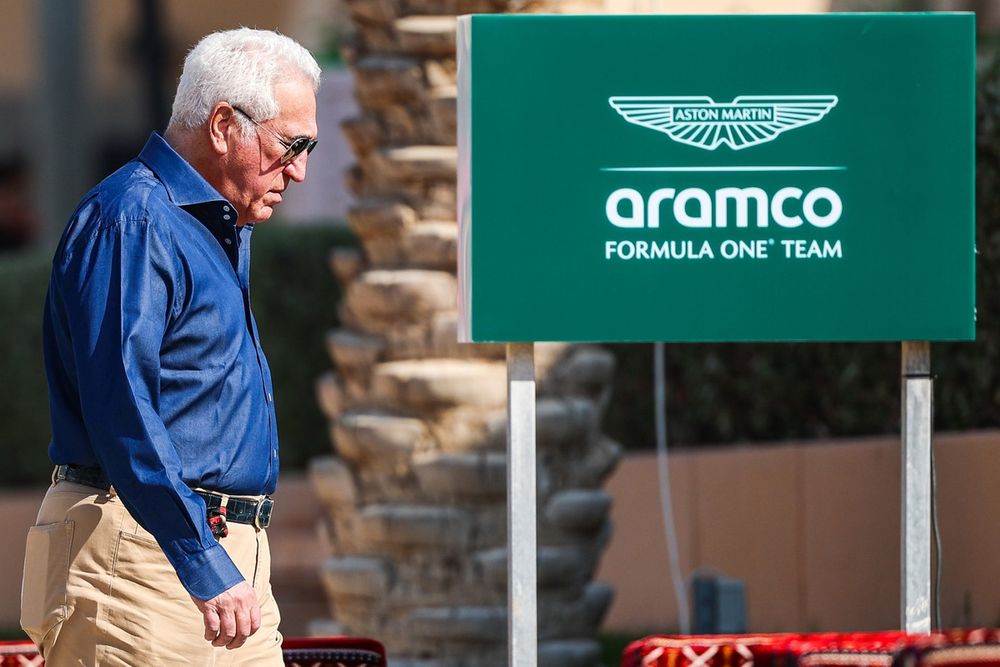
This picture says more than this caption ever could…
Photo by: Kym Illman / Getty Images
If there was anything that could go wrong at Aston Martin across F1’s 2026 testing season, it probably did. The car was late to the Barcelona shakedown, and effectively ran for just one of the allotted three days available to the team – notwithstanding the five laps it managed on the Thursday before Lance Stroll came to a halt. Still, the team had earned plenty of goodwill and hype around its 2026 season, largely in deference to Adrian Newey’s involvement with the design of the car.
As the Bahrain tests progressed, the hype had very quickly depleted into the aether. From a reliability standpoint, the team faced myriad issues across the two weeks – culminating in a battery issue on the Thursday of week two during Fernando Alonso‘s stab at a long run. Powertrain partner Honda subsequently revealed that it was perilously short on spare parts, ensuring that the AMR26 was something of a rare sighting on the final day of the test as Stroll added just six laps to its tally. The team packed up a few hours early, its unoccupied pitwall presenting a funereal image that encapsulated its time in Bahrain.
One takes the rumours in the paddock with a pinch of salt, but the prevailing theories behind Aston Martin’s struggles were as follows: the Honda power unit was 15kg overweight and down on power, the car had no grip, and it was incredibly difficult to weave into a richer performance window. “We need more power, it’s simple as that,” explained Lance Stroll. “And then we also need to improve the car,” he added, demonstrating that it wasn’t quite as simple as that.
Aside from the reliability issues, Aston Martin’s running was characterised by glacial pace. Its fastest lap of the week was a 1m35.974s courtesy of Stroll’s run on the second Wednesday, over 2.5s slower than anything set that day, but the race pace shown by Alonso prior to his battery issue was more concerning.
In a hard-hard stint equitable to the final two stints of Piastri and Verstappen’s runs, Alonso averaged a 1m43.405s in the opening stint and a 1m41.492s in the second before the car stopped – translating to about four seconds per lap off the pace of two cars expected to figure amid the top four.
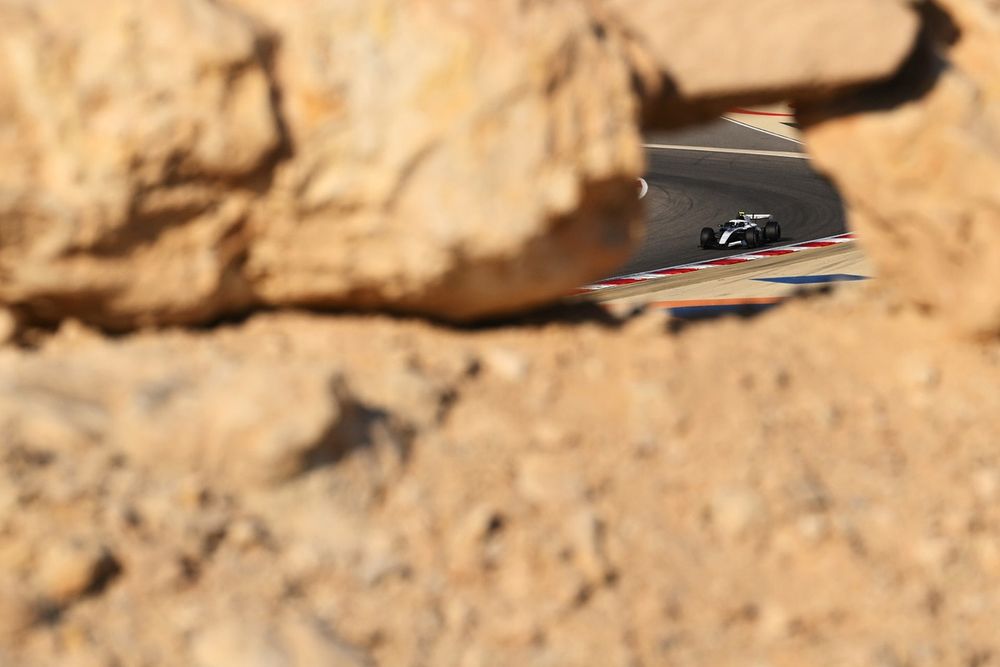
A Cadillac comes into view – the team has made a valiant effort to get to this point without being too far away from the established order
Photo by: Mark Sutton / Formula 1 via Getty Images
This is in line with the pace from Cadillac; Valtteri Bottas did a full two-stop race simulation on Thursday morning, starting his C3 stint in the 1m42s-1m43s, and progressing into the 1m41s-1m42s bracket on stint two on harder tyres, briefly hanging onto the 1m40s at the start of stint three. For an entirely new team, this is a commendable effort; for Aston Martin… less so.
It’s evident that the Aston project has been yanked out of the oven undercooked. Newey noted that the car was approximately three-to-four months behind everyone else having not seen the inside of a wind tunnel until April, and Honda had also revealed before the season that its internal combustion engine was likely to start off the mark of the others. That didn’t stop the memes of a Photoshopped AMR26 engine cover with “underpowered by Honda” writ large from circulating in the paddock.
Of course, both sides can catch up; Newey is keen to press a recovery plan into action, and Honda will be able to take advantage of the FIA’s Additional Development and Upgrade Opportunities (ADUO) to ensure parity with the other powertrains. Before these catch-up mechanisms start to disseminate into the car, it’s likely to be a bruising start to 2026.
Read Also:
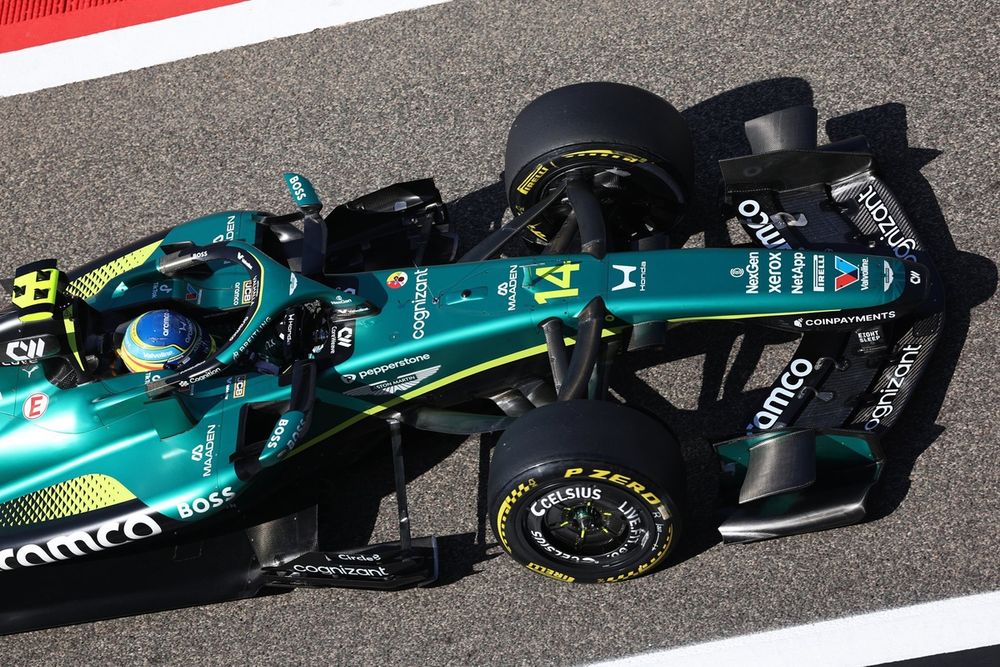
Aston Martin only completed 128 laps in week two – half the tally of anyone else
Photo by: Alastair Staley / LAT Images via Getty Images
We want to hear from you!
Let us know what you would like to see from us in the future.
– The Autosport.com Team