
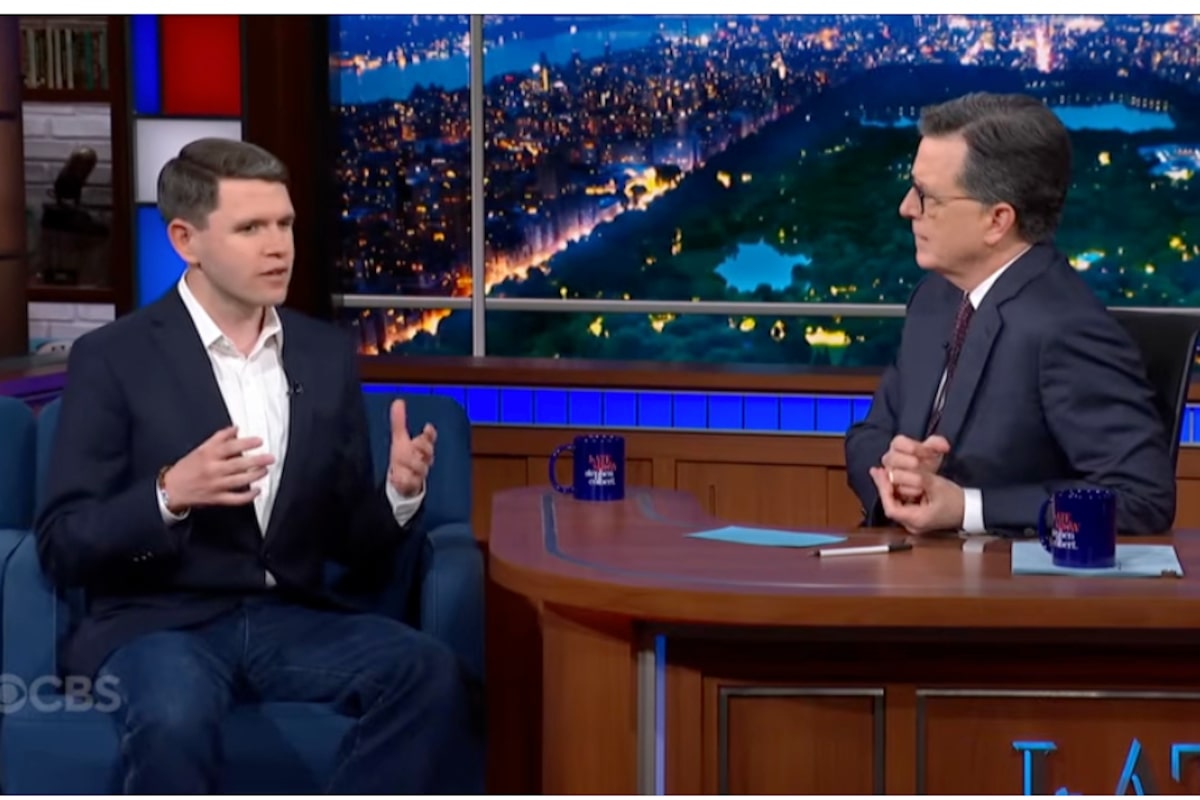
In this YouTube screengrab, Colbert interviews Texas lawmaker James Talarico in a segment that was pulled from the TV broadcast.YouTube/Supplied
Canadians tuning in this week to the ever-escalating American culture wars under President Donald Trump were riveted by yet another controversy over political inference in late-night television.
On Monday’s episode of The Late Show with Stephen Colbert, the host told his viewers that the lawyers at CBS, his network, had informed him he could not air his interview with James Talarico, a rising Democrat star running in a Texas Senate primary.
The dispute relates to an “equal time” rule imposed by the U.S. Federal Communications Commission regarding TV appearances by election candidates. The regulator, increasingly activist under its Trump-appointed chair Brendan Carr, recently issued a guidance that this would start being applied to both daytime and late-night talk shows – you know, the one whose hosts are so often the subject the President’s insults and attacks on social media.
More Nestruck: Jimmy Kimmel’s suspension is a chilling moment for free expression in the U.S.
This may seem like an arcane American argument – one rendered moot by the fact Colbert was able to post his Talarico interview on YouTube where, thanks to the Streisand effect, it garnered more than eight million views.
But Canadians need to realize they are more than just rubberneckers at a car crash when it comes to the increasing tensions that, most notably, led to the brief removal of Jimmy Kimmel Live! from ABC in the fall.
After all, that led to Kimmel being off CTV as well.
Interference in what appears on American screens is interference in what appears on Canadian screens – especially on our English-language private broadcasters, which are saturated with acquired programming from the U.S.
Say what you will about the current state of speech in the United States, there are plenty of discussions about the questionable editorial decisions happening at CBS right now.
But there’s almost nothing in Canada about how Global, which simulcasts Colbert’s show and other CBS programs, is affected by those decisions.
Mike Ananny, an associate professor of communication and journalism at the University of Southern California, doesn’t believe that the effects of a chill on discourse stops at the border.
“So many Canadians are consuming American media content of all types that the kinds of decisions that are made about how the American media system works absolutely have impacts on what Canadians watch and what they think the world is like,” says Ananny, who is currently Orion Visiting Scholar in fine arts at the University of Victoria.
Since a merger last summer, CBS’s parent company, Paramount Skydance – which is attempting to acquire Warner Bros. Discovery and become an even bigger media conglomerate, a move that will require government approval – has been under the control of the Ellison family. Trump has called Larry and David Ellison friends and “big supporters of mine.”
This informs why on Tuesday, FCC commissioner Anna Gomez, a Democrat appointee, called the Late Show news “yet another troubling example of corporate capitulation in the face of this Administration’s broader campaign to censor and control speech.”
“It is no secret that Paramount, CBS’s parent company, has regulatory matters before the government, but corporate interests cannot justify retreating from airing newsworthy content,” Gomez said in a statement.
I reached out to Global this week with questions about the Colbert incident, but the Canadian media corporation didn’t have much to say.
Melissa Eckersley, head of corporate communications and relations at Global’s parent company, Corus, sent this statement: “Global does not produce acquired programs and has no editorial control over them. Global broadcasts acquired programming as it is delivered.”
This is similar to what Corus said in December after a 60 Minutes segment about the maltreatment of deportees to El Salvador from the U.S. was yanked so late that the unaltered episode had already been distributed to Global, which shows that news program in Canada.
The piece had been pulled by Bari Weiss, the newly appointed and controversial editor-in-chief of CBS News. Nevertheless, Global uploaded the full original episode to its streaming app, leading to bootleg versions of the cut segment spreading online and drawing cheers from some Americans who viewed this as an act of cross-border resistance.
But, contrary to speculation, the Canadian network had posted the episode by accident – and removed it once alerted.
Global and Corus then let CBS speak on their behalf for several days before finally releasing a statement on Christmas Eve: “We do not produce and make no editorial decisions whatsoever regarding this show.”
Ananny thinks it’s clear what’s happening in Canada in cases like these. “It’s a censorship by proxy, in a way. It’s a second-order censorship.”
Chris Herrmann, U.S. programme co-ordinator at the European Council on Foreign Relations, warned in December that the United States was following in the footsteps of Hungary – where Prime Minister Viktor Orban has successfully neutered most independent media.
“Under President Donald Trump, American media is being ‘Orbanized’ in a similar way – not through bans or formal censorship, but through presidential power exercised via signals, leverage and regulatory alignment,” he wrote.
The issue of Canadian networks and their closeness to American ones is only going to grow. Global did not answer questions about whether it is re-evaluating its overall relationship with CBS content in the wake of recent incidents.
But Canadians should expect straight answers from media companies about their policies and principles for dealing with American content, Ananny says.
“Canadian ownership and Canadian control of media needs to be bright-line separated from the U.S; it can’t just be a carrier.”