
If you want to enlighten someone who has never been to this part of the world about the history of this weather-beaten yet still-young country, you could do worse than send him along to the Between Water and Sky photo exhibition. The show, currently in progress at the Eretz Israel Museum (MUZA) in Ramat Aviv, under the curatorship of Guy Raz, features work by Werner Braun.
The German-born photographer was here, there, and everywhere throughout his long life, which included quite a few pivotal junctures of our national history, trusty camera inevitably at the ready.
Braun died in 2018 at the age of 100, and he left us with a veritable cornucopia of negatives and prints that tell a multi-stratified tale of this country’s timeline, across a macro/micro spread of events, milestones, and vignettes.
“Werner Braun’s vast archive, which includes hundreds of thousands of organized and cataloged negatives, is an essential source for researching the visual history of Israel,” says MUZA Director General Gil Omer. “At the same time, it offers a window into a soul of the photographer who sought to preserve the dignity of the image and those he photographed.”
This incorporates a motley gallery of characters, from pinup celebrities and politicians, to ordinary folk just going about their day-to-day existential business.

One touching shot of David and Paula Ben-Gurion, taken at the legendary Zionist frontman’s home of Kibbutz Sde Boker, neatly straddles the divide between the stellar and mundane orbits of life. The frame dates from December 14, 1953. That was just one week after Ben-Gurion completed his first stint as prime minister. This is not Ben-Gurion the fabled leader but the doting husband who was already into his “golden years.”
There is a simplicity and unpretentiousness about the setting, utterly devoid of a carefully PR-orchestrated photo-op ambiance. There is nothing sensationalist about the frame, and Braun is not overtly proffering us a behind-the-scenes glimpse of the icon in question, even though that is precisely what we get. Of course, Braun was fully aware of the public interest on the table but, even so, it is as if he was saying: Here’s an elderly couple sharing a tender moment borne of decades of loving partnership, and just that.
Raz neatly slotted in an entertaining and unstaged snap to the museum presentation proceedings, when Braun caught a young MK Menachem Begin unawares at the Knesset’s premises at Frumin House on King George Street in downtown Jerusalem in the 1950s.
The camera shutter – if anyone remembers what that is today – completes its rapid ebb-and-flow course at the precise moment when Begin realizes he has been snared, and instinctively reacts with a broad natural smile. He had no time to adopt an “appropriate” politician’s pose, and we get to see the person rather than the public figure. These cellphone camera-saturated days, it is well nigh impossible to catch anyone with any degree of public profile in something approaching an unaffected facial expression.
Braun was also around to nail a telling portrait of then-foreign minister Golda Meir in 1960, in full interview flow, with famed American broadcaster Edward R. Murrow. This is clearly a serious tête-à-tête and has Murrow with his arms outstretched as he graphically punctuates yet another probing question.
Meir is sitting opposite him on a sofa, trademark cigarette in hand as the smoke billows up to the ceiling, forming a diminutive cloud that seems to have a life of its own. Although already a seasoned politician, Meir looks tense as she prepares to parry Morrow’s considered line of inquiry, and we get some idea of the personalities behind the personas.
Braun had an eye for capturing the essence of the seemingly mundane, as well as conveying the heightened drama and pathos of traumatic real-life events, such as the aftermath of the terrorist attack on Jerusalem’s Ben Yehuda Street in February 1948. “His studio was right across the street,” Raz enlightens me.

Proximity to the epicenter of the horrific action was a help, but Braun also had the presence of mind to make sure he documented the event as things unfolded. He hung around to snap one of the wounded victims being stretchered away, keeping a seasoned objective eye on the bit part players, too. This is not the tabloid, thrill-seeking voyeurism to which we have become accustomed. This is an honest account of what was occurring before Braun’s eyes and, hence, his camera lens – the very essence of professional reportage.
Omer believes that the current collection offers a broader scope of understanding, beyond the actual pictures. “The exhibition invites viewers to encounter the images as they were born,” he declares. “It enables us to reexamine how memory is constructed, how a gaze is preserved, and how a photograph transforms a momentary situation into a legacy.”
Raz goes along with the director general’s thoughts, citing the way Braun viewed and approached his subjects. “In attempting to summarize Werner Braun’s work, one can delineate his ‘photographic gaze’ – that quality that lies between the eye and the camera lens,” he posits. That roving eye never missed a trick, documenting momentous and portentous occurrences, places, and confluences that spanned the birth and evolution of the State of Israel through its manifold labor pains and developmental trials and tribulations.

Braun was born in Nuremberg, Germany, and became interested in photography as a child. He escaped the Nazi regime in 1937 when he relocated to an Aliyat HaNoar hachshara (agricultural training) farm in Sweden. Between learning how to till the soil and grow stuff, he honed his photographic skills in a range of areas, including crafting an entertaining series of matchstick scenes he called Stick & Stav (“stick and staff”).
Years later, he reproduced some of those works for a successful series in the Scandinavian press, which brought in some handy earnings at a time when it was devilishly tough to make ends meet in Israel.
He came to pre-state Palestine in 1946, married to his first wife, Yael, and a father of two. He was soon up and running in his new home, providing for his young family by opening the Photo Braun studio at 31 Ben-Yehuda Street in Jerusalem in 1947.
That facilitated his dramatic shots of the damage caused by the explosion that took place there just a few months later, when he scrambled up to the roof of a nearby building to get an evocative overhead shot, then got back down to catch some of the street-level mayhem.
Braun didn’t limit his geographic or thematic purview to his immediate surroundings, though God knows there was plenty going on in his adopted hometown. He got out and about all over the country, including making visits to the nascent port town of Eilat.

The exhibition at MUZA features a delightful print of Braun’s young son leaping into the air with his left arm raised as he gleefully gestures to a passenger plane taking off for the North. That was evidently a staged creation, with Braun making sure all the requisite props were in there.
“On the one hand, you have the snorkel [in the boy’s right hand], and you see him later in another photo diving under the water in Eilat,” Raz notes. Staged or not, it stills makes for a thoughtful, charming frame. The picture also appears on the front of the exhibition catalogue and spells out the Between Water and Sky theme.
As the weighty tome is in Hebrew and English, there are two covers. The one on the English side of the book is a beautifully composed shot of two Mekorot water company employees inspecting the innards of a massive pipeline segment.

The interplay of light and shade, the postures of the characters, and their reflection in a strip of water on the pipe floor is harmonious almost to a fault. The hazy exterior backdrop, shimmering in the unforgiving Israeli sun, counterbalances the yin-yang setting, complete with a view of a truck and trailer, dusty surroundings, and a postcard-perfect forested hillside sloping down to a clump of trees nearer the foreground. The person who took this picture patently knew what to look for and what to leave out of the mellifluous textural composition.
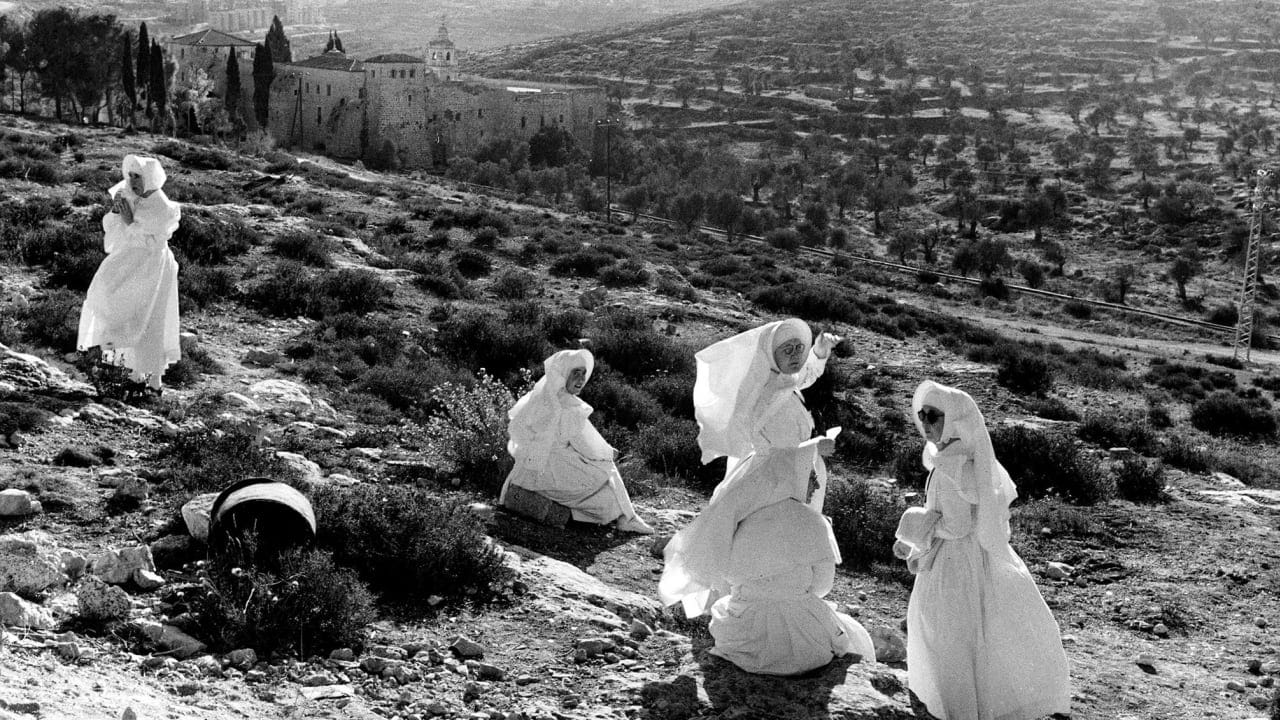
Braun had numerous strings to his documentary bow. His 1964 picture of five nuns in the Valley of the Cross in Jerusalem is nothing short of a symphony in monochrome. The women’s all-white habits ripple in the breeze, like fluttering petals, and the nuns seem to be engaged in some free-flowing dance set, exuding an air of insouciant gaiety set against the stark appearance of the valley.

The photographer’s crisp sense of humor comes across in a frame from Tel Aviv, taken in 1953, in which we see a man having great fun blowing outsized soap bubbles next to a bemused-looking character.
Braun had a tongue-in-cheek side, too. He got one up on a colleague when he caught fellow German-born A-lister snapper Micha Bar-Am, now 95 years old, grabbing forty winks on the roof of a low building, a couple of cameras lying in his lap, right next to the Western Wall, just 24 hours after IDF paratroopers recaptured the sacred site in the 1967 Six Day War.
Braun’s ability to sense and swiftly train his lens on the obverse sides of developing circumstances also comes across in chillingly evocative pictures from the other side of the sacred perimeter structure. For example, as a group of IDF soldiers were celebrating the retaking of the Old City and doing an impromptu hora jig right next to the hallowed masonry, on the other side of the wall some of their brothers in arms were on the Temple Mount supervising the surrender of Palestinians descending the steps from the Dome of the Rock.
Braun shot the scene from behind the backs of a pair of soldiers with their rifles slung over their shoulders rather than aiming their weapons at the prisoners, which serves to amplify the impact of the military victory. The flip side of that can be seen in a picture of Palestinians returning to the West Bank of the Jordan River soon after the completion of the Six Day War, making their way across a barely functional collapsed Allenby Bridge.
Braun lived and breathed photography. Nothing escaped his discerning eye and camera lens. He recorded the physical evolution of the young state with, for instance, an aerial shot of tiny Eilat in 1952. Braun was at the cutting edge of civil aerial photography here and, with his own bare gifted hands, built Israel’s first underwater camera. He also made the country’s first nature documentary, spending an entire year in the Hula Valley snapping the local and migrating wildlife.
At some stage, Braun seemed to have a thing about signposts. Possibly the most striking specimen of that is a shot of an IDF soldier, field telephone receiver in hand, with a quintessentially illustrative backdrop that pinpoints precisely where the frame was captured, at Sa’ad Junction. It also rolls out the subtext, bubbling just under the surface, of a country that even then – back in 1955 – had seen its fair share of existential challenges.
“This is the iconic Braun picture because, even now, 70 years on, it resonates something that is still relevant,” says Raz. Lamentably, that is palpably true. The bottom sign on the post, riddled by bullets during some then-recent skirmish, reads “Nahal Oz,” one of the communities near Gaza devastated by the cataclysmic events of October 7, 2023.
That was not a one-off for Braun. “You look around [the exhibition], and you see that he took photos of signposts all over the country,” the curator continues. “He took around 200 pictures of signposts. I could have made an exhibition made up just of signposts,” Raz chuckles.
Thankfully, he didn’t on this occasion, as there is so much going on in Between Water and Sky. That includes a centrally located Morris column plastered with polychromic newspaper and magazine covers bearing work commissioned by then-popular publications such as Davar, HaZofeh, and the IBA programming magazine.
Braun got into artistic endeavor as well, and the exhibition includes a pair of semi-nudes, taken of the same woman 20 years apart. The lighting for both is dramatic and imbues the sitter with an architecturally leaning appearance.
He also recorded the gestation of such iconic structures as the Shalom Tower in Tel Aviv – then, and for quite some years thereafter, the Middle East’s tallest skyscraper; The Monster children’s play facility in Jerusalem; and the Israel Museum’s Shrine of the Book. He was one of the official photographers at the Eichmann trial in 1961; and he took an evocative shot of Japanese terrorist Kozo Okamoto, who took part in the attack at Lod Airport in 1972 that killed 26 passengers and wounded 80.
No one famous or anonymous, and nothing, was safe from Braun’s roaming lens, including the likes of archaeologist-politician Yigael Yadin and the heavily bearded Swedish chap who cycled all the way from Scandinavia to the Middle East, where Braun caught up with him in 1960 as he posed with Israeli border control personnel at the Mandelbaum Gate in Jerusalem.
That we now are able to view just a few of Braun’s multitudinous memorable frames is thanks to the unstinting efforts of his second wife and former student, Anat Braun, who not only supported and managed her husband’s professional affairs but was also a pretty nifty photographer herself.
It is both sobering and heartwarming to view and recall Israel of yesteryear through the uncompromising eye and unique perspective of Werner Braun.
Between Water and Sky closes April 12.
For more information:
eretzmuseum.org.il/en/