
Growing up on a farm near Boissevain taught Kelvin Hildebrandt many things. But becoming an orchardist has meant taking a comprehensive and strategic approach to acquiring a whole new set of skills.
In the process, Hildebrandt has consulted with local orchardists, including well-known growers like Betty Kehler and Bob Pizey who ran Plum Ridge Farm, a popular u-pick orchard located in the Interlake region near Teulon.
“They taught me a great deal,” says Hildebrandt.
Peter Fuller photo
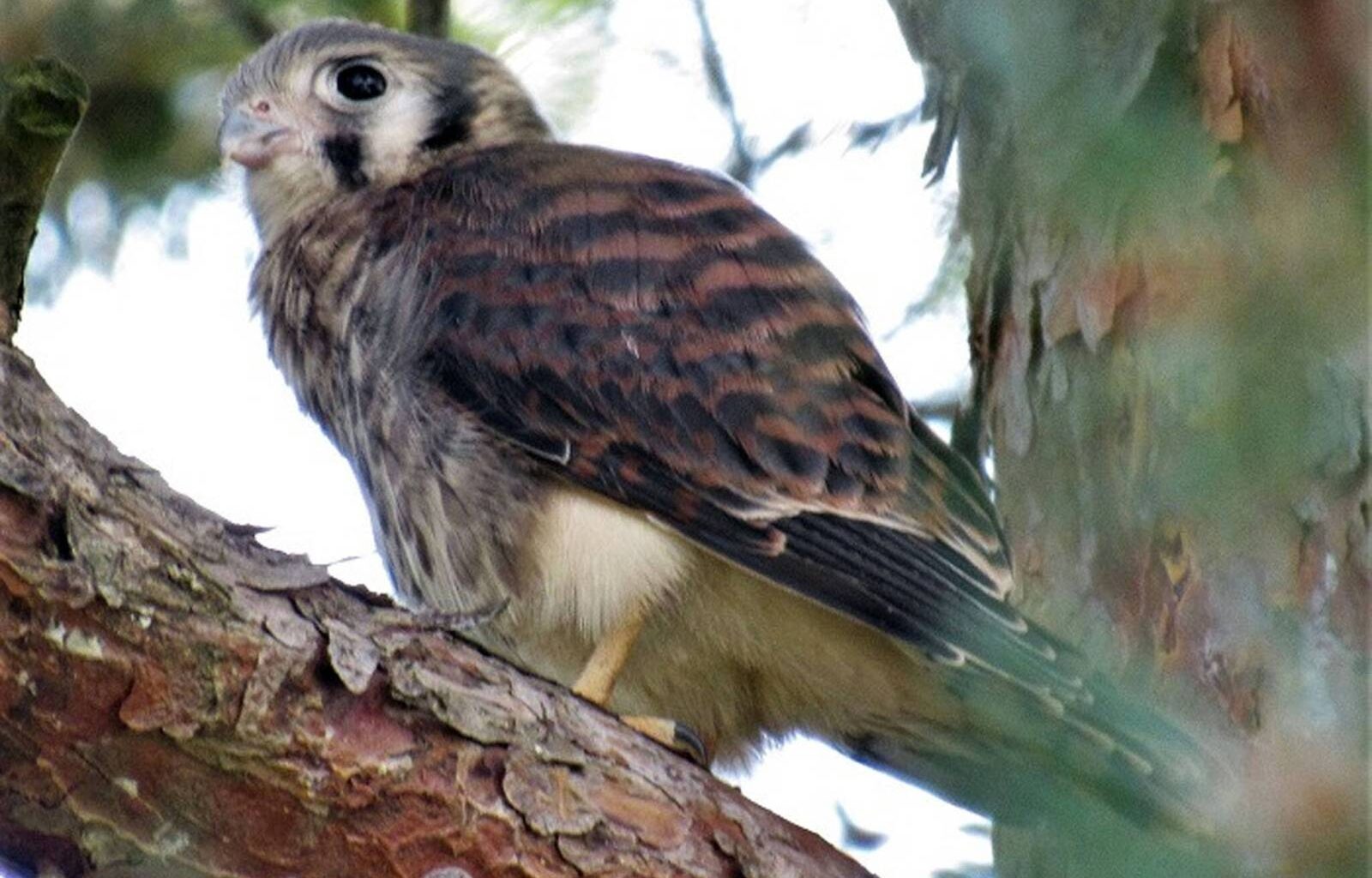
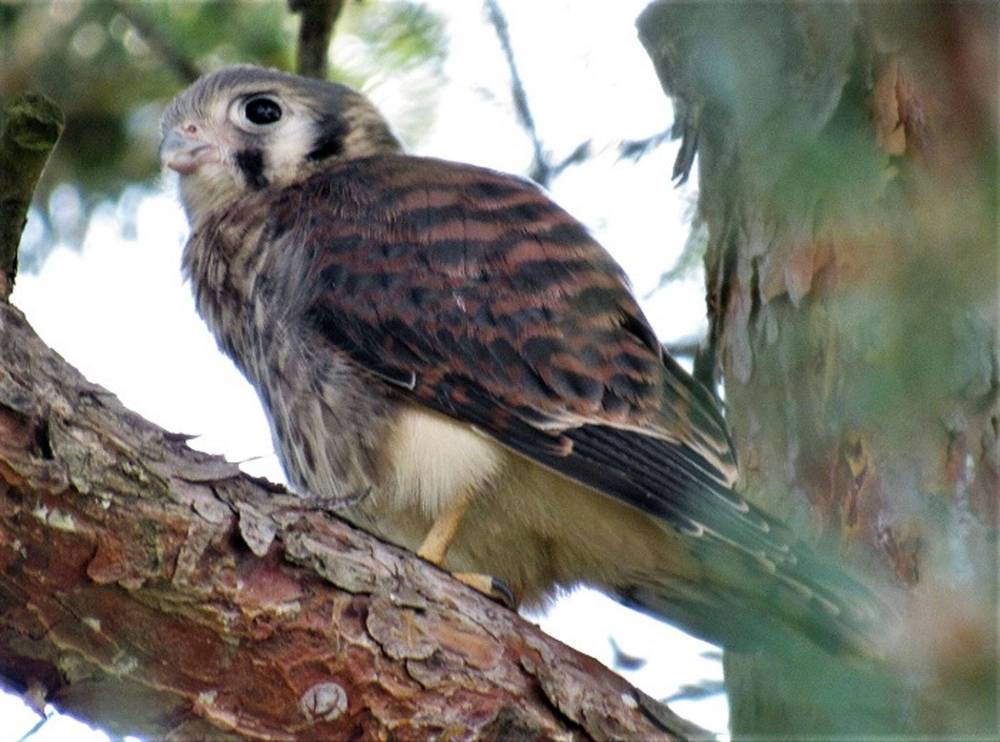
Windhover Orchard in Miami, Man., is named after the American kestrel, a small falcon found in Manitoba nicknamed ‘windhover’ for its habit of hovering in the air.
Hildebrandt has also been influenced by Jean Spencer who owned a 150-tree apple orchard near Miami. “Jean was very welcoming and let me take care of her trees for a while,” he says.
Hildebrandt also gained valuable experience by volunteering at the University of Saskatchewan’s fruit orchard, where he also referenced countless books and attended workshops on grafting and budding techniques, learned how to set up a mist-bed propagation system and experimented with training systems for fruit trees.
“When you’ve grown up on a farm, it’s like you are anchored to nature, somehow,” says Hildebrandt.
Today Hildebrandt grows approximately 2,000 apple trees and plans to graft another 300 trees this year. “But it has been a long, long process of getting the orchard slowly set up.”
Hildebrandt’s path to becoming an orchardist did not follow a conventional path. After high school, he attended Trinity Western University in Langley, B.C. When he returned to Manitoba, he had earned a degree in human services and psychology, and worked for Child and Family Services and for Main Street Project.

Kelvin Hildebrandt photo
Using an X-acto knife, Kelvin Hildebrandt, grafts fruit trees by joining the scion (the upper portion of a selected tree variety) to the rootstock of another variety.
His interest in growing an orchard began when he bought a house on Selkirk Avenue next to the river.
“There was a large apple tree at the bottom of the property which the neighbourhood kids loved to climb,” he says. “They would fill up their pockets with the apples. I started buying apple trees and planting them along the riverbank where it was underdeveloped.”
In the early 2000s, Hildebrandt began looking for a parcel of land along the escarpment that runs through the Pembina Valley Region of southern Manitoba. In 2010, he found what he was looking for — 30 hectares of open land with a 12-hectare area covered with oak and basswood trees for wind protection. The property is located eight kilometres south of Miami in the RM of Thompson.
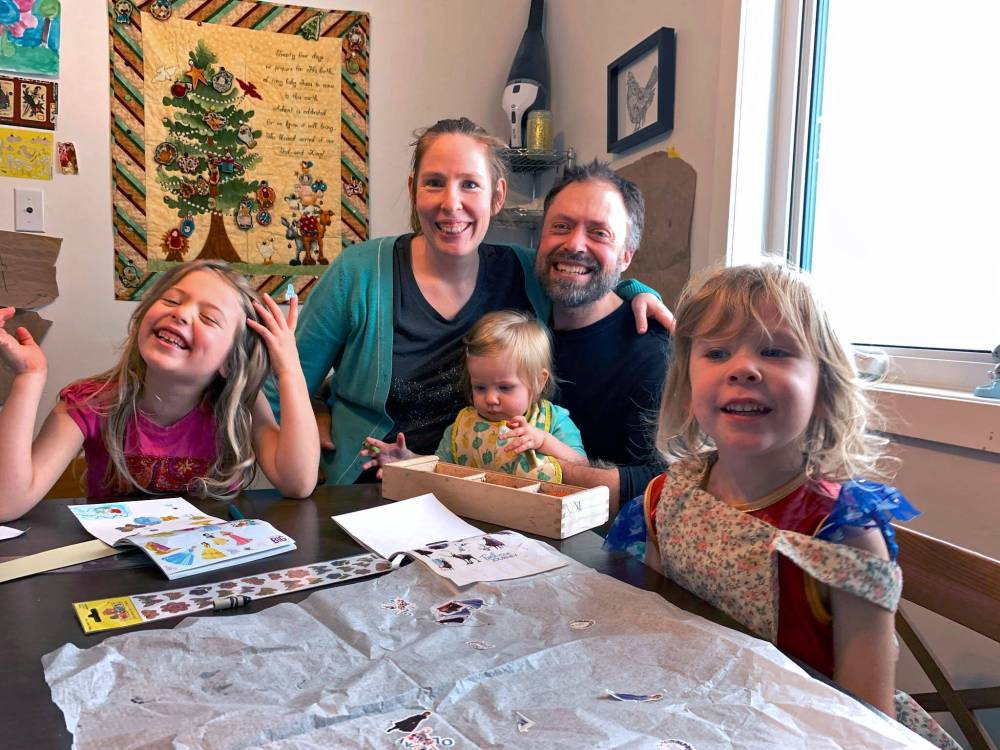
He named it Windhover Orchard after the American kestrel, a small falcon found in Manitoba nicknamed “windhover” for its habit of hovering in the air. He and his wife, Anna, were married on their property in 2011. At the same time as they are growing their orchard, they are also raising four children, the youngest of which was born just last summer.
‘Better late than never’
Windhover Orchard photo
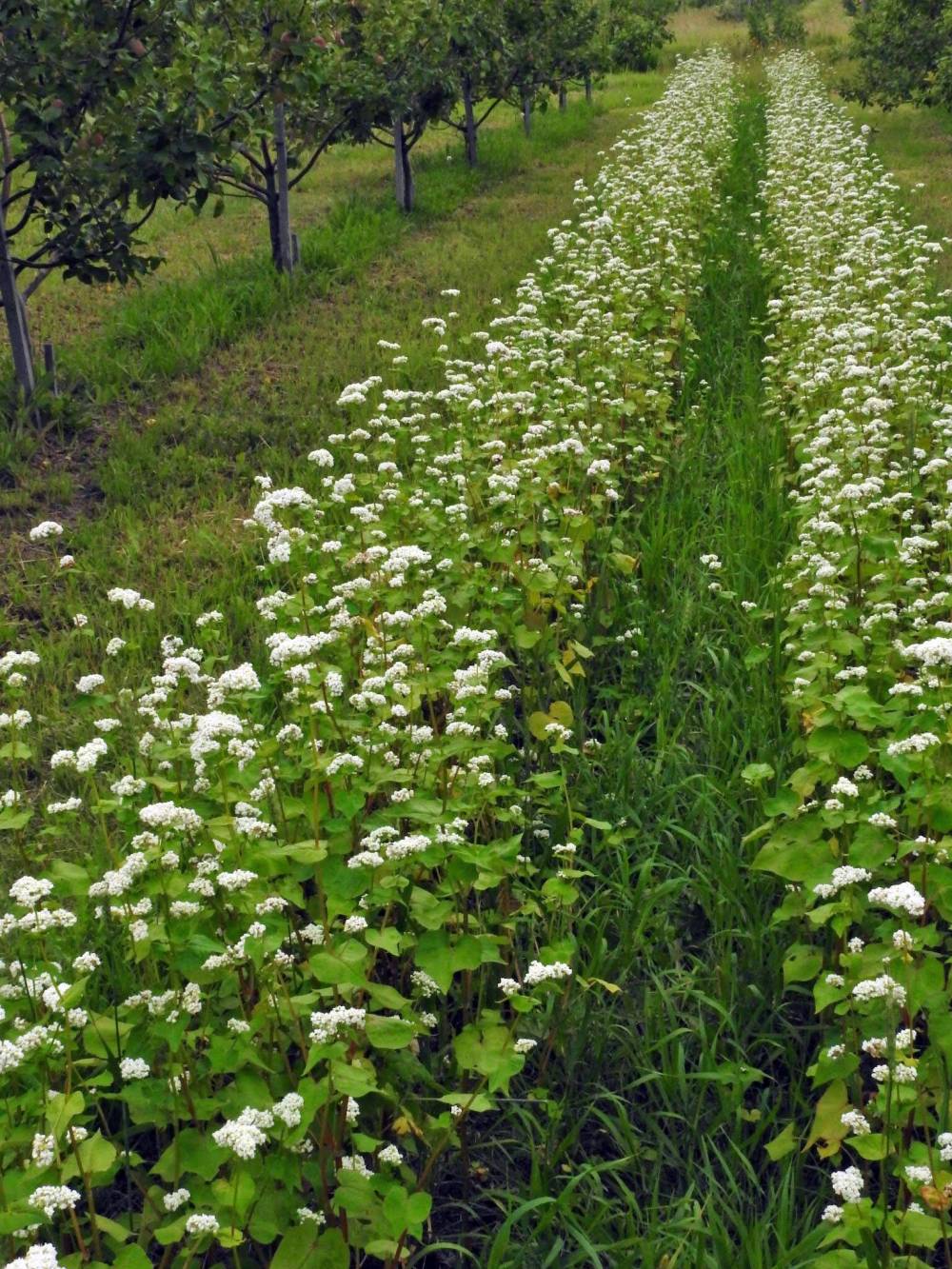
Flowering buckwheat functions as living mulch with soil-health benefits.
Hildebrandt is 49. “I got going a little late, but better late than never.”
In 2012, Hildebrandt purchased Vineland 3 rootstock, a hardy dwarfing rootstock from the Vineland breeding program in Ontario. Next, he obtained scion wood from orchardists in Ontario and trees for a shelterbelt from the program offered by the now defunct Prairie Farm Rehabilitation Administration and set about installing deer fencing.
“Deer fencing is absolutely crucial when you live along the escarpment,” says Hildebrandt. “Once the fencing was established, I set up a misting-bed system for rooting plant cuttings and propagated a bunch of Vineland 3 rootstock. Originally, we had about 825 trees with the V3 rootstock. It’s a lovely rootstock, but I found that in windy conditions combined with my support methods, the trees aren’t quite well-enough anchored, so I’m switching to Geneva apple rootstocks.”
Hildebrandt has been purchasing the Geneva rootstock from CopenHaven Farms in Oregon. Ordering rootstock across borders, however, is a complex process, he says. For anyone who requires a smaller order, Hildebrandt highly recommends Whiffletree Farm and Nursery in Ontario.
“Whiffletree ships rootstock and all sorts of orchard supplies to most places across Canada.”

Windhover Orchard photo
After a bountiful harvest of over 4,500 kilograms of apples in 2025, orchardist Kelvin Hildebrandt sold fresh apples at local farmers’ markets.
By 2017, Hildebrandt began grafting plant in earnest. In one year, he grafted 800 trees. “I took a budding course at the University of Saskatchewan in 2010, but I prefer grafting,” he says. “I think grafting makes for a stronger tree, overall.”
Using an X-acto knife, Hildebrandt grafts fruit trees by joining the scion (the upper portion of a selected tree variety) to the rootstock of another compatible variety.
“Basically, the rootstock has a variety of characteristics you are looking for,” says Hildebrandt. “The scion has distinct characteristics, as well.”
Hildebrandt has planted strips of flowering buckwheat in orchard aisles which function as a living mulch and provides ecological and soil-health benefits. He may experiment with a diversity of plants including food crops in the centre of the aisle and allow chickens or sheep to have the run of the area to aid in enhancing soil fertility through their nitrogen-rich manure.
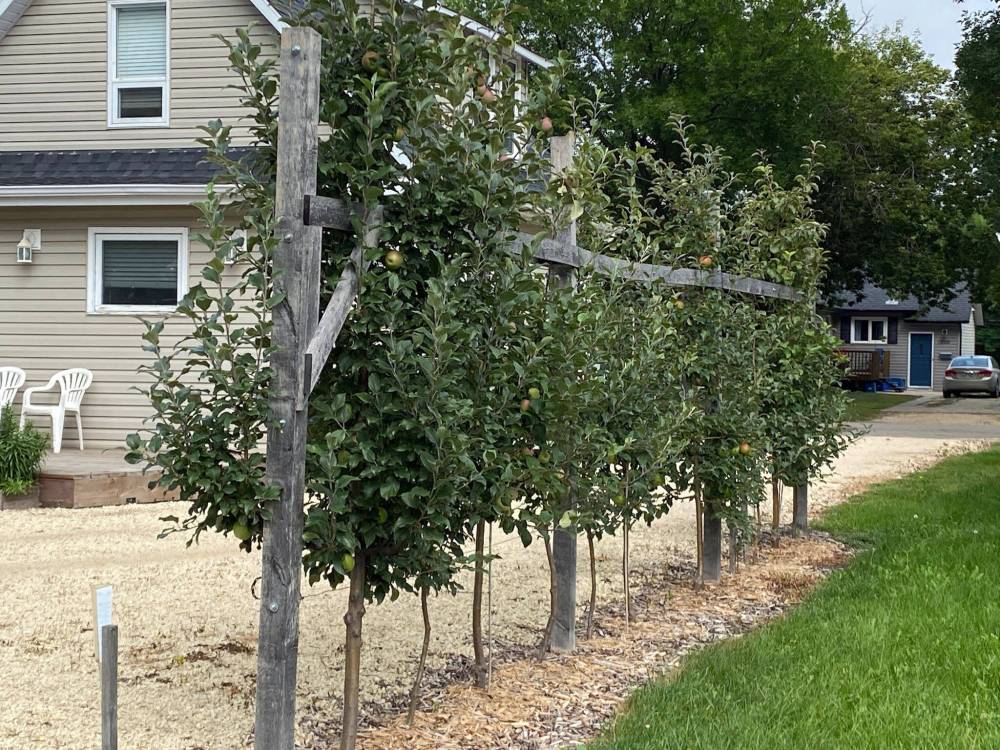
A variety of trellis systems to train trees are used in commercial orchards. Hildebrandt says he may try a trellis system in the future, but for now, space is not an issue. For the home gardener or a smaller-scale operation, Hildebrandt recommends the slender spindle training system in which fruit trees are supported by a pole that extends the height of the entire tree.
Kelvin Hildebrandt photo
With the Slender Spindle training system, fruit trees are supported by a pole that extends to the height of the entire tree.
“This system helps to promote rapid tree growth and supports trees with heavy crop loads,” says Hildebrandt. “It also encourages more fruit growth and helps to strengthen tree limbs.” The height of the tree is controlled by tying the leader down to the supporting post, thus weakening it, he says.
Huge demand
“Our trees are just starting to produce after the consecutive years of drought in 2021, 2022 and 2023,” says Hildebrandt. In 2025, he harvested nearly 4,535 kilograms of apples which he sold at farmers’ markets. “Demand was huge.”
Hildebrandt is interested in planting some new varieties, including Sandow apple, an open-pollinated seedling of Northern Spy apple. Both Sandow apple and KinderKrisp apple, a variety developed in Minnesota which Hildebrandt also plans to cultivate, are late-maturing varieties.
He is also thinking of planting Carroll apple, a classic variety that was introduced by the Morden Research Station in 1961. It is an early-maturing apple that typically ripens in mid- to late-August.
Windhover Orchard photo
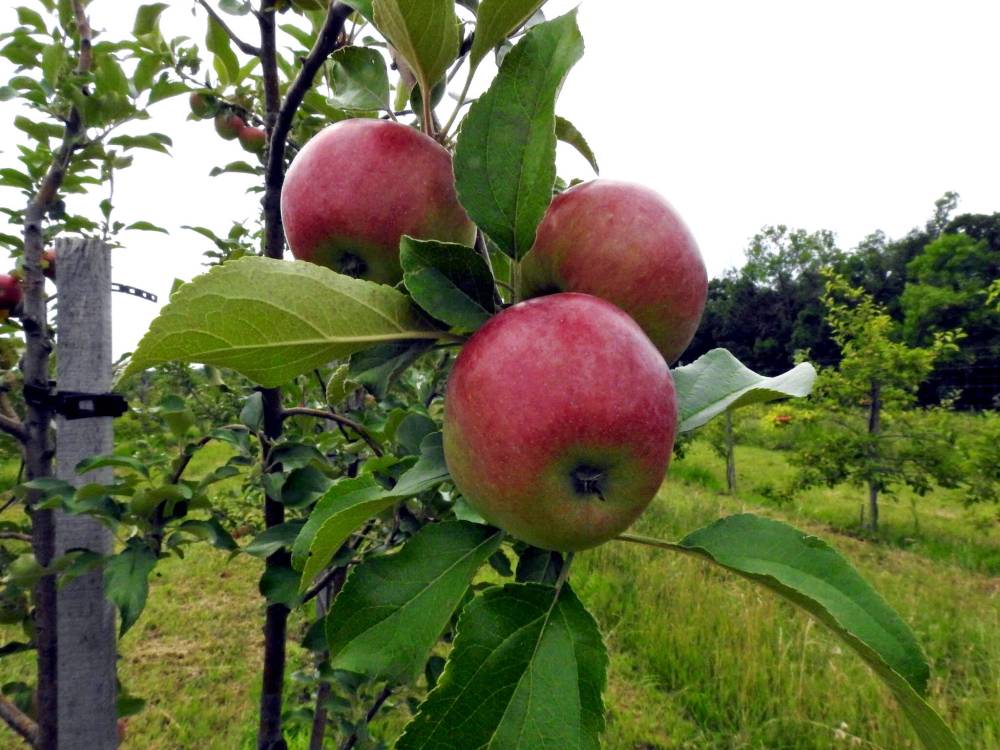
Bite into this: The crunchy flavour of Sweet Sixteen is like a blend of cherry-flavoured Life Savers candy and a hint of liquorice.
Winnipeg Free Press | Newsletter
Winnipeg Gardener
Monthly
What you need to know now about gardening in Winnipeg. An email with advice, ideas and tips to keep your outdoor and indoor plants growing.

“I need to grow more early-maturing apples that ripen in time for the Morden Corn and Apple Festival,” says Hildebrandt. He also plans to grow Miami apple, an heirloom variety that was developed by Harold Orchard at the Glenorchie Farm Nursery, located about nine kilometres north of Miami.
Hildebrandt is experimenting with several apple varieties to test their cold hardiness in Manitoba’s climate. One of the varieties, William’s Pride, produces beautiful dark apples with flavour a bit like grape juice, he says.
Every apple variety has its own personality, says Hildebrandt, but the Sweet Sixteen apple has amazed him with its unique flavour. Developed at the University of Manitoba, he likens the flavour to a blend of cherry-flavoured Life Savers candy and a hint of liquorice.
Hildebrandt insists he is not an expert. “Every year, I have something more to learn,” he says. But he is enjoying the challenge of learning new skills and growing and expanding his fruit orchard.
colleenizacharias@gmail.com
Peter Fuller photo
At the same time as Kelvin and Anna Hildebrandt are growing a home orchard, they are raising a young family.

Colleen Zacharias
Gardening columnist
Colleen Zacharias writes about many aspects of gardening including trends, plant recommendations, and how-to information that is uniquely relevant to Prairie gardeners. She has written a column for the Free Press since 2010 and pens the monthly newsletter Winnipeg Gardener. Read more about Colleen.
Every piece of reporting Colleen produces is reviewed by an editing team before it is posted online or published in print — part of the Free Press‘s tradition, since 1872, of producing reliable independent journalism. Read more about Free Press’s history and mandate, and learn how our newsroom operates.
Our newsroom depends on a growing audience of readers to power our journalism. If you are not a paid reader, please consider becoming a subscriber.
Our newsroom depends on its audience of readers to power our journalism. Thank you for your support.