
Earl Davis, head of fixed income and money markets at BMO Global Asset Management, joins BNN Bloomberg to discuss the outlook on the markets.
Canadian retail sales are showing signs of a rebound after a sluggish end to 2025, while softer U.S. GDP has added another layer of complexity for policymakers weighing interest-rate decisions in 2026.
BNN Bloomberg spoke with Earl Davis, head of fixed income and money markets at BMO Global Asset Management, who said his team expects two Bank of Canada rate cuts in 2026 amid CUSMA uncertainty and housing weakness, while remaining constructive on U.S. growth and corporate credit.
Key TakeawaysMarkets have shifted from pricing in hikes to expecting one to two Bank of Canada cuts in 2026, with Davis’s team forecasting two reductions.Heightened uncertainty around CUSMA negotiations and persistent housing inventory overhang are key factors behind the easing bias.Retail sales are an important signal for policymakers, though housing remains a larger structural driver of Canada’s economy.U.S. GDP weakness was largely attributed to temporary government shutdown effects, with broader growth supported by tax refunds, consumer resilience and policy incentives.Portfolio positioning favours shorter-duration bonds around five years and an overweight to corporate credit, with plans to add on periods of volatility.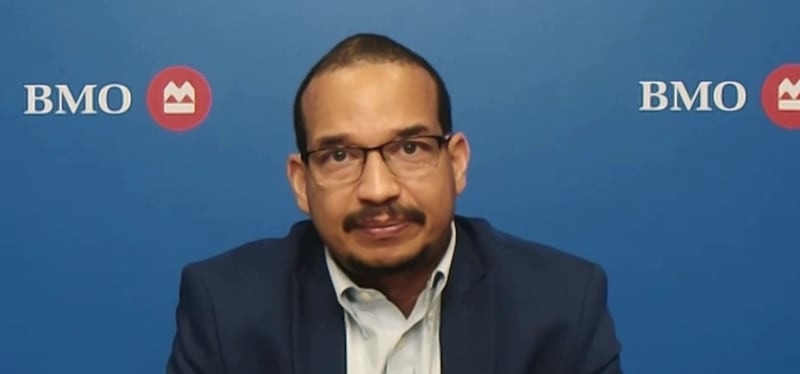 Earl Davis, head of fixed income and money markets at BMO Global Asset Management Earl Davis, head of fixed income and money markets at BMO Global Asset Management
Read the full transcript below:
ANDREW: Let’s get back to those Canadian retail sales. There was a sluggish end to 2025, but it looks as though there was a mild rebound last month. And the Fed, of course, has another data point to digest — U.S. GDP falling short in the latest quarter. Let’s get more from Earl Davis, head of fixed income and money markets at BMO Global Asset Management. Earl, thanks very much indeed for joining us. Start off with the retail sales, if you would. Are they an important metric for the Bank of Canada?
EARL: Good morning, Andy. I would say yes, they are an important metric for the Bank of Canada. Having said that, it’s not like the U.S., where the U.S. is a consumer economy, where consumer spending drives the economy. I would say in Canada, we’re more of a housing economy, from the jobs created through housing, as well as the spending for durables because of housing, which is a bigger driver. So retail sales is important. The Bank of Canada will be encouraged by the number that we see. We’ll have to see if this trend continues or if the actual number is close to the preliminary estimate. But it is a good thing, and I think it reflects increasing consumer confidence.
ANDREW: Looking at the fixed-income markets broadly, you think there are increasing signs that investors expect one cut from the Bank of Canada — an interest-rate reduction — this year?
EARL: Yes. And what’s interesting is, towards the end of 2025, the market was expecting a hike, or a percentage chance of a hike in 2026. Our team did not believe that. We always believed there would be cuts in the market. We were calling for one to two cuts in 2026 despite the market discounting hikes. We still believe there’s going to be one to two cuts. We ultimately believe there’ll be two cuts this year. And the main reason why is CUSMA, the uncertainty around that. You saw in the Bank of Canada minutes that they actually highlighted increased uncertainty because of Donald Trump. And to me, that’s language that opens up the easing possibility again. And we think if they’re going to ease once, they won’t ease once — if you’re going to ease, you ease twice, because you think you need to impact the economy somehow.
ANDREW: The housing market — you don’t see much of a turnaround there this year?
EARL: No, unfortunately not. We don’t see much of a turnaround, just because of the inventory overhang. You have to get rid of the inventory overhang in regards to new condos and new townhomes being built. The key way to doing that is lower interest rates. You lower the price, the entry costs of housing affordability. That’s helpful in getting rid of that overhang. We do, however, believe that the overhang will be taken care of in 2026. So we do see us coming close to the lows, but we haven’t turned around yet.
ANDREW: What about the States’ weakish number for the latest period on GDP? What is your take on the U.S. economy? Is it just ticking along nicely?
EARL: Yeah, ticking along very nicely. And when you look at the details of the surprise weaker number in GDP, the biggest driver was government spending, or lack thereof, and that was driven by the shutdowns. So there’s a little bit of noise in those numbers. They’re actually better than they look if you remove the government shutdown. So yeah, we’re very constructive on the U.S. We believe they’re on an upswing from a growth perspective, and we believe this will be the low print for 2026.
ANDREW: So can President Trump claim that he’s done a decent job of preserving and keeping economic growth solid, even despite the massive disruption around tariffs?
EARL: Yeah, you know what? I smile because I think he’ll proclaim that no matter what the number is. If it’s a low number, it’s someone else’s fault. If it’s a good number, it’s his. So he’ll proclaim that it’s good, without a doubt. But yes, and you have to remember the key thing in the U.S. right now is that the tax refunds are coming out. They’re going to hit consumer pockets, and that is expected to be significant due to the tax reduction from the Big Beautiful Bill. And those refunds come February, March, April. So we expect that to be very supportive of the U.S. economy, at least for the next several months, and we think that will play through throughout the year.
ANDREW: And just finally — we’re very tight for time — but you’re generally saying if you have a bond portfolio that you’re managing, keep it short, because there could be drops in bond prices and rises in interest rates?
EARL: Yeah, we’re saying two things. You want probably a maturity of around five years because there’s more volatility outside of five years. And the second thing, which I think is more important, you do want to own corporate bonds. We do believe this is a supportive environment for credit and risk assets, and we are overweight credit and risk assets, and we’ll go more overweight if the opportunity presents itself.
ANDREW: We’d better jump. Earl, thank you very much, and have a great weekend.
EARL: Thank you. You as well.
ANDREW: Earl Davis, head of fixed income and money markets at BMO Global Asset Management.
—
This BNN Bloomberg summary and transcript of the Feb. 20, 2026 interview with Earl Davis are published with the assistance of AI. Original research, interview questions and added context was created by BNN Bloomberg journalists. An editor also reviewed this material before it was published to ensure its accuracy and adherence with BNN Bloomberg editorial policies and standards.