
Affordable technology, robotic, AI solutions are saving time and eliminating much of the grunt work for Ontario farmers
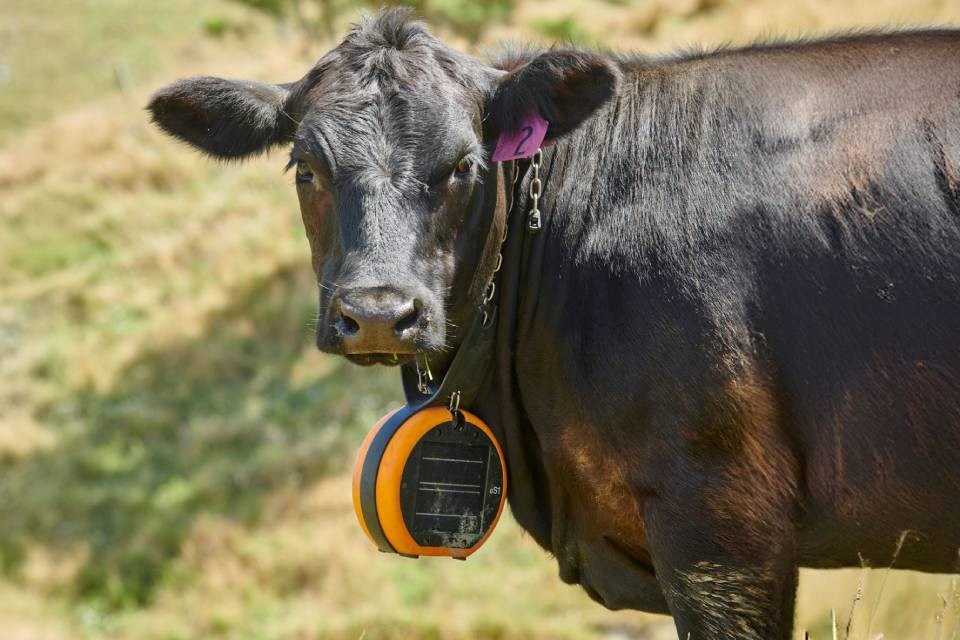
Anyone visiting Don Badour’s cow-calf operation in the last 18 months will have noticed his cattle sporting some spiffy orange bling around their necks.
The bovine baubles aren’t just for looks, however. They’re part of a sophisticated virtual fencing system that helps the Lanark County farmer monitor and track his herd’s movement and wellbeing.
Badour is quite pleased with the investment — and so are the cows.
“I thought that the cows might be not too happy with them on, but we put them on, they gave their heads one or two shakes, and that’s it,” Badour said during a panel discussion at the 2026 Northern Ontario Ag Conference, hosted by the Northern Ontario Farm Innovation Alliance in Sudbury Feb. 6-7.
“They’ve come to realize they’re there. So we haven’t had any trouble with the cows rejecting them.”
Made by the New Zealand company Gallagher, the eShepherd neck bands weigh about eight pounds each and are powered by solar-charged batteries. They run on GPS and the system is operated all through a smartphone app or computer.

BHF Robotics’ autonomous weeder identifies weeds and zaps them with an electric current. BHF Robotics/Supplied
In the app, the farmer’s land shows up as a virtual map, with each cow represented by a coloured dot. The farmer draws out a paddock onscreen, directing the movement of their herd. They can see where an animal is at any time, change a paddock’s parameters to shift grazing, or pick up on potential problems, as when an animal remains in one spot for too long.
Cattle are warned if they come too close to the fence line. Within 10 feet of the paddock perimeter, the collar emits a series of beeps. If the cattle move closer, the beeps get louder. And if they still move closer, the collar gives a shock.
There’s also a speed sensor that kicks in if the cows reach a certain speed — for example, something is chasing them — that enables them to go through the paddock without getting a shock.
“We found they train really quickly to it,” Badour said. “We didn’t have any issues getting them trained.”
A minimum order is 20 collars, which cost $415 apiece, plus charging fees. It’s a hefty investment, but one that has been paying off, Badour said.
In January, Badour was keeping a close eye on three heifers that were set to calve at the end of the month. When he looked in on them through the app one morning, they were all together, and all appeared to be well. But checking back again just a few hours later, he noticed one cow off by herself, prompting him to go into the field to investigate.
The cow had just given birth, earlier than expected, in an isolated area, in -24 Celsius temperatures with a biting wind. Badour was able to get the calf into shelter before any harm came to it.
“So that $3,000 calf paid for quite a few collars right off the bat,” he said.
It’s the kind of advanced technology that Canadian producers are taking a closer look at to streamline farm operations. And some of those solutions are being created right here at home.
David Tao, a Markham-based robotics engineer with an interest in solving technological problems, was visiting a friend’s farm in 2020 when he noticed the carrot crop was overrun with weeds.
Because it was early in the pandemic, the farmer was unable to bring in foreign workers to help weed the fields, and he didn’t want to use herbicides, making it difficult to keep up with the task.
“‘You should probably figure out some technology that can solve the problem,’” Tao said his friend advised him.
Tao took up the challenge, brainstorming various ways to get rid of weeds — herbicides, a mechanical solution, laser — but electricity won out in the end.
The result is the Blitz ElectricWeeder, a robotic weeder powered by artificial intelligence (AI) that uses high-voltage electricity to zap and kill weeds.
It can differentiate between weeds and crop, conducting electricity all the way down to the weeds’ roots, which kills them and prevents them from returning, Tao explained. It works at any stage of the weed’s growth, including when it’s gone to seed, he added.
“So far, we’ve been focusing mostly on organic as well as vegetable crops, especially crops like lettuce, carrots, onions, etc.,” said Tao, who launched BHF Robotics to produce the Blitz.
“But we have seen serious interest from conventional growers for corn and soybean, and we’re preparing to do testing this coming season.”

Haggerty AgRobotics researches and tests various technologies for use in agriculture, including Naïo Technologies’ Oz, which autonomously performs on-farm tasks like weeding. Haggerty AgRobotics/Supplied
Available in human-operated and autonomous versions, the weeder has a 99 per cent success rate for weed removal or weed reduction after each passing, based on current testing. The machine can cover roughly three acres in an hour.
For the autonomous version, other implements can be added to do different tasks, like seeding or thinning, and they can run 24 hours a day, seven days a week.
A Blitz weeder will run producers between $100,000 to $400,000, plus a subscription fee, Tao said, which is a bargain compared to the more than $1 million for similar models on the market. No specialty knowledge is required to run the machine, and it takes just a few hours of training to become fluent in its operation.
Tao said that many farms they’ve dealt with get a payback on their purchase in as little as 12 months. But perhaps the biggest return on investment is time.
“We are freeing growers from those tedious daily tasks, by getting them to think about more important things,” he said.
Though Haggerty AgRobotics doesn’t design and build its own robots, it does search the globe for the best solutions that can meet Canadian needs.
Based in Bothwell, south of London, the company is led by farmers, giving them lots of areas to test products, said Jeff Pettit, the company’s sales manager.
“Our main goal is to bring in robots that fit seamlessly into all kinds of operations without having to change too much of your operation,” Pettit said.
Haggerty focuses on solutions that are affordable for farmers, and provides servicing to all the robots they sell. They’ll also innovate implements for the robot.
“So if you have a special need on your farm, we can take an existing robot and retrofit it to a specific task, or, say, a pinch point that you have on your farm,” he said.
The company has several robots currently in various areas of agriculture right now, including the Ted robot, an all-electric autonomous machine made by Naïo Technologies that can be outfitted with a variety of implements, as well as utility robots, and electric tractors.

Ted, made by Naïo Technologies, is an all-electric, autonomous tool carrier designed for vineyards. Haggerty AgRobotics/Supplied
In Northern Ontario, where the growing season is shorter, farmers are looking for a fast return on machines to justify the investment, he said.
Haggerty’s smallest robot, Naïo’s Oz, can service a market garden-style operation up to about five acres, Pettit said. It sells for $55,000.
“If you have a CSA (community shared agriculture) or a market garden where you have to go to the market once or twice a week, and you have to outsource some labour for the weeds because you don’t want them to get away from you, that kind of pays for itself within a year or two in Northern Ontario,” he said.
Part of Haggerty’s expertise involves troubleshooting connectivity issues in more remote or rural areas that have unreliable communications technology. Some robots work off real-time kinematic positioning (RTK), some use GPS, some work off a cell phone, and Haggerty has even explored satellite systems. But they’re usually always able to find a creative solution to the issue, Pettit said.
Pettit is of the opinion that robots won’t eliminate the need for farmers altogether, but they will alleviate some of the grunt work associated with farming. That’ll free producers up for more important tasks, give them peace of mind, or help make their operations more sustainable.
“I don’t think that we’re replacing people,” he said. “I just think that we’re helping make things more more efficient.”
That’s been the case for Badour, who said he worries about his cattle a lot less since he set up the virtual fencing, especially since he travels frequently for his role as a board member with the Beef Farmers of Ontario.
Even vacations have become more enjoyable, like the two-day trip to Toronto he took with family to see a Blue Jays game last July.
“I got there and realized I forgot to move a group of cows with a rented pasture,” he said. “So I’m sitting in a Jays game, phone in one hand, beer in the other, moving cows.”