
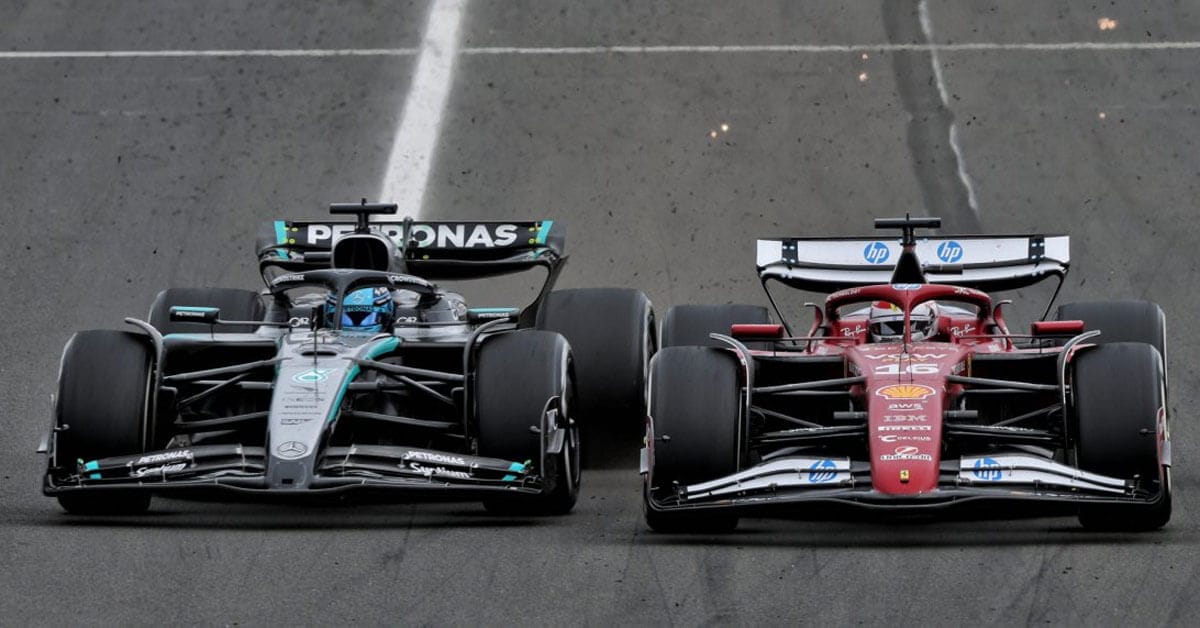
The 2026 Formula 1 pre-season testing program has concluded at the Bahrain International Circuit, and while Ferrari and Charles Leclerc ended the six-day test on top of the overall time sheets, the consensus inside the paddock suggests a different competitive picture. According to multiple observers and insiders, Mercedes appear to be the team best positioned for the season opener in Melbourne.
Although Charles Leclerc’s headline lap grabbed attention and underlined Ferrari’s one-lap pace, long-run analysis, energy deployment patterns, and overall consistency have led many rival engineers to quietly identify Mercedes as the early benchmark under the new 2026 Formula 1 regulations.
Paddock analysis points to Mercedes as team to beat
Discussion throughout the Bahrain pit lane indicates that Mercedes may have more performance in reserve than their final time sheet position suggests. On The Race F1 Podcast, journalist Edd Straw indicated that feedback from across the paddock consistently pointed toward Mercedes as the strongest overall package heading into the Australian Grand Prix.
Edd Straw suggested that conversations with rival teams revealed a shared belief that internal data comparisons showed Mercedes leading the competitive order. While Ferrari demonstrated impressive peak pace through Charles Leclerc, the broader performance picture — particularly across varying fuel loads — appears to favour the Silver Arrows.
There has also been speculation that Mercedes may not have fully revealed their potential during the final phase of Bahrain testing. Their quickest lap was set earlier in the week rather than during the traditional low-fuel performance runs on the final day, raising questions about whether the team was deliberately holding performance in reserve.
Podcast contributor Jon Noble questioned whether enough race simulation data had been shown during the second week of testing, noting that Mercedes appeared to limit extended long-run programs compared to some of their rivals. This fuelled further discussion about possible sandbagging — a common theme during pre-season Formula 1 testing.
Edd Straw cautioned against overusing the term sandbagging but acknowledged that certain race stints suggested Mercedes possessed strong underlying pace. He noted that while their long runs were not always perfectly tidy, there were clear phases where the car’s consistency and tyre management stood out. He also highlighted that Mercedes recorded the second-fastest overall time in Bahrain, approximately eight tenths behind Charles Leclerc’s Ferrari benchmark, and emphasized that the timing of their fastest lap indicated additional performance could still be unlocked.
Many within the paddock reportedly expect Mercedes to take another step forward in Melbourne, particularly if they optimize energy management for Albert Park’s demanding traction zones and acceleration-heavy layout. Under the new hybrid-focused 2026 regulations, efficient deployment and recovery systems are expected to play a decisive role.
Power unit advantage could define early 2026 order
Adding further weight to the Mercedes narrative, Max Verstappen offered an interesting perspective when reflecting on the competitive outlook for the 2026 Formula 1 season. The reigning world champion suggested that any strong chassis paired with a Mercedes power unit would likely be competitive under the new rules.
If that assessment proves accurate, the Mercedes engine could become the reference point of the new era. In addition to the works Mercedes team, customer outfits such as McLaren, Alpine, and Williams could benefit from the projected strength of the German manufacturer’s power unit.
While Alpine and Williams are not widely expected to challenge at the very front of the grid, both teams could become serious contenders in the midfield battle if the Mercedes power unit delivers a clear advantage in efficiency and drivability. Meanwhile, there are indications that McLaren may not have run the latest Mercedes engine specification during the Bahrain test, potentially leaving room for performance gains when the championship begins in Australia.
Ferrari’s strong headline pace vs Mercedes’ consistency
Ferrari’s performance in Bahrain, led by Charles Leclerc and supported by Lewis Hamilton’s development work, should not be underestimated. The SF-26 demonstrated competitive single-lap speed and appeared stable in cooler evening conditions. However, pre-season testing analysis often extends beyond the fastest lap time, with race simulations, tyre degradation curves, and power unit calibration offering a more complete competitive picture.
As Formula 1 prepares for the Australian Grand Prix, the spotlight will remain firmly on the evolving battle between Mercedes and the Maranello team. With Lewis Hamilton and Charles Leclerc aiming to mount a title challenge for the Scuderia, and Mercedes seeking to reassert dominance under the 2026 technical regulations, Melbourne will provide the first genuine indicator of the pecking order.
Testing may have ended with Charles Leclerc at the top of the timing screens, but the broader Formula 1 paddock appears to believe that Mercedes — not Ferrari — hold the early advantage as the new era begins.