
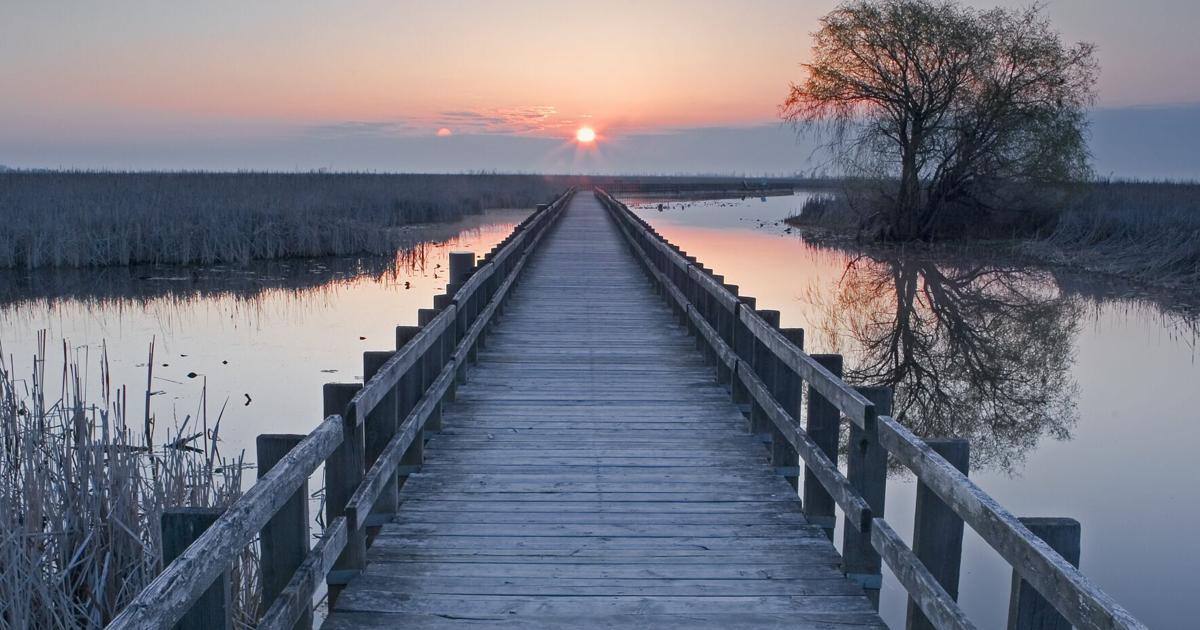
Imagine a marsh so vast it covers 2,000 football fields. Well, at one of Canada’s smallest national parks here in southern Ontario, you don’t have to.
Nestled just over three and a half hours from Toronto at the southernmost point of the Canadian mainland, lies Point Pelee National Park.
Not only is this spot known as one of the most ecologically diverse national parks in Canada, two thirds of its entire area is also covered by its 1,000 hectare marsh, anchored by a scenic, floating boardwalk that meanders through cattail matts and lily pad blossoms.
“Wetlands are known for their remarkable biodiversity, and the marsh at Point Pelee is no exception,” according to Parks Canada.
“The marsh does not only offer opportunities into wildlife. Visitors to the marsh can immerse themselves into another world.”
In fact, at this spot, guests can set their sights on one of the largest marshes in southern Ontario and one of the few large ones left in the Great Lakes system.
Although the area became a national park in 1918, it was officially named a Ramsar site by 1987 to promote the conservation of its wetlands.
However, despite its beauty, the health of the marsh at Point Pelee is in decline, according to Parks Canada, with one of the “most concerning issues” being the loss of open water.
“Since the 1950s, open water habitat has reduced by 10 per cent, or 100 hectares — that’s 140 soccer fields,” Parks Canada states.
To combat the threat, Parks Canada will be working to manage invasive species at the march “with the goal of restoring the diversity of open water and edge-water habitats.”
“Staff plan to create approximately eight hectares of ponds and channels, and undertake targeted removal of invasive species within areas of concern,” Parks Canada states.

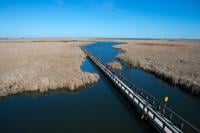
The Point Pelee boardwalk provides sights to its 1,000 hectare marsh.
Ray Akey/Dreamstime
As these restoration efforts work to secure the marsh’s future, visitors can still witness the stunning destination for themselves by traversing the one-kilometre marsh boardwalk loop trail at the park that takes approximately 45 minutes to complete.
And while you’re there, try out one of the other six hiking trails to extend your adventure. The 2.75-kilometre Woodland Nature Trail strolls through old forest habitat in the park and the one-kilometre Tilden Woods Trail journeys by mature swamp forest and savannah.
If you’ll be visiting in the winter, be mindful that the trails are not maintained.
The park can be found on a land mass that juts 15 kilometres into Lake Erie, about a one-hour drive south of Windsor. The “odd-shaped” peninsula was formed over time by sediment deposits along its beach, according to Destination Ontario.
Speaking of its sandy shores, if you’ll be making the trip in the warmer months, the park’s beach is the longest continuous natural beach in Essex County at 20 kilometres long.
Bird lovers will may also be excited to learn that over 370 species have been spotted in the park.
And should the cosmos call your name, Point Pelee is also designated as a dark sky preserve, meaning millions of stars are visible to the naked eye at night. Appointed by the Windsor Centre of the Royal Astronomical Society of Canada in 2006, the honour is given to parks that have “the best places to explore the night sky in Canada,” according to Parks Canada.
Coming up on Feb. 21, The Royal Astronomical Society of Canada will be at the park with telescopes for star gazing. A dark sky night will also run next month on March 14.
Aside from dark sky nights, the park at Canada’s southern tip is open from 7 a.m. to dusk in the winter months. Admission to Point Pelee, located at 1118 Point Pelee Dr. in Leamington, can be purchased online for $7.75.