
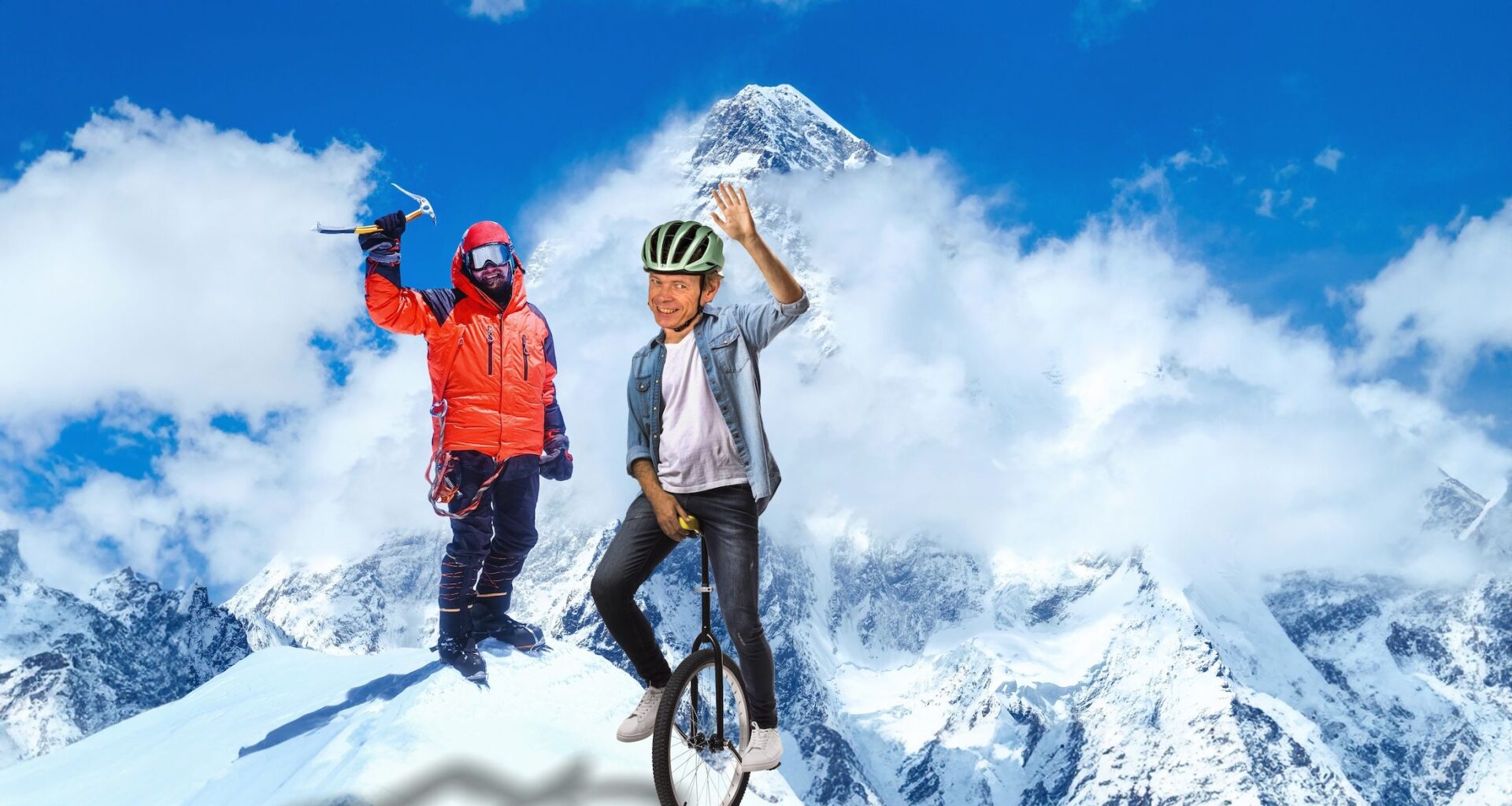
There was an Everesting world championships a couple of weeks ago. I know you know what Everesting is, but someone somewhere still won’t, so let me explain that it is riding up and down a hill until the uphill bits have accumulated a total altitude gain equivalent to the height of Everest. It’s 8848.86 metres, if you fancy it.
The championship event was won by Canadian rider Jack Burke in the men’s category, and by Britain’s Illi Gardner in the women’s, with times of seven and a half and eight and a half hours respectively.
With every apology to Burke and Gardner, this does seem like a peak example of the Venn crossover of “very impressive” and “deeply pointless”. Rarely has so much effort been put into achieving something so odd, and I say that as a rider of 24-hour time trials.
You may like
The championships was held on Etna in Sicily. So immediately I found myself wanting to organise an Etna-ing race on, say, Surrey’s Box Hill. Followed by a Box Hilling race on the M11 motorway bridge at Junction 12 outside Cambridge. Or a race around the world by shuttling between two roundabouts in Milton Keynes.
But I’m going to stop there, because is Everesting actually any sillier than most other bike races? There are really only two sorts of “natural” race. First is the scratch race – all start together, first over the line wins. Second is the time trial – do it one at a time, fastest time wins. That’s the complete collection of non-silly bike races.
Other sports had the same problem. Swimming has one sensible stroke and three that are the equivalent of a sack race. We could have learned from this and gone with riding backwards, or pushing down with both legs at the same time, but we didn’t.
Athletics is similar. It has four events for throwing different random objects, and the same again for different ways to jump. If you don’t agree that the triple jump is the oddest event in the Olympic calendar, I’m not sure we could ever be friends. But I’m also going to assert that the keirin runs it a very close second.
The odd events we do have are most obvious on the track – as well as the keirin, there’s the points, elimination, and tempo, which are all completely artificial. But we tend to overlook how peculiar road events are. Even a flat race almost always revolves around a semi-staged breakaway. This happens for about a dozen reasons, almost none of them having anything to do with the riders in the breakaway winning.
A king or queen of the mountains competition sounds simpler. But in reality it’s only by accident that it ever finds the best climber in a race. The Tour of Britain, for instance, had a climb this year that was classified as1 km at an average gradient of 0.1%. Most of the time
You may like
the jersey is a bonus for someone who’s good at negotiating their way into breakaways, can sprint a little, and doesn’t have anything better to do. This is a strange combination to reward, when you stop to think about it.
The very first road race, held in 1869, had unicycles and tricycles, so we could have gone in a “how many wheels” direction. I personally think that might have been a sliding-doors moment when we, as a sport, chose wrong. The elite men’s road tricycle race might be the event we never knew we were missing.
And unicycle Everesting. Who doesn’t want that?
Great Inventions of Cycling – Tubercles
“Tubercle” comes from the Latin for “small lump”, and it typically refers to a small lump. Often you find them in nature, on the leading edge of a humpback whale’s fins, for instance, or on a hammerhead shark’s head. They have a knobbly appearance, which usually looks like some sort of mistake.
They attracted attention from fluid dynamics experts when they realised that whales are more manoeuvrable than typical models suggest they should be. The experts concluded that the knobbly bits on a whale produce vortices, which spill back over the surface of the fin and delay the point at which the fin stalls. This can reduce the amount of drag on the fin.
Bike designers also like them because they might have the same drag reduction effect on bikes, and also because they hadn’t come up with anything really new in ages. Even if they don’t work, they figured it was fun to make the marketing department talk to journalists about whales with a straight face.
Tubercles have appeared on forks and seat posts (including Filippo Ganna’s Hour Record bike) and on wheel rims, where the wavy shape it produces is a nice visual contrast to normal, boring wheels.
It’s hard to judge how effective tubercles are without using a wind tunnel, but they look trick and if you enjoy the sensation of running your fingers over a bumpy surface a bike is a lot easier to keep in the garage that a whale.
Acts of Cycling Stupidity
Word reaches me of a rider who went on holiday, and made the classic mistake of forgetting an appropriate tool for putting his pedals back on his cranks.
After a couple of bike-free days, a mate at home who he’d messaged suggested that if he just screwed the pedals in by hand, then rode gently for a few kilometres, the precession effect of the pedals and cranks rotating would gradually tighten the pedals up.
He did exactly this. He was delighted to discover that after a careful morning’s ride the pedals were too tight to undo, so happily assumed they were fine to ride. And they were.
He enjoyed this remarkably useful physical effect right up to the point where he had to take the pedals off again so his bike would fit in his bike box.