
After graduating with a degree in agriculture science, Jenna Wight returned home to her family’s Belle Vallée sheep farm brimming with ideas about how she would grow the business when she took over as owner.
“I’d come out of the University of Guelph with thousands of ideas, right?” laughed Wight, a third-generation sheep farmer who farms in the Temiskaming area close to the Quebec border.
“And so [my parents] had to sit me down and be like, ‘Hey, so if this is really going to happen, what are the steps we have to make?’”
What followed was a frank, pragmatic discussion about the day-to-day realities of running a farm, designed to set up Wight and her husband, Andrew, for success.
Though she was already working on the farm, Wight said she began to transition to more of a leadership role, where she was involved in making major decisions about the farm’s operation. Even simple choices, like wiring a new barn rather than hiring someone to do it, gave her greater insight into how everyday decisions impact the business.
“It was a lot of practical decisions, so that when I was ready to take over the farm, I couldn’t just say, ‘Oh, I know how everything works.’ It’s ‘I helped build it.’”

Wight Sheep Farm in Belle Vallée is run by Jenna Wight, a third-generation sheep farmer, and her husband, who produce lamb. Wight Sheep Farm/Supplied
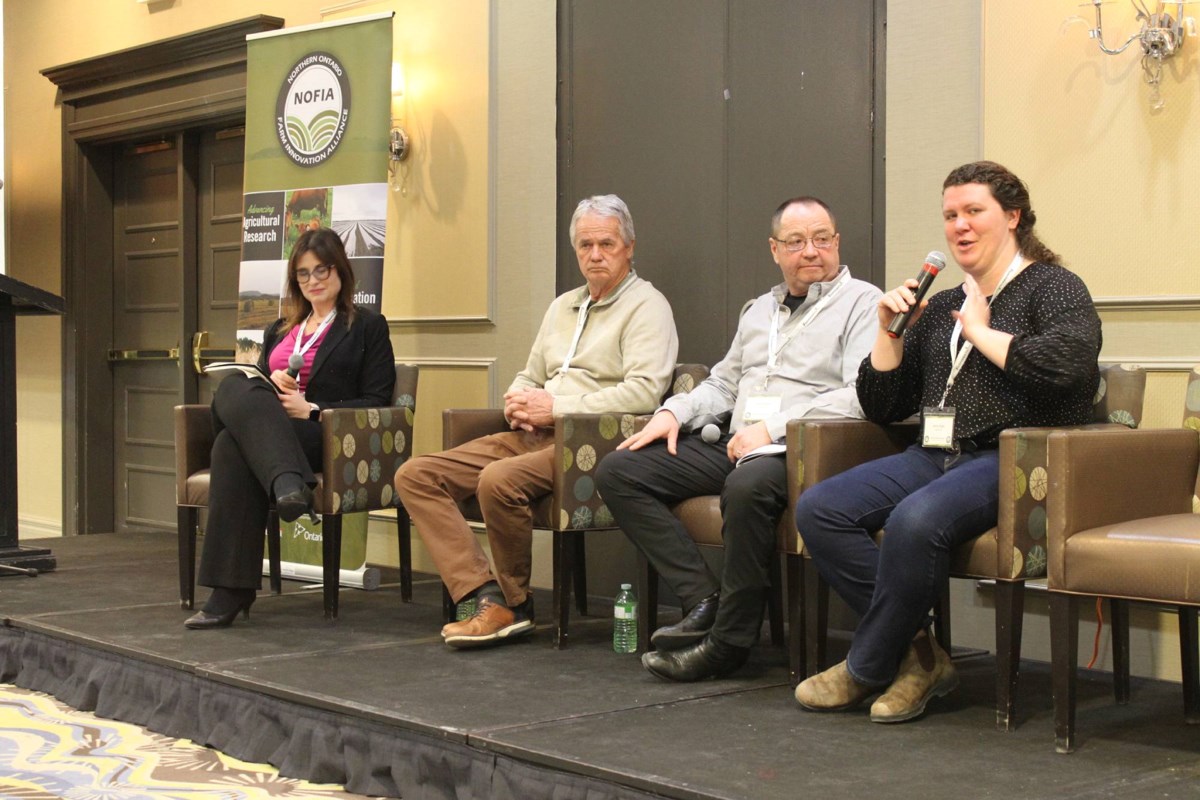
Wight shared her story as a panellist during a discussion at the 2026 Northern Ontario Ag Conference, held Feb. 6-7 in Sudbury.
The two-day event brought together farmers, researchers, funders, suppliers, and other industry representatives to talk about challenges and solutions in agriculture in the North.
Led by Dr. Sara Epp, an associate professor of rural planning and development at the University of Guelph, the panel Wight participated in focussed on celebrating northern successes in agriculture, a theme Epp has been exploring in her work over the last few years.
“I think there’s a lot of myths and misconceptions and perceptions and things attached to the North that we really need to overcome,” Epp said.
“And so the goal of the last two years of [funding] applications has been looking at agribusiness success and to really highlight these things that are happening in the North. This panel is hopefully our first launch into something a little bit more formalized.”
At Jaspers Dairy Farm in Thunder Bay, Fritz Jaspers runs a dairy and cropping farm on about 1,100 acres.
His parents started the farm after immigrating to Canada from Holland in 1954 while he was an infant, and Jaspers’ son now represents the third generation of the family to follow in the business.
While the farm is largely worked by family members, Jaspers said he has brought in hired labour when needed.
Help can be hard to find, however, and Jaspers noted that other farmers in the area have turned to temporary foreign workers to meet their labour needs, a move he doesn’t rule out for the future.
About six years ago, Jaspers outfitted the barn with robotics, which he said has been an invaluable addition, increasing his cows’ production by between 25 and 30 per cent.
“At this point, for what we’re producing, if we didn’t have the robotics, we would have to have a full-time person, and maybe a time and a half, I think, for the amount of work that the robots are doing,” Jaspers said. “It makes a big difference.”
The robotics have automated some of the more routine tasks, like milking and feeding. Jaspers believes integrating that kind of technology to streamline farming helped convince his son to follow in his footsteps.
Such a scenario would have been unfathomable just a generation ago.
“My parents would be blown away by that. How can a machine feed the cows? And it feeds it better, with all the minerals and protein and everything it needs” Jaspers said.
“It’s all tested, scientifically proven, and it shows in the cow production. So there’s a lot of things that are really impressive.”

Fritz and Ryan Jaspers operate Jaspers Dairy Farm in northwestern Ontario. Rural Agri-Innovation Network/Supplied
For John Hambly, success has been expanding his fifth-generation business, Bradford-based Gwillimdale Farms, to become one of Ontario’s largest grower, shipper and packer of carrots, onions and potatoes.
Formerly a dairy farm, Hambly transitioned the business to vegetables in 1995, and their products are now stocked in major grocery outlets across Ontario, including Metro, Longo’s Sobeys, Food Basics, Giant Tiger and Costco.
A little more than a decade ago, Hambly and his wife travelled north to visit family and noticed the same rich black earth they farm in Bradford permeated the land north of New Liskeard along the Highway 11 corridor.
So, they purchased 2,000 acres and harvested their first potato crop in 2017.
“There’s all kinds of opportunities in the North,” Gambly said.
Although Gambly and his family live in Bradford, he spends four out of 10 days in the North and employs four full-time employees at his Northern Ontario operations, as well as five to six migrant workers.
Staying innovative has been key to growing the business, Hambly said. In the North, his team is clearing about 160 to 200 acres a year, and about 95 per cent of their land is tile drained.
In 2024, he developed a proof of concept to use the wood from the tamaracks cleared from the land to build pallet boxes to ship his vegetables in. In southern Ontario, the company is building a sawmill to process the wood, “which will come north eventually,” Hambly said.
The concept earned him the inaugural Innovative Northern Farmer Award at this year’s ag conference.
All produce grown by Gwillimdale is certified by CanadaGAP, a food safety program used to promote Good Agricultural Practices (GAP) among Canadian fruit and vegetable growers that traces all produce, from field to fork.
This paid off a few years ago, Hambly said, when United States-grown red onions were recalled from grocery stores because of an E. coli contamination.
The outbreak actually occurred in a California melon storage facility where the onions were being stored. Because other producers couldn’t trace their route, their onions were pulled off store shelves.
“We could prove that ours weren’t [contaminated],” Hambly said. “So we were allowed to stay on the store shelves.”

Gwillimdale Farms produces cash crops on land in Bradford and in New Liskeard. Gwillimdale Farms/Supplied
In Belle Vallée, Jenna Wight and her husband took over Wight Sheep Farm last year.
Since building their new barn, their ewes have a safe, sheltered space to deliver their lambs, even in colder weather.
They’re clearing more land every year for grazing, and Wight believes her future in farming will involve diversification, and “trying those things that people said aren’t possible.”
“I feel like all farmers are optimists in their core, because you’re always putting something in ground hoping it comes up,” Wight said. “So, I definitely feel like, as a younger farmer, I’m really optimistic.
“There’s just so much potential. Especially in Northern Ontario, I look out, I just see all this land that is an option to grow and expand, and really see a difference in our community, and then I’m really looking forward to what the future will bring.”