
Soviet dogs spend three weeks in orbit
In February 1966, a Voskhod spacecraft with the dogs Ugolyok and Veterok onboard launched on a secret mission under the name Kosmos-110 to prepare a whole series of risky orbital flights designed to outdo NASA’s Gemini program. (INSIDER CONTENT)
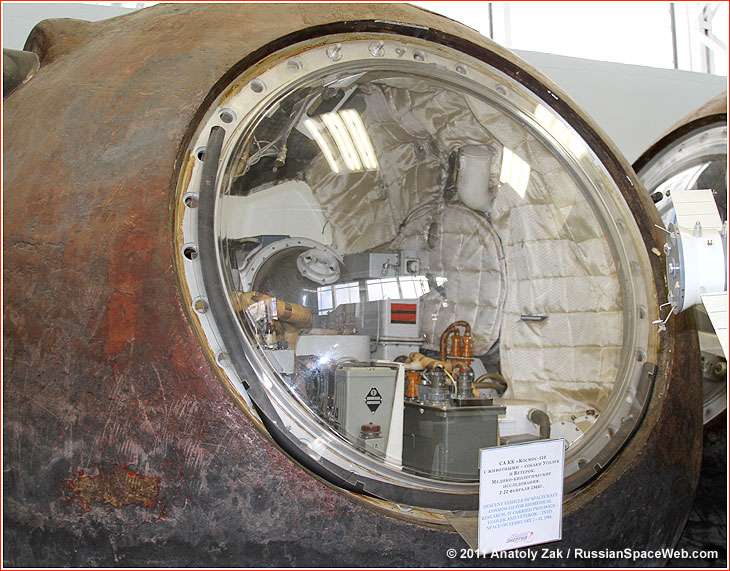
The actual Descent Module of the 3KV No. 5 spacecraft with a dog container inside.
Kosmos-110 mission at a glance:
Spacecraft designations
Voskhod-3, 3KV No. 5, Kosmos-110
Launch vehicle
Launch date
1966 Feb. 22, 23:09 Moscow Time
Launch site
Landing date
1966 March 16
Mission
Unpiloted mission to validate 20-day piloted flights
Spacecraft mass
5,600 kilograms
Descent Module mass
3,000 kilograms
Mission duration
21 day 18 hours 51 minutes, 330 orbits
Crew
No crew (two dogs: Ugolyok and Veterok)
From the publisher: Pace of our development depends primarily on the level of support from our readers!
Voskhod 3KV No. 5 program
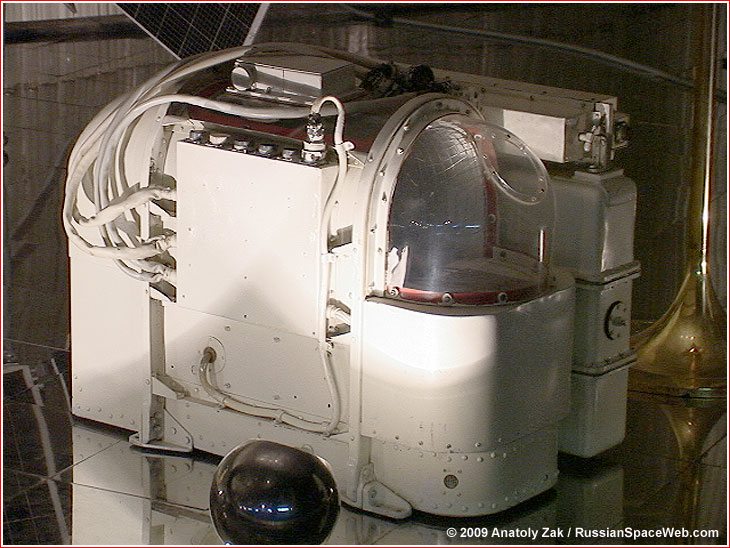
Container for dogs used aboard the 3KV (Voskhod) spacecraft.
For the fifth launch of the Voskhod spacecraft, Soviet scientists selected two dogs, named Ugolyok (Little coal) and Veterok (Little wind), out of around of a hundred stray dogs. Dressed in special costumes, they were to be housed in metal and plexiglas containers, whose designed likely derived from the cabins used in the early Vostok missions. The containers had a forced air circulation and the pneumatic food supply system, which was connected directly to the dogs’ stomachs. It was programmed to deliver 0.5 liter of liquid concentrate each day to each animal.
Every 1.5 hours, the container was programmed to be flashed with air for half a minute for waste removal.
The top wall of the container had interfaces for sensors and probes.
In addition to the dogs, the 3KV No. 5 spacecraft was designed to carry a number of other animals and biological organisms, including bacteria, plant seeds and yeast.
During the flight, gathered medical data was to be transmitted to ground stations via telemetry radio channels and recorded onboard by a pair of “loop oscilloscopes.” The telemetry and ground systems were set to receive electrocardiograms, seismo-cardiograms, sphygmograms, arterial pressure measurements, pneumagrams and intestinal peristalsis measurements in the dogs. In addition, the Signal telemetry system was designed to record the frequency of the heart contractions.
The recording oscilloscopes were programmed to be activated simultaneously. One of them was to operate at high speed in five-minute intervals, while another would run slower but in 25-minute sessions. The control of medical equipment inside the spacecraft was to be performed by a special avionics unit activated by an onboard programming device.
The planners considered a mission lasting from 15 to 30 days but eventually settled for a 22-day duration, which was primarily determined by the limits of the onboard power batteries.
Alongside the animal containers, the capsule also carried a self-destruct mechanism, known by the Russian abbreviation APO (from Avtomatichesky Podryv Obyekta), which would be used only in case of a failed reentry or a descent to Earth beyond the Soviet-controlled territory. (1138)
Scientific wrangling
The experiments aboard 3KV No. 5 were a part of the three-flight science program (covering Missions from No. 5 to No. 7), including two piloted flights with two cosmonauts onboard.
The scientific program for Flight No. 5 was designed at the Institute of Space Biology and Medicine within the Soviet Health Ministry, MZ. The Inter-agency Commission on Support of Space Flight, (also associated with the MZ ministry) approved it in March 1965.
However, the subsequent review of the program by the Soviet Academy of Sciences, led by Mstislav Keldysh, which had its own Medico-Biological Section within the Inter-Agency Scientific and Technical Council, MNTS, concluded that the proposed science program had “a declarative nature, complicating its assessment due to the absence of analysis into the reliability of the planned experiments and no references to the available instruments for these studies.”
MNTS said that the biological research program proposed for Voskhod missions had focused primarily on neurohumoral regulation, blood circulation, vegetative and somatic functions of dogs and other animals in weightlessness. Experiments with humans were mostly limited to assessing the effectiveness of pilots’ control functions and the conduct of science experiments. The research into blood circulation, metabolism and related processes was proposed only in general terms and could not be adequately assessed, according to the MNTS.
The commission proposed a new revision of the multi-flight science program, which would incorporate a complete list of scientific payloads and the description of their flight readiness.
On April 16, 1965, MNTS sent its proposals for amendments to the program to the health ministry, but its Deputy Minister Avetik Burnazyan apparently ignored them, while in his accompanying letter to the March 1965 plan, he claimed that the recommendations of the group had been taken into account, according to MNTS. (1135)
The complaint probably referred to an April 29 letter to Keldysh, where Burnazyan did say that the findings from MNTS were incorporated, but more importantly, he listed industry heavyweights who signed off on the program, including not just Sergei Korolev, the head of the OKB-1 design bureau, but also top scientific experts in the field at the Academy, among them Norair Sisakyan, the Chief Scientific Secretary of the Academy of Sciences; Vladimir Chernigovsky, the Director of the Physiology Institute; Ezras Asratyan, the Director of the Institute for Higher Nervous Activity and Neuro-Physiology; and last but no least, Major General Aleksandr Babiychuk, the Chief of the Air Force Medical Service. Babiuchuk endorsed the document on March 17, 1965, and Korolev did the same a day later.
In regards to the first mission — Voskhod 3KV No. 5 — the document said that “the studies were aiming for gathering data on the neurohumoral regulation of the blood stream in the animals and the testing of several methods which would be used during the research aboard Voskhod No. 7.
The Vehicle No. 5 was to carry two dogs with a mass from seven to eight kilograms each.
In particular, one dog was to have a probe embedded into its arterial channel, which would register the dog’s arterial pressure and provide automated blood sampling for clinical and biochemical analysis. The automated device was also designed to inject drugs into the dog’s system for triggering reaction of tissue and vessel receptors. The arterial pressure was to be recorded in a pre-programmed sequence during the stimulation of intestinal receptors and of the carotid sinus area.
In addition, special sensors were to register key physiological parameters, including cardiac measurements, to provide understanding of the phased sequence of the heart cycle.
The mission was also expected to study the impact of space radiation on biological objects by measuring the total dosage of radiation during the flight, through mapping the radiation dosage in the compartments, by measuring the dosage received by the animals and through observing the physiological reactions of the animals to radiation, depending on the duration of the flight and the absorbed dosage.
Science equipment aboard Voskhod 3KV No. 5:
1
Dogs
2 x 8 kilograms
–
–
–
2
Dog container and the ASU toilet
2 x 20 kilograms
–
–
–
3
Food supply pneumatic and blood sampling system
15 kilograms
54 watts
0.01 hours
0.0005 kilowatts per hour
4
Food supply
25 kilograms
–
–
–
5
Converter and amplifier unit
8 kilograms
16 watts
67.5 hours
1.1 kilowatts per hour
6
Onboard recorders (2)
2 x 6 kilograms
2 x 120 watts
12.5 – 2.5 hours
1.8 kilowatts per hour
7
Sensors and dog clothing
4 kilograms
–
–
–
8
Programming device
3.5 kilograms
3 watts
2.5 hours
0.075 kilowatts per hour
9
Radio-biological equipment
3 kilograms
–
–
–
TOTAL
126 kilograms
~3 kilowatts per hour
Launch and landing
The 3KV No. 5 spacecraft was launched on Feb. 22, 1966, from Site 31 in Tyuratam. Highly unusually for the piloted program, the payload was inserted into a highly elliptical orbit, with an apogee reaching 904 kilometers, a perigee of 187 kilometers and an inclination 51.9 degrees toward the Equator.
The mission, publicly announced as Kosmos-110 to mask its connection to the previous Voskhod missions and to complicate speculations about future Soviet plans in space, remained in orbit until March 16, 1966,
During the braking maneuver with the TDU propulsion system for the return to Earth, mission control recorded excessive deviations of the vehicle along the roll axis, but the ball-shaped Descent Module still reentered the atmosphere, safely delivering Ugolyok and Veterok back to Earth.
The longest biological research mission to date, Kosmos-110 successfully validated the operation of the life support and all other systems aboard Voskhod for a three-week flight. (52)
Still, the long flight took a heavy toll on the dogs, who looked skinny and exhausted with shreds of fur apparently battered and thinned by space radiation. For the first three days after the flight, they were mostly laying down and clearly suffering from dehydration, but both recovered to full health after several weeks. They were later reported living normal lives at the space biology institute and producing healthy offspring.