
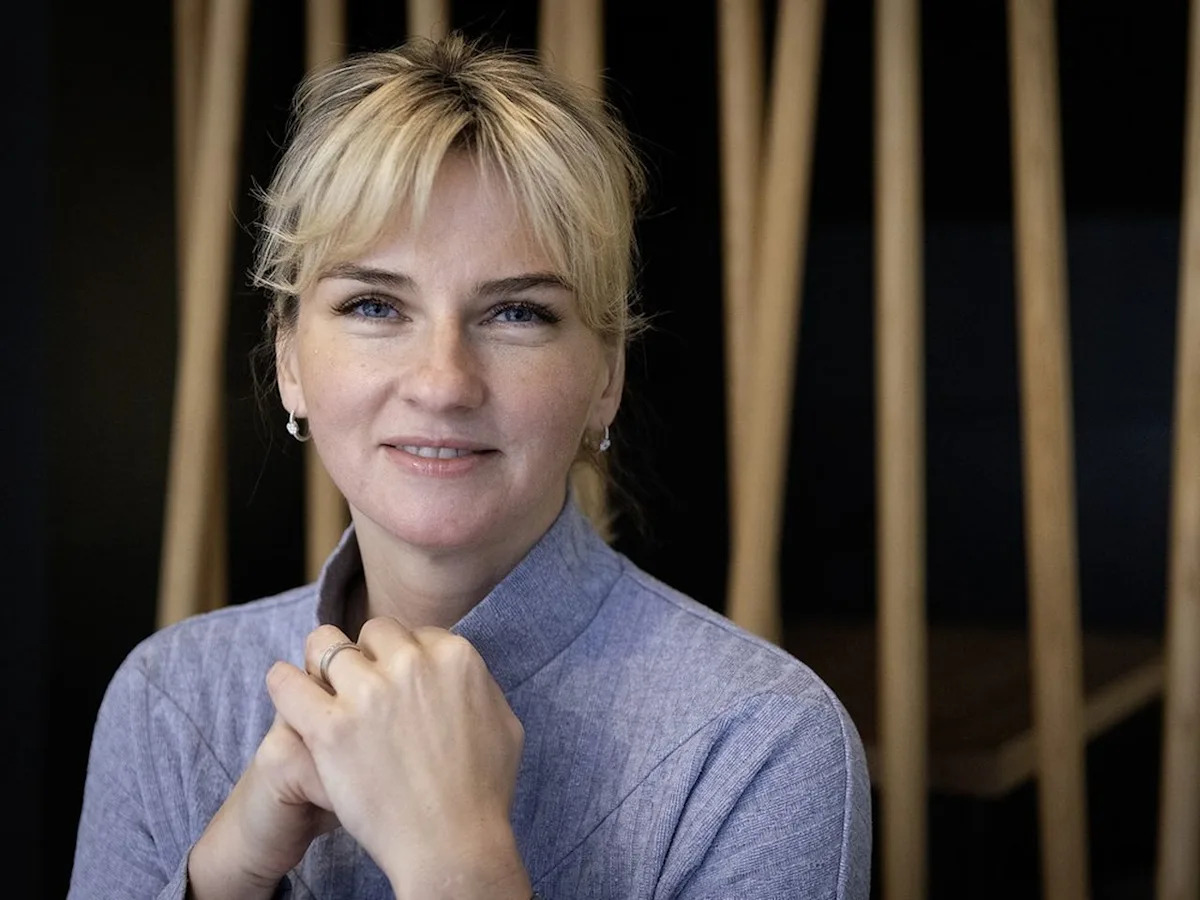
The last morning Victoria Nosenko was in her homeland of Ukraine, she woke up to the sound of air sirens at 5 a.m. on the day Russia launched a full-scale attack.
“We understood that it was war,” she said.
She frantically packed up belongings before hauling her two young sons and mother by car to her sister’s home in Slovakia. It took 24 hours to drive from Kyiv to Bratislava, with planes flying overhead.
“It was really bombing everywhere,” Nosenko said of the difficult escape. “You just drive and you just need to choose the road that is safer.”
She would spend the next few months at her sister’s home, where she considered her next step. With two master’s degrees (in accounting and an MBA), she applied for jobs and received offers from all over the world; she chose Montreal.
Before Feb. 24, 2022, she said, their life in Kyiv had been perfect. Under Russia’s attacks, her workplace was bombed and the new house she was supposed to move to in March 2022 was in a neighbourhood that was also destroyed.
Nosenko, 42, considers herself lucky as the grim fourth anniversary of the Russian invasion approaches. She not only escaped, but she moved to Montreal in June 2022. She is one of about 300,000 Ukrainians displaced by war who were welcomed by Canada under emergency measures known as Canada-Ukraine Authorization for Emergency Travel (CUAET).
While she is grateful for the help she received, especially from one local family that helped her secure an apartment for her family, the first year wasn’t easy. Her children didn’t speak English or French, and it was hard to adjust to life away from Ukraine, where her father and two sisters remain.
Now, her two sons are thriving. They have immersed themselves in Montreal, attending French-language public schools and taking part in a variety of activities, including basketball, piano lessons and Ukrainian classes. Her mother helps her care for her boys.
Nosenko works a minimum of 60 hours per week at her two jobs in operations management and massage therapy. In her spare time, she has pored over books to learn French — and has taken both government and private classes to improve her proficiency in hopes of permanently staying in Montreal.
She loves the city, saying its hospitality, architecture and many cultures remind her of Kyiv.
“I would fight for this because I like this province.”
Nosenko is far from the only displaced Ukrainian who has since built a life here. Michael Shwec, president of the Quebec provincial council of the Ukrainian Canadian Congress, said that after four years and with no end in sight for the war, what Ukrainians need is a pathway to permanent residency. Of the 300,000 Ukrainians welcomed to Canada, about 10 per cent came to Quebec, he said, as he lauded the country and province’s benevolence.
He estimates about 15,000 displaced Ukrainians (based on data from the issuing of medical insurance cards) remain in the province. Like Nosenko, he noted many have laid down roots here, found jobs and had babies.
While there will be some who hope to go back, others will want to stay — or don’t have a home to return to “because their towns have been completely destroyed,” Shwec said.
That is the case for Nosenko, who said while Ukraine will always be home, she can’t risk her sons’ lives by returning. Even if the war ends, Russia is too volatile.
“I want to raise them in a safe environment, and I found Canada is super safe,” she said.
Ukrainians who came to Canada under CUAET have until the end of March to apply to renew open work permits, according to Shwec.
“The problem is: Will you qualify to stay permanently? So it’s the uncertainty that is extremely difficult to live with,” Shwec said.
As Nosenko builds a life here, she continues to financially help a family in Ukraine and also volunteers in Montreal. After she was welcomed with open arms, she desperately wants to give back.
“We would like to show people that we are here. We are here for you and if you need our help, we are here,” she said.
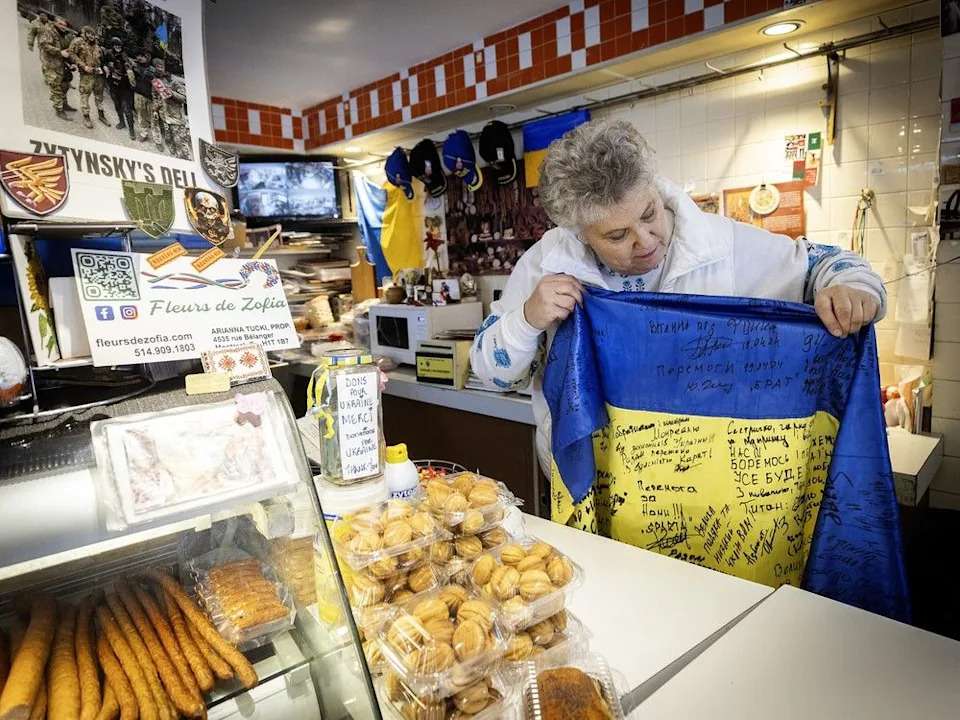
Angel Zytynsky, a third-generation Ukrainian Canadian, displays a Ukrainian flag signed by soldiers at her Montreal deli on Thursday, Feb. 19, 2026.
‘They feel at home’
Angel Zytynsky, a third-generation Ukrainian Canadian, has found her own ways to help newcomers in Montreal and her grandparents’ homeland over the past four years.
She runs her family’s long-standing deli nestled in the heart of the diaspora’s community on Beaubien St. It offers all kinds of Eastern European delicacies, ranging from hearty borscht to pierogies.
The store is also filled with Ukrainian flags and family photos, spanning generations. Zytynsky’s grandparents all emigrated from Ukraine in the early 20th century, with the deli opening in 1922.
Standing behind the counter and wearing a white sweater adorned with blue flowers, Zytynsky switched effortlessly from English to French to Ukrainian as customers streamed in to place orders on a mild afternoon in February. Since the invasion, people from all backgrounds have stopped by to show their support, she said.
Canadian and U.S. currency, and even a euro, is stuffed into the tip jar. Behind the counter, she explained every tip she has received since the invasion began has gone to war-torn Ukraine. She has donated thousands of dollars.
When asked if she thought the attacks would last this long, she had a one-word response: “Never.”
Aside from collecting money for relief efforts, Zytynsky has also hired Ukrainians who fled the war. One of them, a woman named Oksana, who recently moved from Kyiv to Montreal, flourished behind the meat counter during the busy holiday stretch.
But it isn’t only Zytynsky — her adult children have also stepped up and helped Ukrainians find employment. One of her sons recently hired two men, she said.
“It has rubbed off on my kids to help, too,” she said.
The deli has shelves and freezers stocked with all kinds of goods: cabbage soup, pickled vegetables and jams, to name a few. And when newcomers ask Zytynsky for a certain product that she doesn’t have? She finds a way to get it.
“That’s how I support them,” she said. “And yeah, they feel at home.”
Helen Revko, a regular at the deli, said her parents emigrated from Ukraine with one wood suitcase to start a life in Canada, where she was born. She admits she doesn’t see the war ending soon.
“It’s sad, but I don’t see anything good coming out of it,” she said.
Revko believes Russian President Vladimir Putin will always want more.
“Even if they (Ukraine) give something, Ukraine is what Putin wants. It will never be enough.”
All Zytynsky wants, like many in the city’s Ukrainian community, is for Russia to end its invasion. She said one of her customers, a woman, went to visit family in Ukraine last fall, and described hearing air-raid sirens warning of attacks. The woman is trying to find a way to bring her mother to the safety of Montreal.
“I’d like it to stop because innocent people are dying,” Zytynsky said.
For his part, Shwec put it bluntly: “Ukraine wants peace. Russia wants Ukraine.
“If Russia stops fighting tomorrow, there is no more war. The war is over. If Ukraine stops fighting, there is no Ukraine.”
Ukrainians have shown incredible resilience, but many households are currently in a “very, very tough situation,” he added.
“We know that Russia has really bombarded infrastructure like never before. People have no electricity, no hot water, no warmth in their houses,” Shwec said.
After being forced to flee, Nosenko prays for the war to end. Even if her family is eventually allowed to permanently stay in Montreal, she said she will continue to help Ukraine in any way she can.
“We will take a very active part to rebuild Ukraine,” she said.
Related