
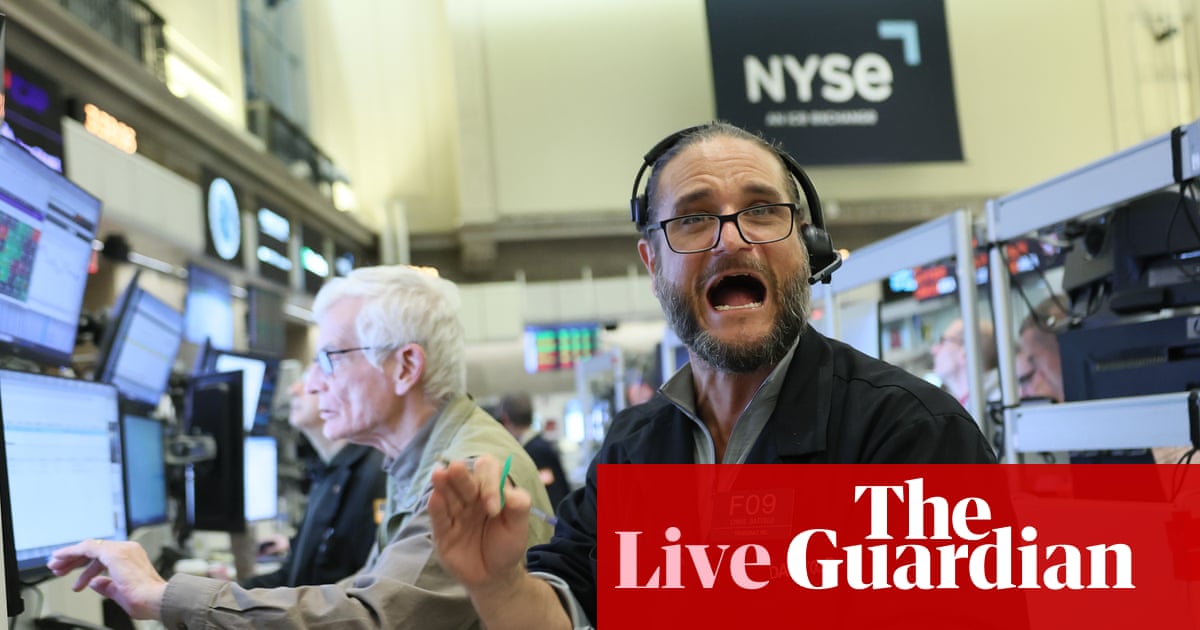
Trump threatens ‘more powerful and obnoxious’ tariffs
Donald Trump has declared that he can use tariffs in a ‘much more powerful and obnoxious way’ than he has thus far.
Posting on his Truth Social network, the US president again attacked the supreme court for ruling against his sweeping global tariffs last Friday – calling them ‘incompetent’.
He also claims the justices have ‘‘accidentally and unwittingly’ expanded his presidential powers on tariffs.
Trump writes:
double quotation markThe supreme court (will be using lower case letters for a while based on a complete lack of respect!*) of the United States accidentally and unwittingly gave me, as President of the United States, far more powers and strength than I had prior to their ridiculous, dumb, and very internationally divisive ruling.
For one thing, I can use Licenses to do absolutely “terrible” things to foreign countries, especially those countries that have been RIPPING US OFF for many decades, but incomprehensibly, according to the ruling, can’t charge them a License fee – BUT ALL LICENSES CHARGE FEES, why can’t the United States do so? You do a license to get a fee! The opinion doesn’t explain that, but I know the answer! The court has also approved all other Tariffs, of which there are many, and they can all be used in a much more powerful and obnoxious way, with legal certainty, than the Tariffs as initially used.
Our incompetent supreme court did a great job for the wrong people, and for that they should be ashamed of themselves (but not the Great Three!).
[That’s a reference to the minority of three justices who backed Trump in last week’s ruling].
* – or perhaps he’s now following the Guardian style guide
Updated at 08.16 EST
Key events
Show key events only
Please turn on JavaScript to use this feature
Here’s Joe Mazzola, head trading & derivatives strategist at Charles Schwab, on today’s Wall Street losses:
double quotation mark“Tariff uncertainty reigned this morning, pushing stocks to early losses and raising volatility on Wall Street.
Investors kept buzzing over the Supreme Court’s 6-3 decision Friday to overturn President Trump’s trade barriers, which threw world trade into confusion and raised questions about the durability of trade deals struck under auspices of the tariff regime.”
ShareUS told in G7 trade meeting to treat Europe fairly, France says
G7 countries have urged the US to ensure they give European countries fair treatment, following the supreme court ruling on tariffs on Friday, France’s trade ministry has revealed.
Afterr hosting an online meeting of G7 trade representatives today, an official from France’s trade minister’s office says:
double quotation mark“The Europeans must be treated fairly as partners and companies need visibility.”
The Russell 2000 index, which tracks two thousand small US company stocks, has dropped by 1.8%.
BritishAmerican Business (BAB), the transatlantic trade organization, is concerned that UK businesses will be hit by higher tariffs once Trump’s new global tariff of 15% kicks in tomorrow.
BritishAmerican Business CEO Duncan Edwards says:
double quotation mark“The new 15 per cent tariff on imports into the US, imposed under section 122 of the 1974 Trade Act means an effective 50 per cent increase in the tariff rate for most UK exporters to the USA which will come into effect tomorrow.
“This is clearly disappointing news and begs important questions which the UK team will need to raise with their opposite numbers and for which businesses will be hoping for answers.
“First, will the UK be granted a ‘discounted’ 10 per cent tariff under this new Executive Order in line with the Economic Prosperity Deal? Second, will UK exporters be able to claim back tariffs that have been previously paid and how will that process work?
And third, what will happen when the 150 day period allowed by the Act expires?
“It seems to us that the answer to the third point now lies with Congress which will have to decide whether the trade policies promised by this administration during the election become enshrined in law. Given the narrow margins in both houses of Congress a definitive answer looks unlikely, so business would be wise to expect continued uncertainty.”
ShareAvatrade: Tariff changes have made markets wobbly
Kate Leaman, chief market analyst at AvaTrade, says:
double quotation mark“The Supreme Court’s decision last week to block President Trump’s big emergency tariffs gave markets a quick lift, but his fast follow-up, has markets wobbly again today.
“Trump bumped this from a 10% blanket tariff, skipping some energy and minerals but nailing most imports. It’s spooked the EU into pausing deals and India into delays. US companies buying abroad, in tech, factories and gadgets, face fresh cost squeezes – though milder than before.
“This isn’t a permanent end to trade disputes. The workaround lasts a maximum of 150 days, after which Congress will weigh in. Investors should expect further ups and downs ahead.”
UK and US government bond prices are rising, as investors shun shares in favour of safer assets.
This has pushed down the interest rate, or yield, on UK 10-year bonds to their lowest level since December 2024.
It’s a small move – 10-year bond yields are down less three basis points (0.03 percentage points) to 4.327%, but the US government will certainly welcome this, as it shows the cost of issuing bonds and servicing the national debt has fallen.
Updated at 10.40 EST
DJIA down almost 700 points
The US stock market is sliding nearly as fast as a British Winter Olympic skeleton racer.
The Dow Jones industrial average is now down 681 points, or -1.37%, at 48,944 points, after an hour of trading, as traders react to the uncertainty over US tariffs and the threats emerging on Donald Trump’s Truth Social account.
Twenty one of the thirty stocks on the index are down, led by American Express (-6.2%), Salesforce (-5.3%) and Nike (4.9%).
Updated at 10.41 EST
Trump threatens higher tariffs on countries who ‘play games’ on deals
A clearly fuming Donald Trump has also posted that any country who chooses to ‘play games’ with the US will face even higher tariffs.
In another post on Truth Social, the president says:
double quotation markAny Country that wants to “play games” with the ridiculous supreme court decision, especially those that have “Ripped Off” the U.S.A. for years, and even decades, will be met with a much higher Tariff, and worse, than that which they just recently agreed to. BUYER BEWARE!!!
Thank you for your attention to this matter. President DONALD J. TRUMP.
It’s not clear which countries he has in mind, but earlier today the EU did postpone the ratification of its trade deal with the US, due the tariff uncertainty.
America’s factories ended 2025 on a weak note, despite Donald Trump’s efforts to revive the sector.
New orders for manufactured goods fell by 0.7% in December, the US Census Bureau has reported, following a 2.7% jump in November.
The December decrease was driven by weaker demand for transportation equipment; orders fell by 5.4% on the month.
The Dow Jones industrial average is continuing to drop.
After almost half an hour’s trading it has lost 321 points, or 0.65%, to 49,304 points.
Nike are among the top fallers, now down 3.8%, while business software group Salesforce has lost 4.5% and American Express is down 4.2%.
The S&P 500’s now down 0.4%.
Updated at 09.59 EST
The apparent winners from Donald Trump’s 15% tariff may not be celebrating for long.
Stephen Brown, deputy chief North America economist at Capital Economics explains:
double quotation markWhile the imposition of a new temporary baseline 15% tariff means the average US tariff rate has not fallen much, several economies – including Brazil, China and others in Asia – find themselves in much better positions.
This may not last, however, as the administration intends to start Section 301 investigations into potential unfair trade practices, which would enable Trump to hike tariffs again.
ShareEU postpones ratification on US trade deal Lisa O’Carroll
The European Parliament has just decided to pause the ratification process relating to the US trade deal struck with Donald Trump last July in Scotland.
A vote tomorrow morning in the Trade Committee has been postponed.
Anna Cavazzini, trade policy spokesperson for the Greens/EFA group, comments on this decision:
double quotation mark“Given the current enormous uncertainty, a vote would be unjustifiable. The new tariffs on EU exports are over 15 percent, thus violating the deal. At the same time, Trump continues to blithely announce arbitrary tariffs. This lack of trust prevents simply rubber-stamping the implementation of the US deal now.”
“The top priority must be finding a solution for the remaining 50% tariffs on steel, aluminum, and related products. The ball is now in the US’s court. Tariffs are extremely unpopular and have not led to the industrial jobs promised by Trump.”
ShareNike and Gap shares hit by tariffs
Shares in US importers are falling in early trading, as investors digest the impact of the new 15% global tariff annouced by Donald Trump on Saturday.
Sportswear firm Nike are among the top fallers, down 1.8%, while clothing and accessories retailer Gap are down 3%.
Wall Street has opened lower, as investors respond to Donald Trump’s new 15% tariff, and his threat of new ‘powerful and obnoxious’ ones too!
The Dow Jones industrial average, which tracks 30 large US companies, fell by 144 points or 0.3% at the start of trading, to 49,481 points.
The broader S&P 500, and the tech-focused Nasdaq, both dipped by a mere 0.07%.
ShareManufacturers seek urgent clarity over tariff situation
The confusion over whether the UK will face Trump’s new 15% tariff is particularly worrying for British manufacturers who have already sent goods to America.
Richard Rumbelow, director of international business at Make UK, says these firms ‘urgenty’ need clarity:
double quotation mark“Many UK exporters will be concerned at the further prospect of trade disruption to goods entering the US market. Stability, certainty and clarity are key cornerstones for global trade policy and for UK businesses who plan, invest and conduct trade with partners across the global economy, and particularly with customers in the United States. It’s now important UK exporters work with their US importers to maintain their trading relationships by working through customs guidance as it emerges
“Given many companies will have goods at sea clarity is now urgently required on how UK exports will be treated on arrival into the United States, with the imperative being to protect the benefits of the bi-lateral trade framework that was concluded with the United States last year. It is vital Government continues to seek gradual reductions in tariffs and other opportunities and seeks a strengthening of trade relations from the current position.”
Tom Knowles
Artificial intelligence is unlikely to affect UK unemployment rates in the long run, a policymaker at the Bank of England has suggested.
Alan Taylor, a member of the Monetary Policy Committee (MPC), which sets interest rates in the UK, said he can’t see AI creating mass unemployment for now.
At an event at Deutsche Bank in London, Taylor said:
double quotation mark“History is full of people saying ‘This new technology is going to lead to unemployment.’ And yet, over the course of history, unemployment has always returned to its normal level.”
“There are changes in the composition of the labour force but we haven’t yet seen that kind of structural shift, which is not to say it can’t happen, but we haven’t seen it yet.”
Taylor, who was one of four out of nine members of the MPC to vote for cutting interest rates this month, said the increase in youth unemployment, which rose to an 11-year high in January excluding Covid, was cyclical and unlikely to last long-term.
He said:
double quotation mark“It always goes up in cyclical ways. When the economy weakens and when unemployment is rising, usually youth unemployment rises faster. That’s true across the world. So for me, it’s mostly cyclical. I believe that as the economy normalises, that will start to normalise again.”.
Taylor reiterated his previous public comments that inflation is returning to the Bank’s 2% target faster than previously forecast, with wage growth also now slowing. “Things are normalising at a pretty healthy clip,” he said, suggesting he will vote to cut rates again at the MPC’s next meeting in March.
He said the MPC could make two to three more interest rate cuts to get the economy back to a normal level. But he expressed concern that services inflation had not declined as quickly as expected in recent months. Services inflation slowed to 4.4% in January from 4.5% previously, according to the latest data, well below the Bank’s forecast of 4.1%.
“I’m looking for services price inflation to continue to normalise along with wages as the year unfolds,” Taylor said.
Back in Europe, Germany’s stock market is still being weighed down by trade war uncertainty.
The DAX is down 0.4% so far today. Other markets are looking cheerier, though – Italy’s FTSE MIB has gained 1%.