
The following article is republished here with permission from Melanie Cheng (originally published 23-Feb-2026 as “Planning in the Downtown and Broadway Areas”). https://melaniecheng.ca/2026/02/23/vancouver-growth-classrooms-and-capacity/
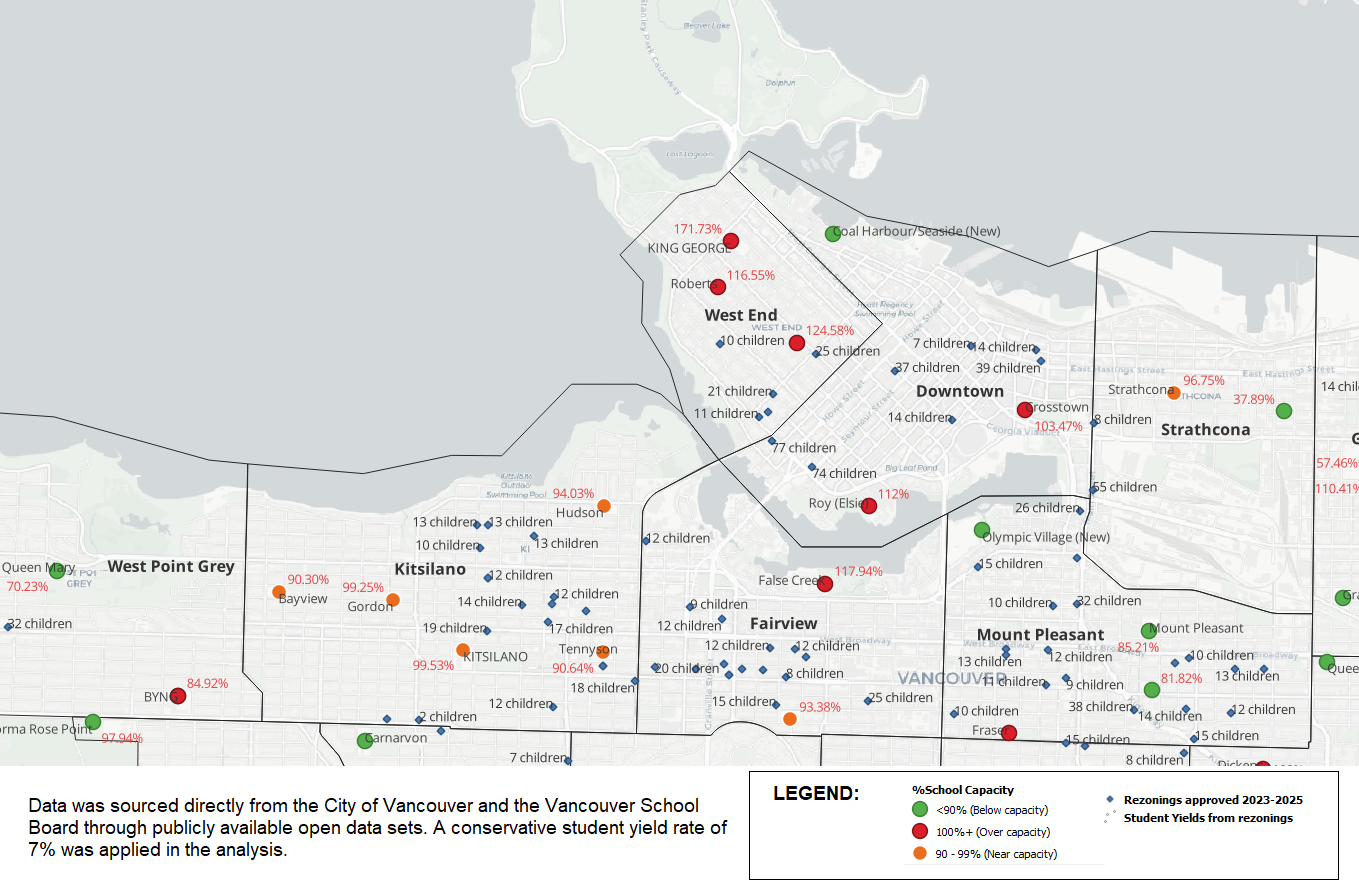
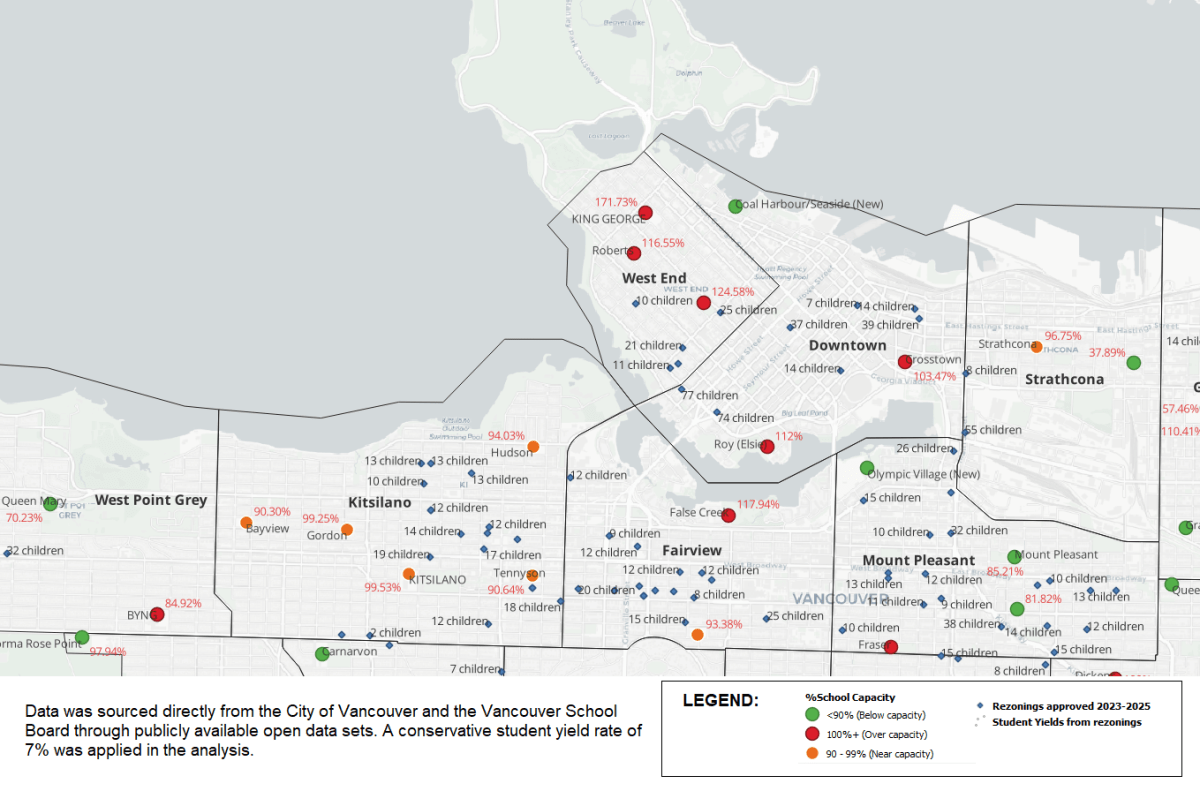
Above: Data Map prepared based on City of Vancouver rezoning data and VSB school data (click to expand)
Vancouver is entering a decade of accelerated residential growth.
Between 2023 and 2025 alone, 16,118 new residential units were approved in:
West End
Downtown
Kitsilano
Fairview
Mount Pleasant
Using a conservative 7% student yield rate (a rate commonly referenced in provincial school site acquisition planning) this translates to approximately:
1,128 additional school-aged children
The central question is straightforward:
Is school infrastructure expanding at the same pace as housing approvals?
Current Capacity Realities
1. West End
School utilization:
King George Secondary: 171.73%
Lord Roberts Elementary: 116.55%
West End elementary average: 124.58%
Rezonings approved (2023–2025):
1,206 units
Estimated 84 students
Schools in the West End are already operating significantly above capacity. Even before these additional 84 students are absorbed, the system is stretched.
2. Downtown
School utilization:
Crosstown: 103.47%
Elsie Roy: 112%
False Creek: 117.94%
Rezonings approved (2023–2025):
3,492 units
Estimated 244 students
Downtown schools are already over capacity. An additional 244 students will intensify strain unless permanent seats are created.
The new Coal Harbour (Seaside) school redistributes students, but it does not resolve structural shortage. Replacement funding for Roberts Annex remains uncertain, and projected costs exceeding $194 million (VSB Environmental Sustainability Plan 2026–2032, p. 35) raise feasibility concerns.
3. Fairview (Broadway Plan Area)
Rezonings approved (2023–2025):
3,117 units
Estimated 218 students
False Creek Elementary catchment currently sits at 117.94% utilization.
Broadway Plan intensification will concentrate growth further. Adding 200+ students into an already overheated catchment requires coordinated capital planning and not reactive boundary adjustments.
Long-term student projections should be embedded transparently within Broadway Plan implementation. School facility planning cannot be an afterthought or deflected between the City and the Vancouver School Board.
4. Kitsilano
Rezonings approved (2023-2025):
2,574 units
Estimated 180 students
Most elementary schools are currently operating between 90–99%.
Kitsilano Secondary sits at 99.53%.
An additional 150–200 students could push multiple schools into sustained overcapacity.
5. Mount Pleasant
Rezonings approved (2023-2025):
5,729 units
Estimated 401 students
Some elementary schools currently operate between 81–85%, and Olympic Village has temporary headroom.
However, Mount Pleasant is absorbing the largest share of projected student yield in this dataset.
More than 400 additional students will significantly narrow remaining capacity.
6. Secondary School Pressure
High school capacity is especially concerning:
King George Secondary: 171.73%
Kitsilano Secondary: 99.53%
If even one-third of the projected 1,128 additional students reach secondary level over time, that represents roughly 375 additional high school students.
There is currently no clearly articulated secondary expansion plan proportional to this scale of growth. While there is a capital plan for King George Secondary, there is no equivalent expansion plan for Kitsilano Secondary to accommodate density along the Broadway Corridor.
Recent boundary reviews conducted by the VSB have moved students geographically; however, they do not create new seats.
The Planning Gap
The numbers in the Downtown and Broadway are reveal a structural mismatch:
16,118 new residential units approved
1,128 estimated additional students
Multiple catchments already above 100%
Secondary schools at or near capacity
Once density is approved in built-out neighbourhoods, land acquisition becomes exponentially more difficult and expensive. Expansion options for other essential services like Strong Start Programs and child care narrows quickly when capacity is maxed out.
Access to public local school spaces directly affects housing affordability, retention of families in Vancouver and the stability of communities.
When families cannot secure stable access to nearby schools, migration patterns shift. Downtown demographic data already shows significant losses in early childhood cohorts.
Growth without coordinated school planning risks deepening this trend.
What Responsible Growth Requires
A coordinated approach should include:
Student yield modelling embedded in every major rezoning referral;
Public reporting of projected school impact alongside development approvals;
VSB capital planning sequenced with large-scale density approvals;
City–Province–VSB infrastructure alignment for the essentials of complete neighbourhoods.
Schools are not amenities. They are core civic infrastructure.
There needs to be transparent, coordinated and evidenced based planning for children and families across Vancouver to ensure access to safe and accessible school and child care facility space keeps pace with densification.
*****
Post navigation
Previous post on CityHallWatch:
When New Family Housing Comes Without Childcare: A Warning Sign (by Melanie Cheng) (3360-3384 Vanness Ave, in Joyce-Collingwood. Public Hearing Feb 17) – https://cityhallwatch.wordpress.com/2026/02/11/new-family-housing-no-childcare-warning-intracorp-vanness-cheng/