
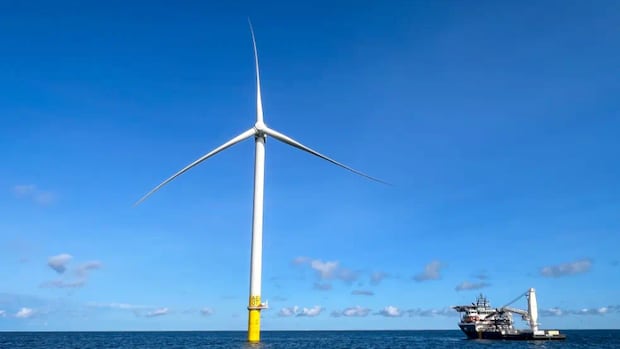
The U.S. president’s war on wind power just keeps coming.
“There are windmills all over the place, and they are losers,” Donald Trump announced to global leaders last month at the World Economic Forum in Davos, Switzerland.
“They’re a joke, they don’t work,” Trump told the United Nations General Assembly last September, doubling down on his declaration on Day 1 of his second term: “We’re not going to do the wind thing.”
His attacks on wind power have soured investors and builders in the U.S. offshore wind industry. But where Trump sees big “ugly” windmills, Canada sees opportunity.
“There’s a lot of eyes on Nova Scotia right now,” said the province’s premier, Tim Houston, who says offshore Atlantic Canada is one of the best locations in the world for large-scale wind power.
“The interest is through the roof,” Houston told CBC News.
It’s a bitter reality for the New England coast, which is battling Trump’s threats to gut wind power.
“I’m sad to say but Canada has a big opportunity because of the stain the Trump administration has left” on wind power, Rhode Island Sen. Sheldon Whitehouse recently told CBC News.
“Our loss will be Canada’s gain.”
 U.S. Sen. Sheldon Whitehouse, a Democrat from Rhode Island, is seen during a press conference on climate change in Washington, D.C., on Nov. 20, 2025. Whitehouse has criticized U.S. President Donald Trump’s antipathy to wind power. (Tom Brenner/Reuters)A project that promised 1,200 jobs
Rhode Island is the epicentre of Trump’s latest war on wind. In late December, the Department of the Interior imposed stop-work orders on five offshore wind projects along the Atlantic Coast, including Revolution Wind, 23 kilometres off the coast of Rhode Island and 85 per cent complete.
Orsted, a Danish energy giant, and Skyborn Renewables are developing the project, a 65-turbine wind farm to supply 704 megawatts of power to 350,000 homes in Rhode Island and Connecticut.
Revolution Wind promised 1,200 jobs, with many demanding specialized training to install giant turbine towers.
 Harry Antone, who is part of Climate Jobs Rhode Island, says workers were excited about the new offshore wind industry, which would provide long-term jobs constructing the windfarms and maintaining them. (Jill English/CBC)
“This industry was booming … there was a pipeline of work that was promised for decades,” said Harry Antone, of Climate Jobs Rhode Island, which is affiliated with the AFL-CIO, the country’s biggest federation of unions.
“This stop-work order was issued days before Christmas,” Antone said. “[The workers] feel betrayed. They feel like they’ve been punched in the gut.”
Elsewhere, a $300-million US refit turned the New London State Pier in Connecticut into an offshore wind staging hub. It’s stacked with massive, 266-metre-high turbine towers with blades 97 metres long, preparing for their transport out to the ocean.
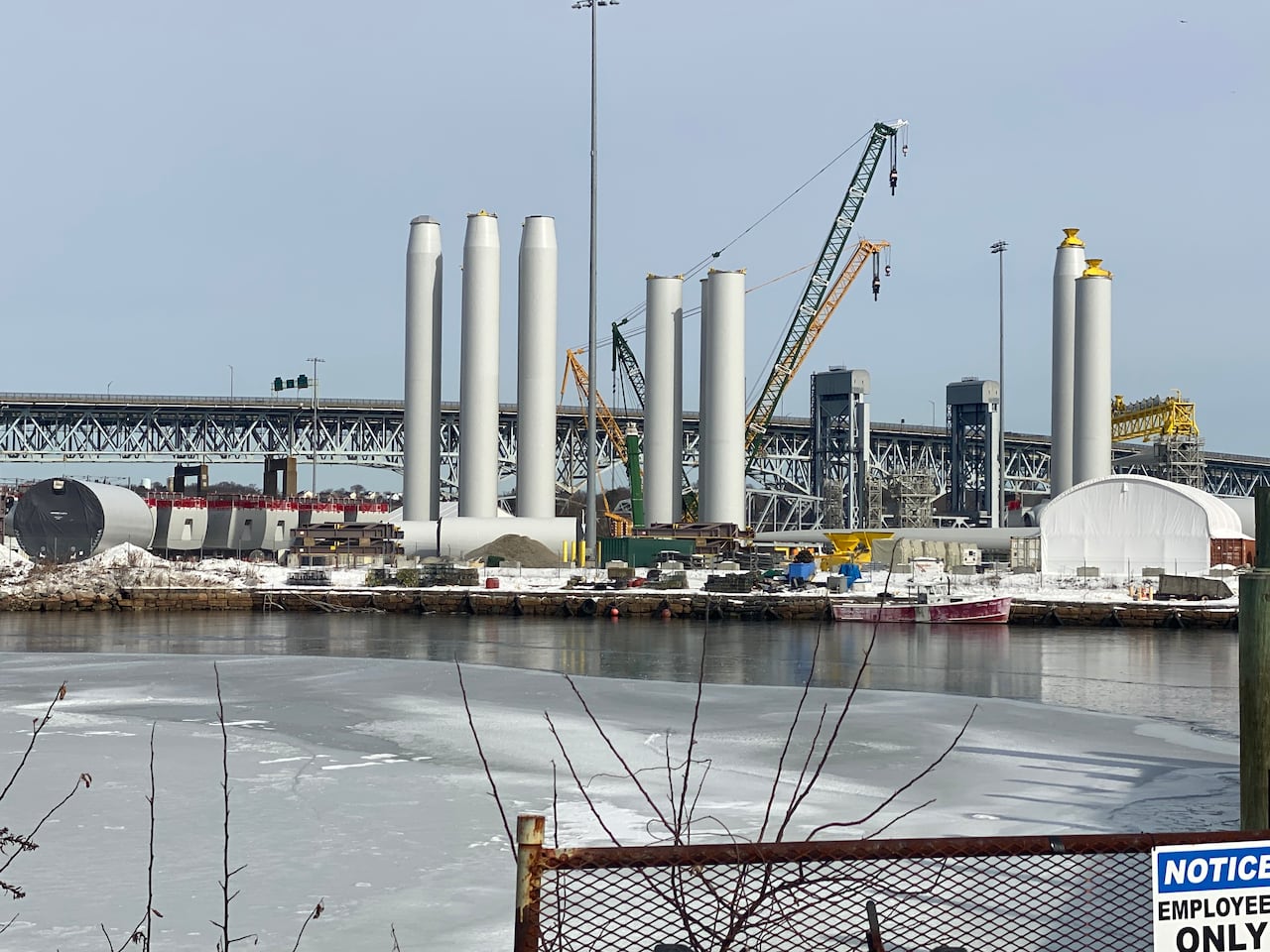 New London State Pier in Connecticut is a marshalling hub for offshore wind projects. Massive turbine towers stationed here will be transported offshore and become part of new wind farms. (Susan Ormiston/CBC)
“The money is already gone, the stuff’s here,” said Ian Kapura, a veteran construction worker who worked at the pier, in an interview with CBC. “Why are you going to stop it now?”
Kapura said it’s “just a power trip. [Trump is] just trying to use his muscle to get what he wants. Obviously, the administration is about oil and coal and gas.”
“His whole administration is staffed by stooges of the fossil fuel industry,” said Sen. Whitehouse, a Democrat. “With all of the funding that the fossil fuel industry has given to Trump, this is kind of payback.”
‘A completely bogus claim’
The Trump administration first tried to shut down Revolution Wind in August, then again in December, claiming it and four other projects posed national security risks identified by the Department of Defence, with no evidence of those risks.
WATCH | Trump’s hatred of wind power could benefit Canada: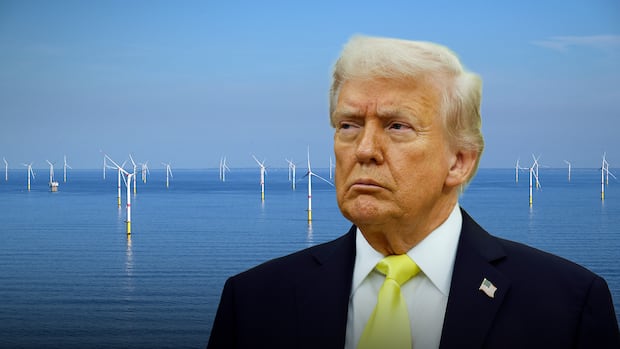
Trump sees big, ugly windmills. Canada sees opportunity
Donald Trump has been trying to gut the U.S. wind power industry, but as CBC News international climate correspondent Susan Ormiston explains, America’s loss could be Canada’s gain.
“That is a completely bogus claim,” said Kris Ohleth, director of the Special Initiative on Offshore Wind (SIOW), an independent organization for strategy in the sector.
Orsted says Revolution Wind passed an extensive national security review before final approval in 2023, when Joe Biden was president.
After the Department of the Interior suddenly issued the stop-work orders in December, the wind companies and several states challenged them in court. One by one, courts overturned all five orders, allowing work offshore to temporarily resume. But the main legal battle remains unresolved.
“What we have seen, in this country, whether it’s offshore wind or otherwise, is that litigation is Trump’s love language, and we have to learn to speak that language right back to him,” said Ohleth.
Work on Revolution Wind is now resuming, but the damage is long-term. Orsted has spent billions on two wind farms on the Atlantic coast, then paid out more than $100 million in legal fees and costs to suspend work on those projects, before getting them back on track.
All signals from the current administration suggest the battle is not over. Interior Secretary Doug Burgum recently told Bloomberg News the federal government will “absolutely” appeal.
Companies are taking note. In an earnings call this month, Orsted CEO Rasmus Errboe said “we have no expectations whatsoever to increase our exposure to offshore wind in the U.S.”
Wind power projects elsewhere
That’s why Whitehouse says big international investors and builders are looking for areas outside the U.S., to get around the “Trump mischief factor.”
Nine European countries committed in January to speed up wind power development in the North Sea, signing on to the Hamburg Delegation, which would add 100 gigawatts (GW) of new capacity to ensure energy independence, security and climate goals.
Canada is trying to tap some of that enthusiasm for wind power.
“People in the industry are looking around the world, and they’re seeing Nova Scotia, one of the best opportunities worldwide,” Premier Tim Houston told CBC News in an interview from Government House in Halifax.
“The resource is there. These are incredible wind speeds … [some] of the highest in the world,” Houston said.
He is pitching Wind West, the first large-scale offshore wind mega-project off the Atlantic Coast. But it will require “massive investments” — an estimated $40 billion to build and another $20 billion for transmission lines.
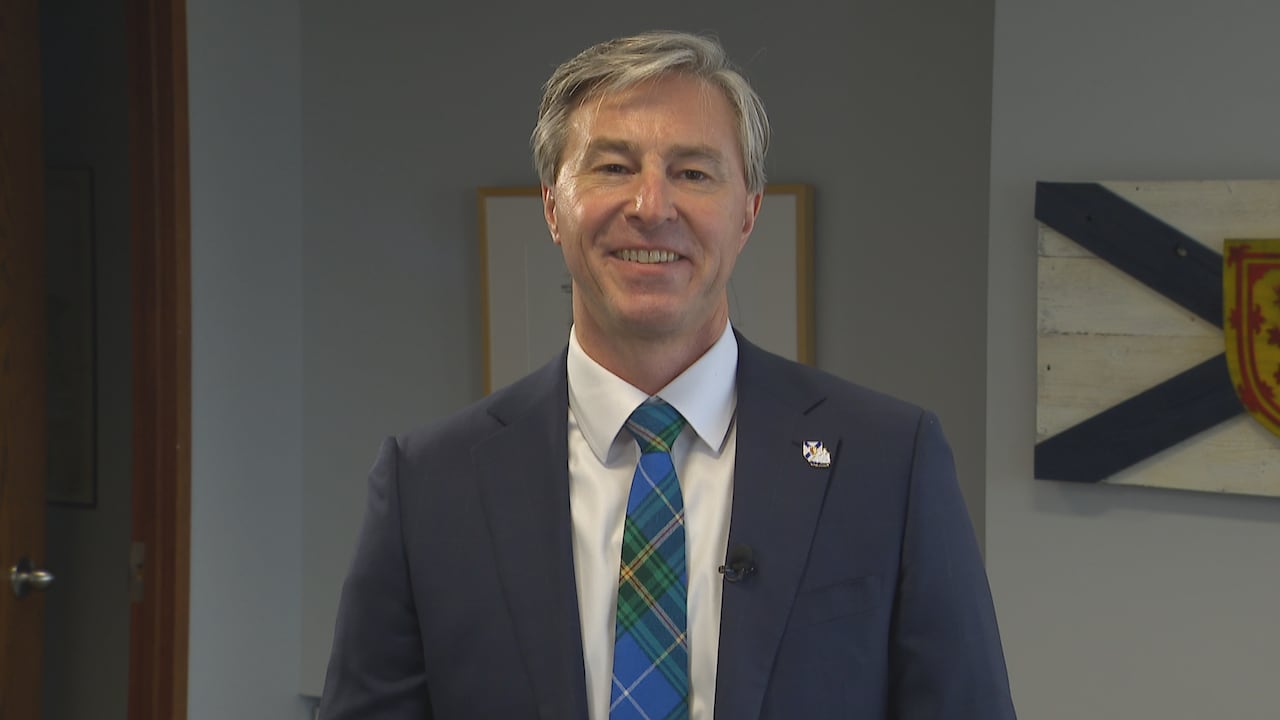 Nova Scotia Premier Tim Houston says ‘interest is through the roof’ on a proposed wind farm off the Atlantic coast, but plans are still in the early stages. (David Laughlin/CBC )
This month, the premier signed a memorandum of understanding with the state of Massachusetts to collaborate on wind power, before going on to New York as the keynote speaker at a major ocean tech conference.
The plan for the province’s Wind West is to initially generate five gigawatts of wind power and eventually get up to 40 gigawatts. The province is expected to call for bid proposals this year.
A recent engineering report by Stantec commissioned by the federal and provincial governments acknowledged that Atlantic Canada is one of the best places globally for wind power. But it also concluded the province was overstating its scale, saying wind power generation could range from nine to 16 gigawatts, not 40.
The Stantec report also suggested transmission could be “financially prohibitive.”
Houston says the province is talking to the federal government and industry for ways to finance the projects. In September, Prime Minister Mark Carney mentioned wind power in Atlantic Canada as a potential candidate of the Major Projects Office in the future.
 The offshore wind power project Revolution Wind promises to provide power to 350,000 homes in Rhode Island and Connecticut. (Jill English/CBC)
Back in New England, Orsted and Revolution Wind are expecting to deliver “first power” within weeks and are rushing to complete a second project, Sunrise Wind, which is slated to come online next year.
Despite resistance from the current U.S. government, there is hope, says Ohleth of the Special Initiative on Offshore Wind, that investment could return.
“While it’s a challenge and we have to manage the maniac in the White House in the interim, there are real benefits being seen in these states, and I think we will still see the development of clean [wind] power,” said Ohleth.