
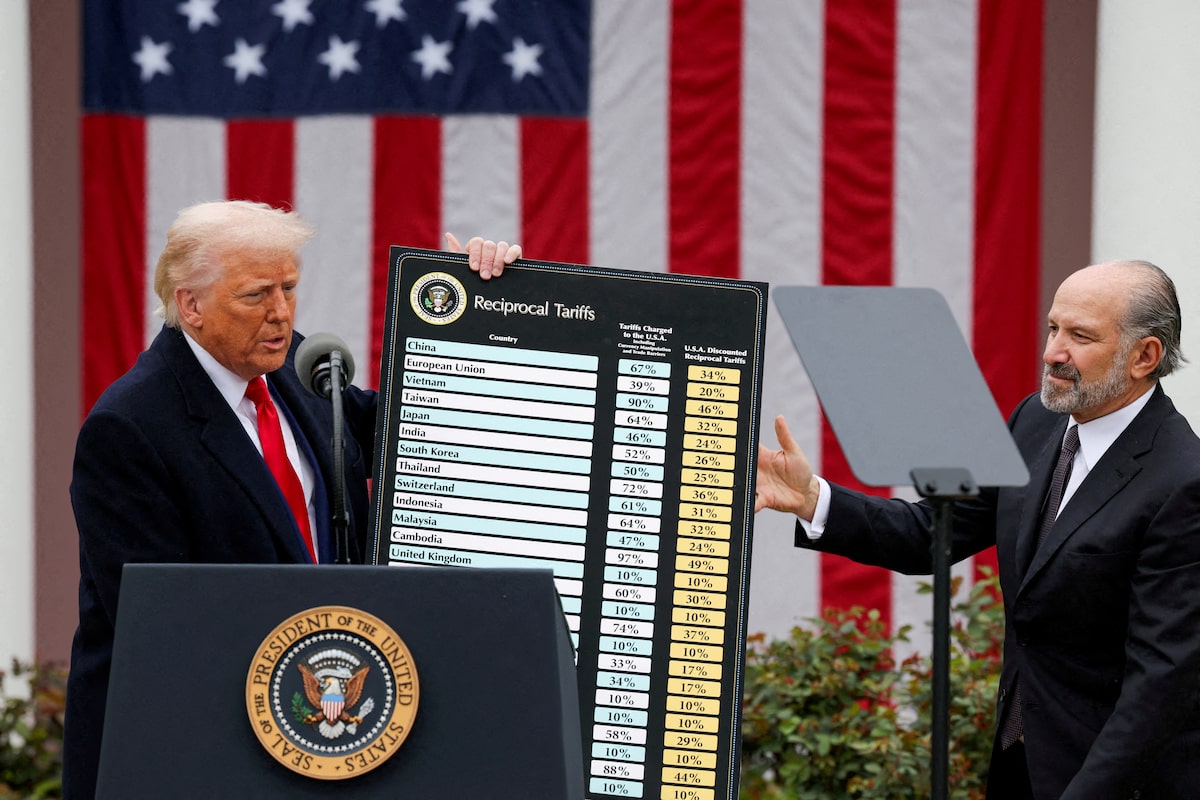
U.S. President Donald Trump holds a chart next to U.S. Secretary of Commerce Howard Lutnick during a tariff announcement at the White House on April 2, 2025.Carlos Barria/Reuters
Whether you’re playing cards, investing or coaching hockey, all you can do is come up with a strategy with the best odds, and trust the process. The process raises the likelihood of a win, but doesn’t guarantee it. Even you have stronger hand and play it well, you may not get a perfect outcome.
I’m talking about the Canada-U.S. gold medal hockey game last Sunday. I’m also talking about Canada’s trade dealings with the administration of U.S. President Donald Trump.
The game started in late 2024, will be played at a fever pitch in 2026, and could go into an uncertain overtime lasting until at least the end of the Trump administration.
Canada has to play according to our best strategy. Will it guarantee a win? No. Will it raise the odds? Yes.
Our best strategy is to keep on ragging the puck.
Trump warns against backing out of trade deals after Supreme Court ruling
The invalidation of one major category of Trump tariffs last week at the U.S. Supreme Court has left several American trading partners wondering why they were in such a hurry to agree to lopsided (and explicitly non-binding) “deals” with the Trump administration.
Last year, Britain accepted a 10-per-cent U.S. tariff on most exports, and promised to not retaliate. The Europeans swallowed a 15-per-cent tariff.
The ruling that Mr. Trump’s “Liberation Day” tariffs exceeded his legislative authority means that those taxes on imports, which once ranged from 10 to 50 per cent depending on the country, are now history.
Tariffs can only be imposed by the U.S. Congress, not by the President, except in instances where Congress grants that authority. The manner in which Mr. Trump used the 1977 International Emergency Economic Powers Act, or IEEPA, exceeded his authority.
On Friday, Mr. Trump announced that he’d use a different statute, section 122 of the Trade Act of 1974, to reintroduce a 10-per-cent tariff on most countries. On Saturday, he raised that to 15 per cent.
(Canada is largely exempt from these tariffs, as was the case with the IEEPA tariffs, because the White House continues to sort of respect the United States-Mexico-Canada Agreement. However, Canada is subject to sectoral tariffs on steel, aluminum, lumber, copper and some motor vehicles and parts.)
Why is Mr. Trump’s replacement tariff a blanket 15 per cent? Because that’s the maximum allowable under s. 122. In a further plot twist, tariffs under that law are temporary. They expire after 150 days.
What’s more, the White House’s use of s. 122 could be illegal, though it will take the courts months, or years, to answer that.
Mr. Trump’s tariff crusade is not over. It is instead entering a new and more uncertain phase.
We’ve gone from Tariff Man: Unbound to the sequel – Tariff Man II: Constrained & Furious.
The big winner from the invalidation of the IEEPA tariffs is China. Along with Brazil and India, its exports will face a lower average tariff than before, according to an analysis by the Switzerland-based Global Trade Alert. Europe, Britain, South Korea and Japan – which made quick concessions to get deals – are facing higher average tariffs than before.
European Parliament postpones vote on U.S. trade deal again after tariff upheaval
What did their knee-bending win them? Nothing.
The Trump tariff regime has been chaotic, unstable and uncertain. Some of its methods have been lawless; most have been unpopular with Americans. All its dealings have been faithless.
That’s why Ottawa has every reason to continue ragging the puck.
Keep a couple of things in mind.
The first is that ripping up the USMCA, and thereafter erecting a high tariff wall against Canada, would not be easy. Mr. Trump could face significant legal and congressional hurdles.
The second thing is that, though trade with the U.S. is a positive for Canada, even very high tariffs would have less of an impact than is widely assumed.
A study done in late 2024 by University of Calgary economist Trevor Tombe for the Canadian Chamber of Commerce estimated the impact of a 25-per-cent U.S. tariff on all Canadian exports. That’s a levy far higher than is in place now.
Under this extreme scenario, exports to the U.S. of Canadian oil and gas would drop by 60 per cent. Motor vehicle exports to the U.S. would fall by 39 per cent. Shipments of other transportation vehicles, pharmaceuticals, metals, chemicals and wood products would all fall by around 20 per cent.
However, that would knock just 1.8 per cent off Canada’s gross domestic product. If our country retaliated, GDP would decline by just 2.6 per cent.
That’s the estimated immediate impact. But Canadian trade patterns would quickly begin to adapt, and the economy would adjust. The long-term reduction in GDP would be notably less.
Free trade with the U.S. is a good thing, and a positive for our economy. We should want to preserve it. But we shouldn’t be too desperate to sell the farm.
We must recognize that, if necessary, the Canadian economy can survive and thrive in a future of less trade with the U.S. Remember, we were already one of the world’s richest economies in the mid-20th century, before free trade.
That knowledge should give us the confidence to face down the coming threats.