
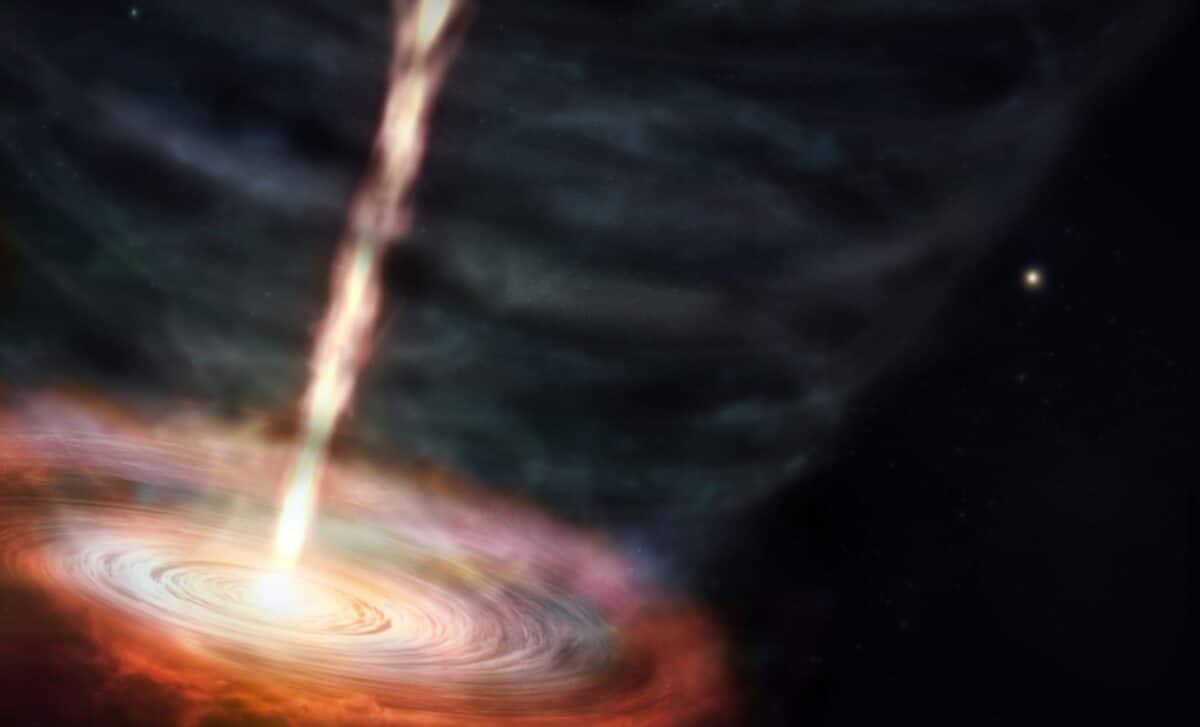
Astronomers have identified the most powerful and distant microwave laser, or maser, ever observed, originating from two colliding galaxies nearly 8 billion light-years from Earth. The signal, detected at 1667 megahertz, was so intense that researchers immediately recognized it as record-breaking.
The discovery centers on the galaxy H1429-0028, whose light is warped and magnified by a foreground galaxy acting as a gravitational lens. The system was observed using South Africa’s MeerKAT radio telescope array, initially as part of a search for molecular hydrogen-rich galaxies.
Masers are the microwave counterparts of lasers. While lasers emit coherent visible light, masers produce highly focused radiation at microwave frequencies. In rare cosmic environments, particularly in merging galaxies, natural conditions can replicate the same chain reaction seen in laboratory lasers.
A Serendipitous Laser Detection at 1667 Megahertz
The team, led by Roger Deane at the University of Pretoria, was not originally hunting for masers. According to a study, published in arXiv, the researchers were using the 64-dish MeerKAT array to search for galaxies rich in molecular hydrogen, which emits at a specific frequency.
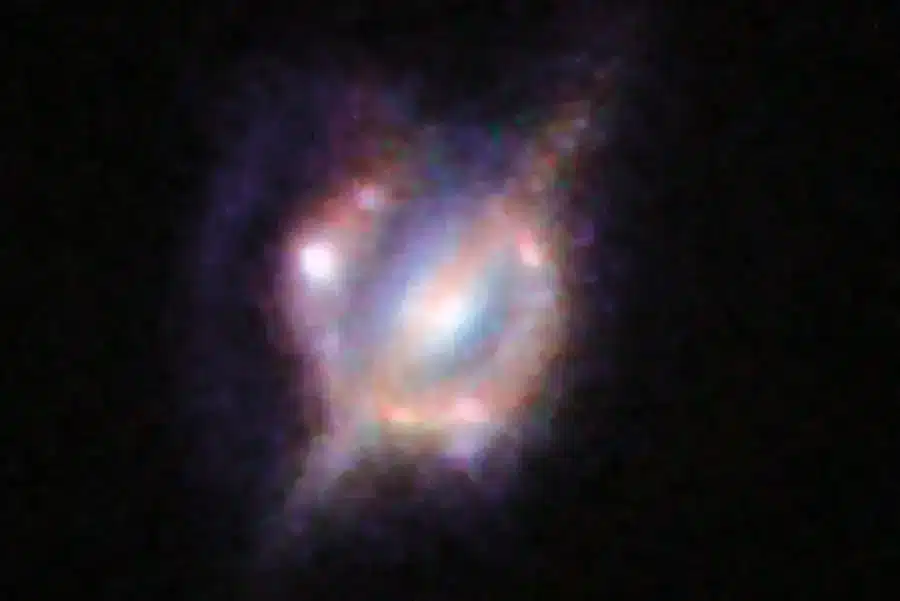 Composite image from Hubble and Keck II showing a foreground galaxy lensing H1429-0028 into a ring. Credit: NASA/ESA/ESO/W. M. Keck Observatory
When they turned the instrument toward H1429-0028, they checked the 1667 megahertz channel almost casually.
“We had a quick look at the 1667 megahertz [frequency], just to see whether it was even detectable, and there was this booming, huge [signal],” Deane said. “It was immediately the record. It was serendipitous.”
The signal’s strength marked it as the brightest and most distant maser ever observed. The background galaxy’s light is amplified by gravitational lensing, visible in combined imagery from Hubble and the Keck II telescope, where the foreground galaxy appears as a diagonal streak and the lensed galaxy forms a distorted ring.
How Galaxy Collisions Generate Powerful Masers
Masers require very specific physical conditions. When galaxies collide, their gas clouds are compressed, triggering intense star formation. Light from these newly formed stars travels through dust clouds, exciting hydroxyl ions, molecules made of hydrogen and oxygen, into higher energy states.
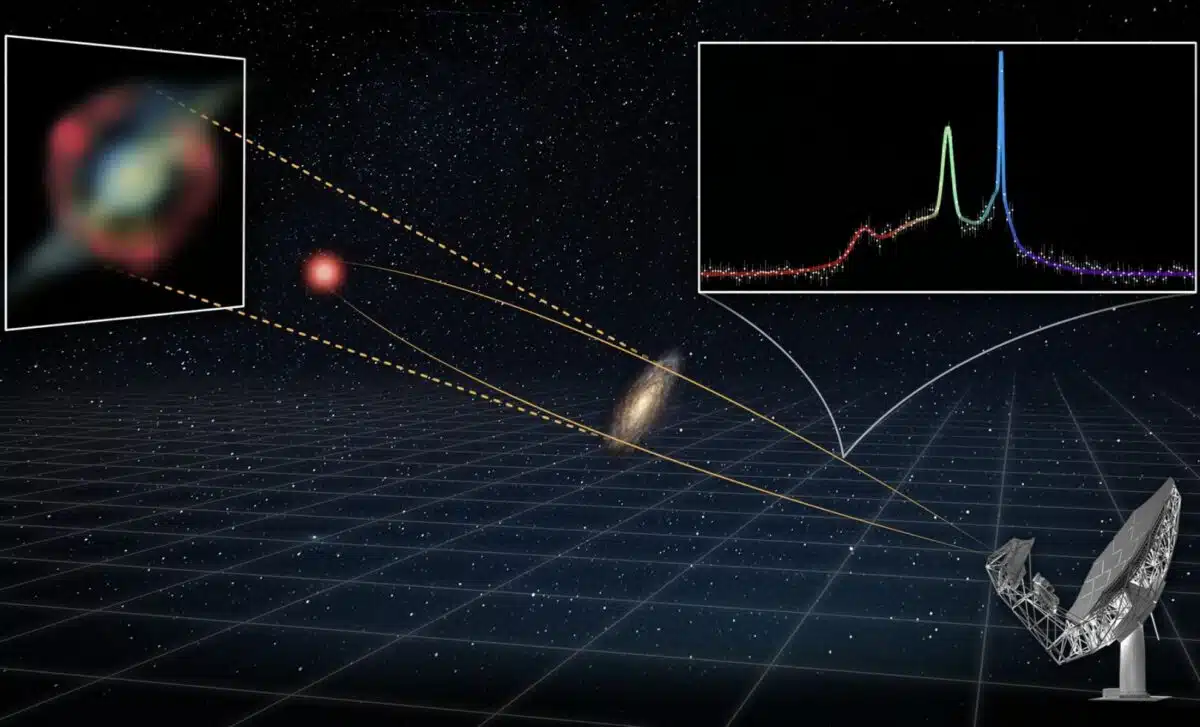 Illustration of the record-breaking cosmic microwave laser. Credit: South African Radio Astronomy Observatory (SARAO)
As the study’s authors explained, when these excited ions are struck by radio waves, such as those produced near a supermassive black hole, they can rapidly release energy in the form of coherent microwave radiation. This produces a highly concentrated beam at a single frequency.
Deane stated that the newly observed maser may qualify as a gigamaser, a category more powerful than previously known megamasers detected in closer galaxies. He noted that the luminosity is about 100,000 times that of a star, concentrated into a very small portion of the electromagnetic spectrum.
A Tool for Probing Galaxy Mergers in the Distant Universe
Because H1429-0028 lies nearly 8 billion light-years away, the detected radiation began its journey when the universe was much younger. Such distant masers offer insight into how galaxies merged and evolved over cosmic time.
Matt Jarvis of the University of Oxford emphasized that these signals arise only under precise conditions.
“[Masers] need very precise conditions,” he said. “You need this radio continuum emission and you need this infrared emission, which you only really get from dust heated around forming stars. In order to get these very specific physical conditions to get the maser in the first place, you need merging galaxies.”
Jarvis added that future observations with the Square Kilometre Array in South Africa, a more sensitive successor to MeerKAT, should allow astronomers to detect similar masers at even greater distances.