
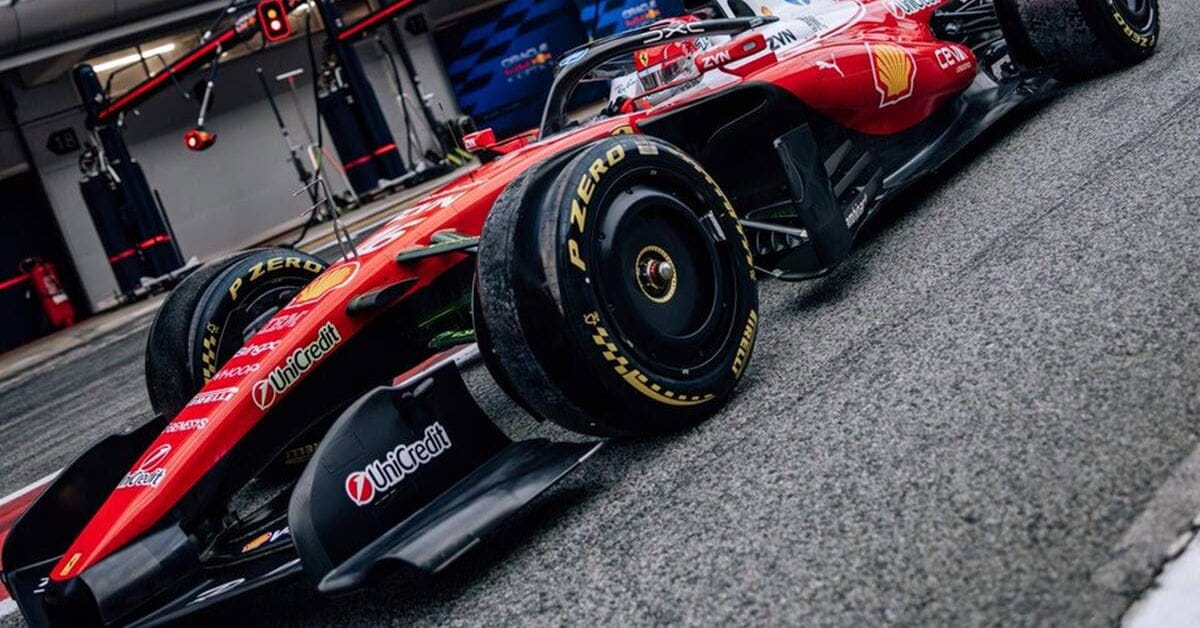
At the dawn of Formula 1’s new technical regulations for the 2026 season, Ferrari faced a clear and unprecedented design discontinuity that required a fundamental rethink of its car architecture. This was not merely an evolutionary step or a minor update of existing concepts; it represented a profound paradigm shift that forced the team to completely revisit aerodynamic philosophy, simulation methodologies, and the overall vehicle development strategy. The new regulatory framework significantly modifies car proportions, redefines the principles of downforce generation, and changes the way cars interact on track, compelling all teams, including Ferrari, to effectively start from scratch with entirely new conceptual foundations for their 2026 machines.
The technical scope and magnitude of Ferrari’s transformation were thoroughly explained by the team’s Chief Aerodynamicist Diego Tondi, who carefully outlined both the challenges and opportunities posed by the updated Formula 1 regulations. Diego Tondi made it clear that the changes are not superficial but structural, affecting every aspect of the car’s design and performance. The Italian aerodynamicist indicated that the upcoming Ferrari cars would appear more compact, with a significantly shorter wheelbase and a narrower track width compared to previous seasons. Additionally, the tires themselves would be narrower, while the front and rear wings would be redesigned with noticeably different dimensions and profiles to comply with the new aerodynamic regulations. According to Diego Tondi, active aerodynamics represents one of the most notable and transformative elements introduced in the latest technical framework.
He further highlighted that drivers would experience considerably higher top speeds along the straights, as well as a substantially different balance of aerodynamic load when transitioning between cornering and straight-line modes. In straight-line mode, both the front and rear wings are designed to rotate, dramatically reducing downforce while simultaneously lowering aerodynamic drag. This innovation is intended to facilitate overtaking, but it also requires precise energy management and careful coordination between drivers and engineers. In addition, Ferrari has moved away from the three-dimensional Venturi tunnels on the underfloor—a staple of past aerodynamic concepts—and is now implementing flatter, strictly regulated surfaces. This change reduces the car’s sensitivity to ride height and shifts the responsibility for generating downforce toward the wings and upper bodywork. Diego Tondi explained that these new aerodynamic rules are designed to enable closer racing by carefully managing the wake generated by the car ahead, which historically has been a limiting factor for overtaking.
From a purely aerodynamic standpoint, Diego Tondi emphasized that Ferrari essentially had to start from a blank sheet of paper. The Maranello team needed to reassess their correlation between computational fluid dynamics simulations, wind tunnel testing, and on-track performance. Every previous assumption and methodological choice had to be reviewed to ensure it remained valid under the new technical framework. This meant recalibrating models, validating every component, and analyzing whether the development philosophy employed in past seasons was still compatible with the 2026 rules. Diego Tondi described the challenge as enormous, yet he expressed strong enthusiasm and confidence in Ferrari’s ability to tackle this complex engineering puzzle.
The transformation begins with the car’s fundamental geometric proportions. Shortening the wheelbase influences braking stability, corner entry performance, and high-speed aerodynamic balance. Narrower track widths affect how the airflow interacts with the sides of the car, changing the quality of underfloor feeding and the behavior of the boundary layer across the floor. Compact wings require a reconsideration of load distribution between the front and rear axles, inevitably impacting mechanical balance and suspension behavior. All of these factors must be carefully optimized to ensure that Ferrari’s new car performs reliably and predictably under race conditions.
Perhaps the most significant conceptual evolution is represented by active aerodynamics. Coordinated wing rotation on the straights introduces a dynamic variable that alters the trade-off between downforce and drag in real time. This innovation is not merely about reducing aerodynamic resistance; it is about ensuring stability during the critical transitions between cornering configurations and straight-line performance. Achieving this requires an in-depth study of structural stiffness, aerodynamic kinematics, and the interaction between aerodynamic loads and the suspension system. Ferrari engineers must guarantee that the car remains predictable for Lewis Hamilton and Charles Leclerc while exploiting every potential advantage offered by the new regulations.
Equally transformative is the departure from three-dimensional Venturi underfloors, which in previous seasons were a primary source of downforce. By returning to flatter, regulated surfaces, the Ferrari engineers and technicians have decreased the potential downforce generated at the underfloor while redistributing aerodynamic responsibility to the wings and upper bodywork. This adjustment reduces the sensitivity of the car to ride height variations, simplifying some operational challenges, but simultaneously requires a complete redefinition of the car’s overall aerodynamic balance. For Lewis Hamilton, Charles Leclerc, and other competitors across the grid, this means adapting to cars with a different feel and balance throughout each lap, particularly in high-speed corners and braking zones.

The most delicate and critical phase of this transformation is methodological. Starting “from a blank sheet” means rigorously verifying the accuracy and reliability of CFD simulations and wind tunnel data, recalibrating correlation models, and validating each design decision in an entirely new regulatory context. With Formula 1 now operating under strict budget caps and tightly controlled limits on aerodynamic development hours through the ATR mechanism, precision in correlating simulated data with on-track performance has become a decisive factor in competitive advantage. Every gram of downforce, every adjustment to wing angle, and every refinement to the underfloor must be verified to ensure it produces the intended result without introducing unpredictable behavior. For Ferrari, this methodological rigor is essential to maintaining competitiveness in the 2026 season.
The technical challenge is therefore not limited to finding aerodynamic downforce; it also encompasses understanding whether the development philosophy that guided Ferrari’s success in prior seasons remains compatible with the new regulatory framework. In transitional periods of such pronounced discontinuity, previously established hierarchies on the grid are often redefined. For Ferrari, the 2026 regulations are not simply a technical challenge—they represent a comprehensive test of the aerodynamic department’s capacity to reinvent itself, combining rigorous methodology, precise correlation of data, and a clear strategic vision to maintain and enhance competitiveness. The team’s approach ensures that both Lewis Hamilton and Charles Leclerc can extract maximum performance from the car while remaining confident in its behavior under all track conditions.
Moreover, the changes introduced by the new regulations underscore the growing importance of strategic integration between aerodynamics, hybrid power units, and driver inputs. The interplay between the car’s aerodynamic balance and the hybrid energy deployment systems means that Ferrari must carefully coordinate decisions in the wind tunnel, in CFD, and on track to maximize overall lap time. For Lewis Hamilton and Charles Leclerc, this results in a car that not only handles differently compared to previous seasons but also demands greater awareness of energy management, tire degradation, and aerodynamic transitions during every lap.
In addition, the updated aerodynamic regulations enhance the opportunity for close racing and overtaking. By reducing the sensitivity of the car to wake turbulence from the car ahead, the new rules create a more predictable platform for drivers to follow each other closely. This is particularly relevant for high-speed circuits where Lewis Hamilton and Charles Leclerc must navigate through traffic, manage slipstreams, and strategically deploy energy from the hybrid system while maintaining optimal aerodynamic efficiency. Ferrari’s ability to optimize these interactions in the design and development phase is therefore critical to achieving competitive success in the 2026 Formula 1 season.
fc
The words of Diego Tondi vividly capture the scope of Ferrari’s technical revolution. From the compact proportions and narrower track widths to the replacement of the Venturi underfloor with flat surfaces and the introduction of dynamic active aerodynamics, the Ferrari engineers and technicians have undertaken a comprehensive reinvention of their Formula 1 car. Coupled with rigorous validation of CFD and wind tunnel data, meticulous correlation with on-track performance, and a strategic approach to aerodynamic and energy integration, Ferrari is positioned to meet the challenges of the 2026 regulations head-on. For Lewis Hamilton and Charles Leclerc, this transformation promises a machine that combines innovation, reliability, and strategic performance potential, setting the stage for a season of competitive racing, close battles, and thrilling overtaking opportunities across the global Formula 1 calendar.
Feb 23, 2026Maria Lombardi
Let other Scuderia Fans know about us


