
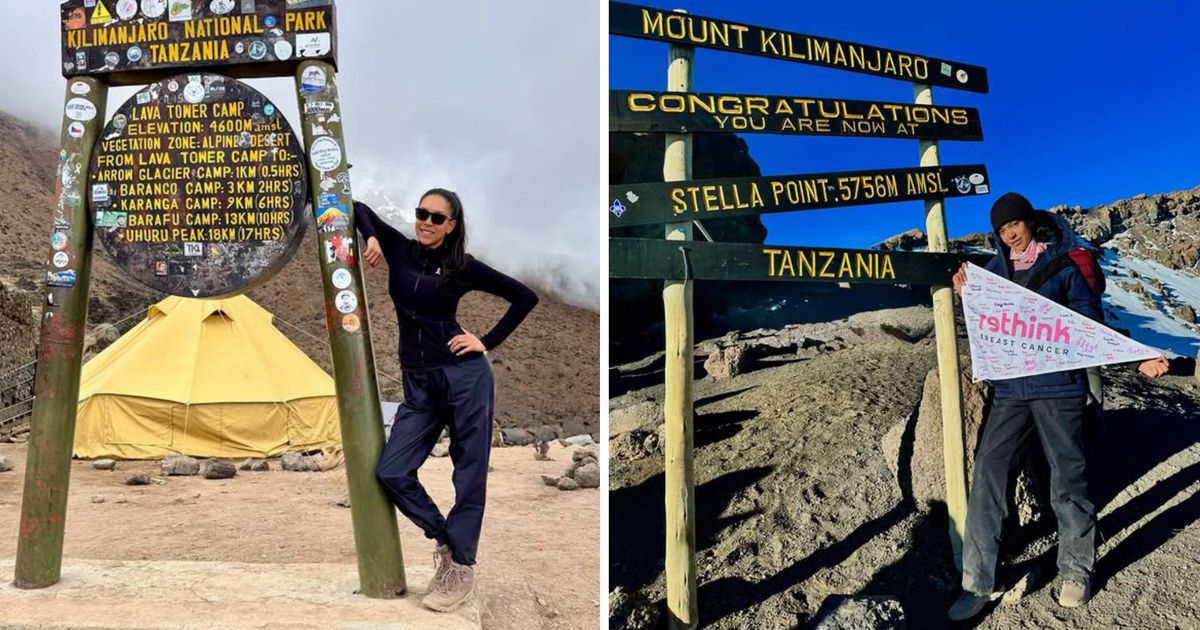
A Toronto woman turned her battle with breast cancer into a defiant act of strength by climbing one of the world’s most famous mountains to honour her final year of remission.
What first began as a minor nipple irritation led to then-29-year-old Tarot Stephens being diagnosed with breast cancer, a disease which she tells blogTO runs in her family.
“I came back to Toronto [after living in Los Angeles] and at the biopsy, they discovered that it was grade three invasive ductal carcinoma, which is a very aggressive form of breast cancer,” she says.
Since the diagnosis, Stephens has endured multiple rounds of chemotherapy, a double mastectomy and reconstruction, and will have to take menopause-inducing medication for at least the next five years.
Breast cancer is rarely diagnosed in people under the age of 40, according to Health Canada. Most cases (80 per cent) occur in women over the age of 50, but rates are rising among women in their 30s and even 20s, like Stephens.
“The ages are getting younger, and it’s scary because [doctors] don’t really have an answer as to why,” she says. “But I hope that generating awareness around the topic will encourage people to start being more proactive about their health and doing self-exams.”
To mark her final year of remission, Stephens, now 34, wanted to celebrate in the biggest way she could think of: by climbing the world’s tallest free-standing mountain, and the tallest on the African continent.
Standing at 5,895 metres (over ten times as tall as Toronto’s CN Tower), Kilimanjaro is the highest free-standing mountain above sea level, the fourth most prominent peak in the world, and one of the iconic “Seven Summits.”
“I’ve always dreamed of going to Africa, and climbing Kilimanjaro has always been something that I’ve aspired to do at some point in my life,” she says.
And so, on Jan. 28, she flew to Tanzania and embarked on an eight-day solo expedition to celebrate her final year of remission. Her climb of Mount Kilimanjaro concluded Feb. 4 – coincidentally, World Cancer Day – thought it wasn’t intentional.
“This was the second hardest thing I’ve ever done, second only to my battle with cancer, and surviving that gave me the confidence to believe I could do this too,” Stephens says.
The beauty of climbing this particular mountain, she says, is that it offers a variety of landscapes along the Kenyan border. Climbers start in the rainforest, then move through alpine terrain, desert, and even arctic conditions.
“I thought that that would be really beautiful to kind of mimic the journey and the changes that I went through in my treatment,” Stephens says.
It’s estimated that around 380,000 people have climbed Kilimanjaro, with roughly 30,000 attempting it each year. The fact that Stephens completed the climb independently in just eight days (some climbers take about nine) and did so with a bad knee injury speaks volumes about her strength and resilience.
“I had knee surgery about a year ago, and you can see in most of the photos I’m wearing knee braces on both knees because the left has to overcompensate for the right, which then causes strain on that one as well,” she explains.
“I can barely walk just down the street, let alone climb a mountain!”
But Stephens trained herself both mentally and physically to accomplish her goal. She also used the climb to raise awareness and funds for Rethink Breast Cancer, a charity that provides resources, advocacy and support for young women facing diagnosis.
Though it was a solo expedition, Stephens wasn’t entirely alone. She tells blogTO she was accompanied by a guide named Winny, and several porters, typically local Tanzanian workers who hike ahead of climbers to carry supplies, set up camp and prepare meals for the daily treks.
“They carry everything for the eight days on their backs and on their heads throughout the entire expedition, and they do this entire route with you, so you kind of become family,” she says.
As soon as Stephens completed the climb and returned to level ground, the first thing she did was call her mom. Despite getting to talk to her biggest supporter, Stephens says she was disappointed when she was taken back to her hotel without the chance to properly say goodbye to her guide and the porters who had been such an integral part of her life-altering experience.
Luckily, Stephens was later able to say a proper farewell with her new friends, giving them a deserved send-off before her trip back home.
“We sang and danced, and it was a teary goodbye,” says Stephens.
After receiving such a positive response to what she was able to accomplish in Tanzania, Stephens says she hopes to continue travelling, connecting with people, and raising awareness for causes she’s passionate about.
Kilimanjaro may have only been a prelude for things to come.
“Next stop, base camp, Everest!” Stephens says with a laugh, although she admits she needs time for her joints to recover.