
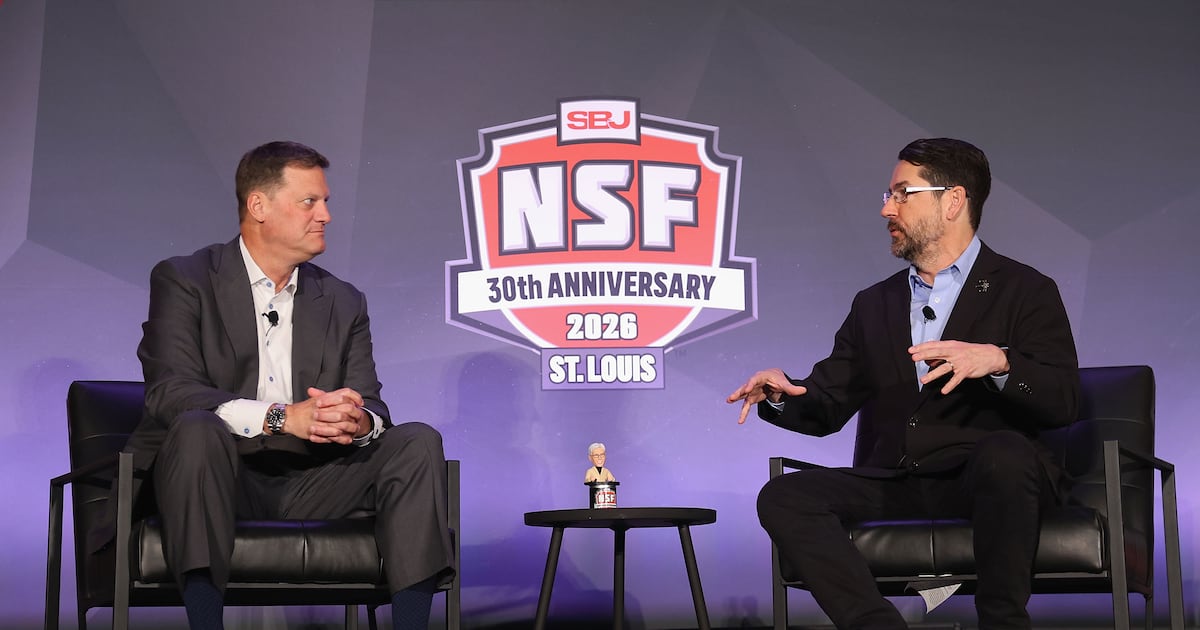
NASCAR President Steve O’Donnell joined ESPN Senior Writer Ryan McGee on Day 2 of SBJ’s National Sports Forum in St. Louis to discuss how the motorsports entity, emerging from a challenging period, is resetting its approach to growth and refocusing its long-term direction.
O’Donnell framed the moment as a reset for NASCAR marked by turbulence across the industry, most notably a federal antitrust lawsuit filed by Michael Jordan’s 23XI Racing and Front Row Motorsports tied to negotiations around the sport’s charter system. The lawsuit was settled in December. NASCAR Commissioner Steve Phelps then exited his role in January.
“We had a difficult 18 months,” O’Donnell said. “We came out of that in a good place … the opportunity now is we’re going into this season really with no contractual obligations out in front of us, no lawsuits, no COVID. We can just talk about how cool NASCAR racing is.”
That reset, O’Donnell noted, has enabled NASCAR to refocus unifying its teams, tracks, sponsors and media partners. “Your job is simple,” O’Donnell recalled Fox Sports’ Eric Shanks telling him when he first assumed his role. “You got to get the industry back.”
Chasing a different priority
O’Donnell acknowledged that in recent years NASCAR became too “insular” and, at times, overly focused on chasing new audiences and formats while assuming longtime fans would remain engaged. He said that approach contributed to confusion around the sport’s former championship format and minimized storytelling around winning and star-building.
“We probably chased a few too many things trying to be like other sports,” O’Donnell said. “We assumed that our hardcore fans would stay with us and newer fans would jump in. … Instead of new fans coming in, they did not understand it.”
The prior model, used from 2014 through 2024, resulted in the final race of the season determining the champion in a forced Game 7-type moment. NASCAR has now returned to a “Chase”-style championship format, mirroring what the Cup series used in the early 2000s. That shift has been one of the most visible signs of NASCAR’s broader reset.
O’Donnell said the league is now more intentional about embracing its identity while being more open to how it tells its story, including working with social creators and influencers in ways the league “may not have been comfortable with five years ago.”
O’Donnell added that reset has also been reinforced by the involvement of Michael Jordan, whose role as a 23XI Racing co-owner has brought both credibility and competitive momentum to the sport. On 23XI’s Daytona 500 win by Tyler Reddick, O’Donnell pointed to Jordan’s active presence around the team: “He’s there all day. … He grew up a fan.”
That change is also playing out in NASCAR’s schedule. The 2026 calendar includes experimental events such as a race at a San Diego naval base tied to the U.S. Navy’s 250th anniversary, while also restoring races at nostalgic venues like North Wilkesboro and Rockingham.
“We deserted our fan base,” O’Donnell said. “So now what you’re seeing us do is … yes, we can introduce the sport to new fans, but here’s how we got here.”
International growth remains a longer-term opportunity, with NASCAR operating series in Mexico, Canada, Brazil and Europe. O’Donnell noted immediate focus remains on reestablishing the sport’s U.S. footprint before pursuing further international expansion.
Managing that balance, O’Donnell said, has made communication one of the most central pieces of his role. O’Donnell: “Every decision we make … is going to have an effect. … If you don’t make those calls and if you do it in a vacuum, that’s when trouble happens.”