
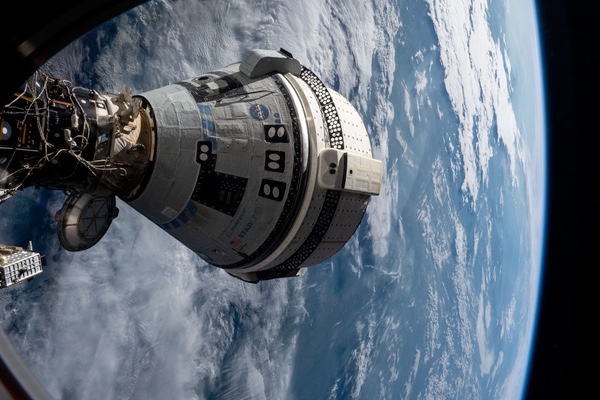
Boeing’s CST-100 Starliner docked to the International Space Station during the CFT mission in 2024. (credit: NASA)
by Jeff Foust
Monday, February 23, 2026
In briefings before the launch earlier this month of the Crew-12 mission to the International Space Station using a SpaceX Crew Dragon, reporters asked NASA officials about the status of the other commercial crew vehicle, Boeing’s CST-100 Starliner. That vehicle has been grounded since its flawed crewed test flight in mid-2024 that led NASA to bring the spacecraft back without the two astronauts who launched on it. Those astronauts, Suni Williams and Butch Wilmore, returned last March on a Crew Dragon, an eight-day test flight that turned into an eight-month expedition.
Starliner has design and engineering deficiencies that must be corrected, but the most troubling failure revealed by this investigation is not hardware,” Isaacman said.
NASA had said nothing about Starliner since last November, when it announced a contract modification. Boeing’s original commercial crew contract included six operational missions to the ISS after 2024’s Crewed Flight Test (CFT) mission. Under the modification, the first of those, Starliner-1, would carry only cargo; in effect, another test flight after CFT. After that would be three more crewed operational flights, with options for two more.
At the time NASA said Starliner-1 could launch as soon as April, but provided no updates since then, hence the questions at the Crew-12 briefings. “Starliner, we’re planning to fly on a another uncrewed mission this spring, sometime in the spring to summer,” Ken Bowersox, NASA associate administrator for space operations, said at one briefing January 30.
“We’ll launch it when it’s ready. We’ll gather all the information we need to complete the certification, and then we want to work Starliner back into the rotation,” he added, alternating flights with Crew Dragon as originally planned.
“Right now, we’re continuing to have a no-earlier-than April launch date,” for Starliner-1, said Steve Stich, NASA commercial crew program manager, at a second briefing February 9.
He pointed to great strides in resolving the technical problems seen on the CFT mission. That included changing seals that caused helium leaks before and after launch, work he said had been closed out. There had also been tests of thrusters, several of which failed in flight, with engineers taking the data to develop models to predict thruster behavior, he noted.
“When we get through that and get to a point where we’re comfortable predicting thruster performance, then we’ll go move forward and look towards a launch date,” he said.
Stich added that NASA had not yet decided if the next crew rotation mission after Crew-12, launching late this year, would be another Crew Dragon mission, designated Crew-13, or the first operational Starliner crewed mission, Starliner-2. “We’d want to work through and get through Starliner-1 into the summer timeframe,” he said. “We have some time to decide.”
Those comments offered a relatively optimistic assessment of Starliner, with a cargo test flight as soon as April and the beginning of routine missions as soon as the fall—six years after SpaceX’s Crew-1—suggesting that, perhaps, the worst of Starliner’s development problems was behind it. A report last week, though, changed that.
At a press conference held on less than two hours’ notice, NASA administrator Jared Isaacman started by reading from a four-page letter he had sent to the agency’s workforce that day, noting that the Aerospace Safety Advisory Panel was set to brief Congress on its annual report and that NASA would release its own independent report on the Starliner CFT mission.
“Let me begin with the most important point. Starliner has design and engineering deficiencies that must be corrected, but the most troubling failure revealed by this investigation is not hardware,” he said. “It’s decision making and leadership that left that, if left unchecked, could create a culture incompatible with human spaceflight.”
He followed with a history of the program, including the problems seen on the first two uncrewed test flights in 2019 and 2022. The investigations into those flights, he said, “did not drive to or take sufficient action on the actual root cause of the anomalies that we observed. The investigations often stopped short of the proximate or the direct cause, treated it with a fix, or accepted the issue as an unexplained anomaly.”
Isaacman then took up the CFT mission, heaping blame on both Boeing and his own agency. “The engineering reality, however, is that Starliner, with its qualification deficiencies, is less reliable for crew survival than other crewed vehicles,” he said.
“But at NASA, we managed the contract. We accepted the vehicle. We launched the crew to space. We made decisions from docking through post mission actions. A considerable portion of the responsibility and accountability rests here,” he said.
The problems with CFT, he argued, were as much with organizational failings at NASA as they were technical problems with the Boeing-developed spacecraft. “Witness statements routinely reflected a belief that management within the commercial crew program could only succeed if Starliner launched,” he said.
Even before OFT in 2019, testing showed there was a risk of the thrusters were subject to thermal environments that “could exceed qualification limits.”
“On orbit, disagreements over crew return options deteriorated into unprofessional conduct while the crew remained on orbit,” he continued. “Witness statements describe an environment where advocacy tied to the Starliner program, viability persisted alongside insufficient senior NASA leadership engagement to refocus teams on safety and mission outcomes.”
Isaacman concluded reading the letter with a commitment to continue working with Boeing on Starliner, while making changes within the agency. “Programmatic advocacy exceeded reasonable bounds and placed the mission, the crew, and America’s space program at risk in ways that were not fully understood at the time decisions were being contemplated. This created a culture of mistrust that can never happen again, and there will be leadership accountability,” he promised.
“Pushing a rock uphill”
As he spoke, NASA released the 312-page report, “redacted only where legally required or as directed by our commercial partner,” Isaacman said.
There are still significant redactions in the report, particularly in sections about the technical causes of the helium leaks and thruster failures on the Starliner CFT mission. Many details are blacked out, along with most illustrations or images of spacecraft systems.
Nonetheless, the report makes clear the severity of the issues on the flight. On approach to the station, five of Starliner’s thrusters failed, causing a loss of 6DOF, or movement in six degrees of freedom. Starliner could not move forward on the +X axis, towards the ISS, and had degraded control of pitch and yaw.
“The loss of X-axis translation resulted in a loss of movement in the forward direction and the Starliner vehicle was no longer capable of docking to the ISS, until a subset of thrusters could be recovered,” the report stated. Four of those thrusters were recovered, allowing the docking to proceed.
The report praised that decision, noting that backing off any making another attempt, or deciding to return to Earth immediately, could have made the thruster problems worse. That would have created a “higher risk to loss of life” for Wilmore and Willams.
But the report noted that there had been thruster failures on the two uncrewed test flights, OFT and OFT-2. Even before OFT in 2019, testing showed there was a risk of the thrusters were subject to thermal environments that “could exceed qualification limits.”
Nonetheless, NASA agreed to accept the risk of thruster problems on CFT. “This decision was made without resolving the core thermal qualification issues, effectively mischaracterizing the severity and operational impact of the thermal risks,” the report stated [emphasis in original].
In addition to the thruster failures in the Starliner service module on approach to the ISS, there was a separate failure of a thruster in the crew module during its uncrewed return to Earth. Notably, that failure brought the module to zero fault tolerance. “Loss of the single remaining redundant thruster, for this control axis, would have resulted in a loss of crew,” the report stated.
There are fewer redactions in the section on organizational issues. For that section, the independent review team relied on 66 interviews with people from senior management to line engineers, examining decision-making processes, communication, team dynamics, and more.
The report paints a picture of a rather dysfunctional management process during CFT, as engineers and managers evaluated the severity of the technical problems with Starliner and whether it was safe for Williams and Wilmore to return home on it.
“It was probably the ugliest environment that I’ve been in,” one interviewee said of the Starliner mission management meetings.
While crew safety was “the primary focus of discussion” throughout the mission, the report showed how those discussions were carried out was problematic. Technical teams said they did not have enough time to evaluate data and develop potential explanations of the problems with the spacecraft, which made meetings unproductive. With no published agenda for the meetings of the Starliner mission management team, people felt compelled to attend every one out of the belief it “could be ‘the one’ that was going to make the big crew return decision.”
Other issues ranged from differences between NASA and Boeing in how they evaluate risk and the perception of some that they felt NASA had to show the spacecraft was unsafe, rather than Boeing prove it was safe.
“Strong personalities within CCP [commercial crew program] and Boeing were seen as overly optimistic in presenting data, which some interviewees interpreted as lobbying rather than objective analysis,” the report stated. “This dynamic discouraged dissenting views and contributed to a growing sense of distrust. As one interviewee described, opposing positions felt like ‘pushing a rock uphill.’”
Then there was what Isaacman called in his letter the “unprofessional conduct” during debates about Starliner’s return. The report said that several interviewees brought up what it called “frustrating and/or unprofessional communication styles” during those meetings without being prompted. The report included several quotes from people recalling those meetings:
“There was yelling in meetings. It was emotionally charged and unproductive.”
“There are some people that just don’t like each other very much, and that really manifested itself during CFT.”
“It was probably the ugliest environment that I’ve been in.”
(That is only a subset of the quotes included in the report on the topic.)
The report identified three root causes for the Starliner CFT incident, none of which were technical in nature. One was a “hands-off approach” used by NASA during the start of the commercial crew program that kept the agency form gaining enough data and knowledge about the spacecraft to accept it as a service. The second was inadequate systems engineering and integration at Boeing during the design phase, resulting in Starliner thrusters operating outside of qualification ranges. The third was a culture in the commercial crew program that seeks two successful providers, which led to accepting greater risk.
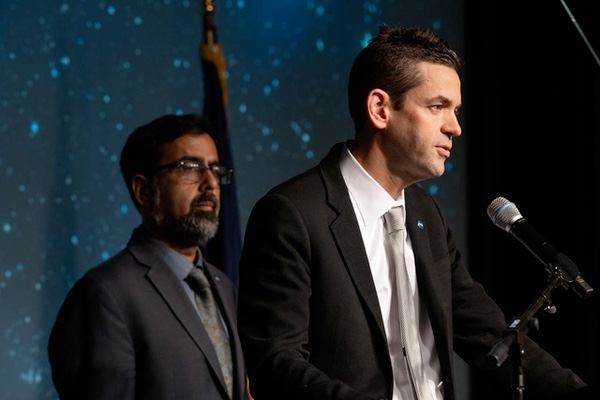
NASA administrator Jared Isaacman at the microphone, with associate administrator Amit Kshatriya behind him, at Thursday’s briefing about the Starliner report. (credit: NASA/Joel Kowsky)
Whither Starliner?
One recommendation made by the independent review was that the Starliner CFT mission should be classified as a “Type A mishap” in agency parlance, one that requires an independent review. Isaacman said he accepted that recommendation and considered the report that independent review.
That classification attracted headlines because it is NASA’s most serious classification for a mishap, one that includes the losses of the shuttles Challenger and Columbia. But is also includes any accident that results in more than $2 million in damage or “unexpected aircraft or spacecraft departure from controlled flight.” Isaacman noted at the briefing that a recent gear-up landing by a NASA WB-57 aircraft at Ellington Airport in Houston, which damaged the plane but did not injure the two people on board, was also a Type A mishap.
One reason that the independent review recommended the Type A mishap classification was so that the incident could be formally captured in NASA databases, like the NASA Mishap Information System, and warned without doing so “transparency, trust, and institutional learning are compromised.”
At its most recent public meeting in December, the Aerospace Safety Advisory Panel had also raised the issue. Not classifying the mission as a mishap or “high-visibility close call” while in flight confused decision-making processes, the panel argued.
“Had this been done in a timely fashion, after the docking of Starliner, the communication of these decision-making authorities and the primary path to resolution of the crew return question would have dramatically improved,” said former astronaut Charlie Precourt, a member of the panel.
Isaacman offered few other specifics about agency responses to the report. Asked what “leadership accountability” meant in terms of potential changes in the commercial crew program or the Space Operations Mission Directorate, Isaacman instead focused on the failures of accountability during the CFT mission, which he said went all the way to the top of NASA.
“To be clear, NASA will not fly another crew on Starliner until technical causes are understood and corrected, the propulsion system is fully qualified, and appropriate investigation recommendations are implemented,” Isaacman said.
Leadership failures, he argued, existed at multiple levels of NASA “right up to the administrator of NASA,” who at the time of the mission was Bill Nelson. “I can’t imagine a situation like that, why there would not have been some direct involvement to bring people back to the mission and the crew and figure out the correct pathway forward.”
In the briefing, some asked why NASA should continue to support Starliner given its problems and the impending end of life of the ISS. “We see near-endless demand for crew and cargo access to low Earth orbit, well beyond the life of the International Space Station,” Isaacman argued. “America benefits by having multiple pathways to take our crew and cargo to orbit.”
That is, interestingly, similar to the concern raised by the report that the commercial crew program was too focused on supporting two providers, resulting in increased risk. And while there are obvious benefits of having two crew providers, it’s not clear if that “near-endless demand” projected by Isaacman will materialize in time to save Starliner’s business case. In fact, the report stated that limited hardware spares and plans to retire the Atlas 5 “raise concerns about the program’s long-term viability.”
Isaacman made clear, though, that he would not rush to bring Starliner back. Asked about the schedule presented in recent weeks about the uncrewed Starliner-1 flying as soon as April, with a crewed mission as soon as late this year, he did not explicitly rule out that schedule, but suggested it was not feasible.
“Our focus here at NASA is working alongside Boeing again to understand the technical challenges that have caused these service module and crew module thruster issues, to remediate them, make sure we have a full understanding of the risk associated with this vehicle, implement the report, the recommendations from the report, and get back to flight,” he said.
He added that “what we don’t want to do is perpetuate past problems by establishing endless target launch dates that we were unable to meet.” One finding of the report was that, over a five-year period leading up to CFT, the program was within six months of a scheduled launch date for 41 months during that time: schedules repeatedly slipped as worked dragged on. The reported noted “repeatedly moving launch dates a little at a time will have a negative impact on team dynamics.”
“To be clear, NASA will not fly another crew on Starliner until technical causes are understood and corrected, the propulsion system is fully qualified, and appropriate investigation recommendations are implemented,” he said.
Boeing was not a part of the briefing, but did issue a brief statement confirming it would continue to work on Starliner.
“In the 18 months since our test flight, Boeing has made substantial progress on corrective actions for technical challenges we encountered and driven significant cultural changes across the team that directly align with the findings in the report,” the company stated. “We’re working closely with NASA to ensure readiness for future Starliner missions and remain committed to NASA’s vision for two commercial crew providers.”
Also at the briefing was Amit Kshatriya, NASA associate administrator. He filled in some of the technical details but also providing closing remarks.
“For the workforce of NASA—and I’ve been here in the agency almost 20 years now—it is hard to hear sometimes, when we were talking about our culture and we’re talking about how we do things,” he said. “I think it’s important to recognize that this form of leadership allows our culture to get better.”
Kshatriya, a former flight director in Mission Control, noted he worked with both Williams and Wilmore throughout his career. “Butch and Suni are honestly like family to me,” he said.
“They have so much grace, and they’re so competent, the two of them, and we failed them. The agency failed them,” he said. “We have to say that. We have to recognize that our responsibility is to them and to all the crews that are coming and to the crews that about to go fly. And our responsibilities to each other, too. We’re a family.”
Note: we are now moderating comments. There will be a delay in posting comments and no guarantee that all submitted comments will be posted.