
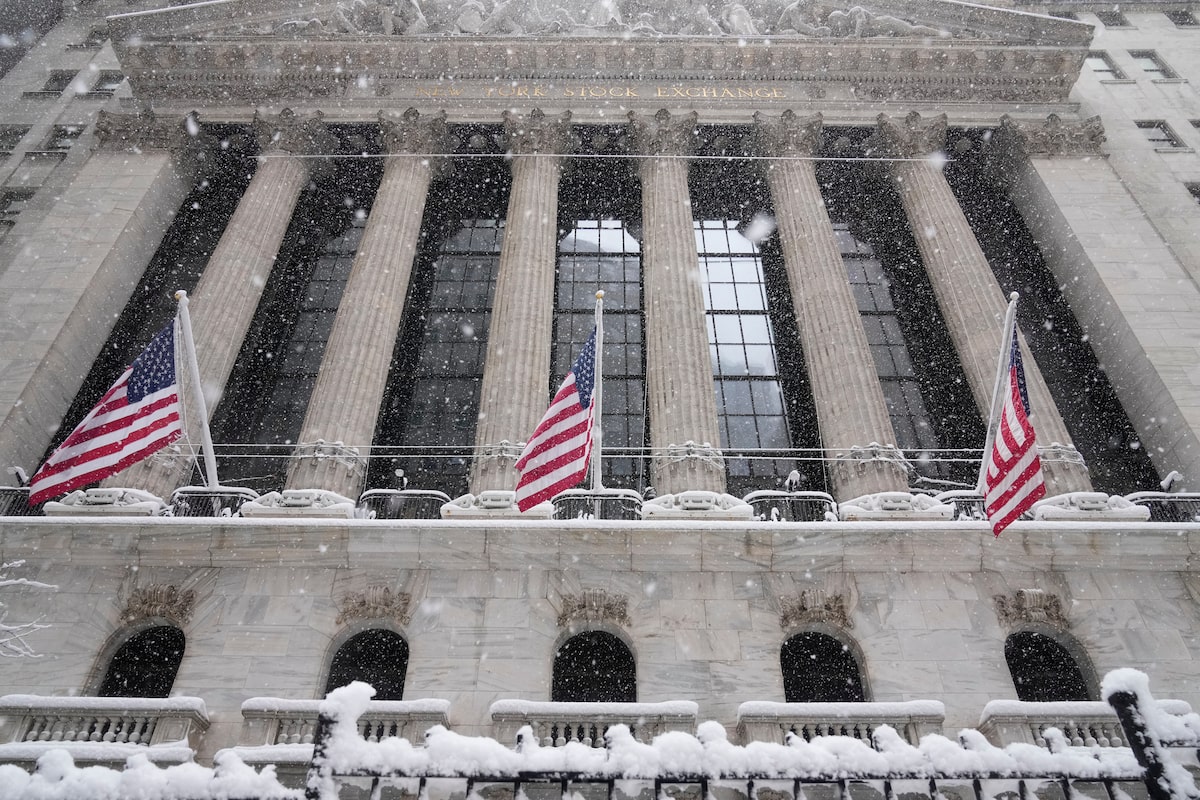
With the fog of uncertainty around U.S. President Donald Trump’s tariffs suddenly thickening again, foreign investors’ appetite for U.S. assets is under renewed scrutiny. Yet capital from overseas keeps flowing into U.S. markets at a record rate. So is the “Sell America” trade overblown? Probably.
Trump’s controversial policies and erratic decision-making may dim the allure of U.S. assets, yet the hard numbers show that foreign capital inflows have risen, not fallen, during the volatile first year of his second administration.
Treasury International Capital figures published last week showed that net foreign purchases of U.S. stocks and bonds in calendar year 2025 totaled a record US$1.55-trillion. That was up 30 per cent from the year before.
Almost all of that came from private sector investors who more than doubled their purchases of equities from the year before to more than US$650-billion, a powerful tailwind that pushed the S&P 500 and Nasdaq to all-time highs.
Foreign private sector investors also bought over US$440-billion of U.S. Treasury notes and bonds last year, dwarfing the modest net sales by foreign official institutions. That was a bit less than in 2024, but still a hefty amount that punctures the argument that the world is unwilling to lend to Uncle Sam.
Even claims about China dumping U.S. Treasuries – which seem accurate on first glance – are likely overstated. True, Beijing’s official holdings fell US$76-billion last year to a 17-year low of US$683 billion. But that’s because China is instead funneling vast quantities of foreign assets, including Treasuries, into its state banks, argues Brad Setser of the Council on Foreign Relations.
These holdings, swollen by China’s record US$1.2-trillion trade surplus last year, are potentially worth trillions of dollars, Setser reckons.
Put all this activity together, add in the Federal Reserve’s three rate cuts last year, and it is clear why Treasury yields, including on the ultra-long 30-year bond, fell last year, despite rising “debasement” fears.
If Treasuries performed relatively well against their global peers in 2025 and have continued to hold their own over the past two months, the same cannot be said of U.S. stocks. They lagged behind their global peers last year and are already playing catch-up in 2026.
This may seem counterintuitive given all the news about the U.S. artificial intelligence capex boom. A handful of U.S. tech giants are set to spend roughly US$650-billion on AI this year alone, which, all things being equal, should boost the U.S. economy and its tech-heavy markets.
But the S&P 500 is flat in the year to date, and the Nasdaq is down 2.5 per cent. Meanwhile, the benchmark stock indexes in chipmaking hubs Taiwan and South Korea, where significant AI investment is flowing, are up 20 per cent and 40 per cent, respectively.
Wall Street is also lagging the major European, UK and Japanese indices, which are up around 6 per cent, 8 per cent, and 12 per cent this year, respectively.
So someone is selling America, but it appears to be U.S.-domiciled investors. They have pulled US$52-billion from U.S. equity products since the start of this year, the most in the first eight weeks of any year since at least 2010, according to LSEG/Lipper data.
For the rest of the world, Wall Street’s liquidity, historical returns, scale, dynamism and relative “safety” still make it an attractive place to be. Even if foreign investors are more nervous about their U.S. exposure than they used to be and more willing to hedge dollar risk, they remain reluctant to actively sell U.S. stocks.
To be sure, there are reasons to doubt whether last year’s record pace of foreign inflows will be sustained. But as long as the U.S. runs a large balance of payments deficit – last year’s trade deficit was a record US$1.24-trillion – capital from abroad will be required to plug the shortfall. Foreign investors, it seems, will not be selling America any time soon.