
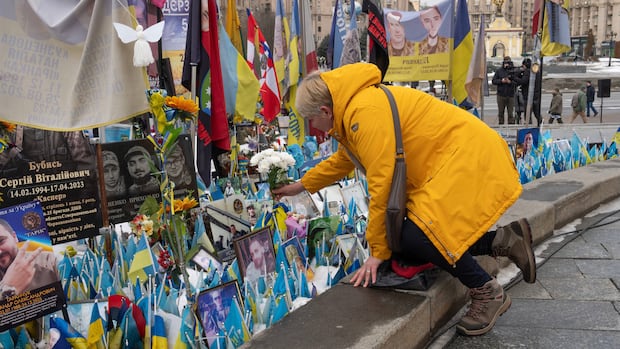
Canada is donating an additional $2 billion of military equipment, including more than 400 armoured vehicles, to Ukraine as the embattled Eastern European country’s war with Russia rolls into its fifth year.
Prime Minister Mark Carney announced the assistance on Tuesday at the same time as Global Affairs Canada announced additional sanctions on individuals and companies that are helping fuel Moscow’s war effort, including Russian firms that specialize in artificial intelligence, drone production and individual tankers that smuggle Russian oil to market.
The prime minister also announced a three-year extension of Operation Unifier, the Canadian military training mission that has — since 2015 — helped instruct an estimated 47,000 Ukrainian soldiers.
“We’re in it for the long haul,” Carney said on his way into cabinet Tuesday on Parliament Hill. “Russia is failing. The sooner they come to the table and actually participate in peace negotiations, the better it will be.”
WATCH | Carney on Canada’s commitments to Ukraine: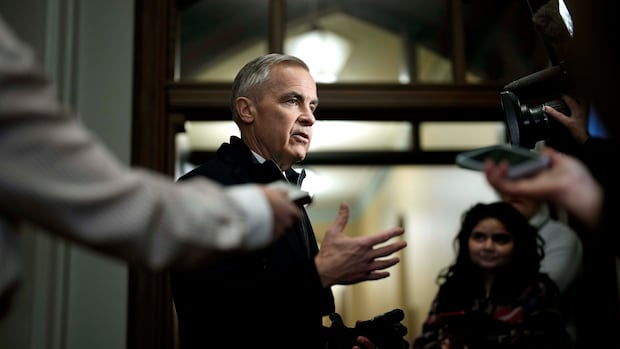
Canada’s PM pledges more Ukraine aid 4 years after Putin’s invasion, says ‘Russia is failing’
Prime Minister Mark Carney on Tuesday announced a number of measures Canada will take to support Ukraine, four years after Russia’s full-scale invasion of its neighbouring nation. The measures include further sanctions on Russia, $2 billion in additional military aid over the next year and more armoured vehicles for Ukrainian forces.
Western leaders who are part of the “coalition of the willing,” which has offered security guarantees to Ukraine once there’s a ceasefire, also met on Tuesday.
Speaking to journalists following the meeting, Ukrainian President Volodymyr Zelenskyy said Russia has not achieved its objectives in his country and that the next trilateral meeting aimed at getting a ceasefire — involving negotiators from Ukraine, Russia and the U.S. — would happen within a week or 10 days.
It was four years ago Tuesday that Russia began a full-scale invasion of Ukraine with the aim of toppling the government in Kyiv.
The United Nations Human Rights Monitoring Mission in Ukraine has confirmed more than 15,000 civilian deaths — and over 40,000 injuries — in the country since the invasion began.
A Washington-based think-tank, the Center for Strategic and International Studies, recently estimated that Ukraine has suffered up to 600,000 military casualties, including as many as 140,000 deaths.
It also estimated that Russia suffered 1.2 million casualties, including up to 325,000 troop deaths, between February 2022 and December 2025. Moscow stopped releasing figures on battlefield deaths in January 2023.
Carney, who also participated in the coalition meeting, echoed Zelenskyy’s sentiment.
“Russia is failing to achieve all of its objectives, four years into this conflict, 12 years if you include its annexation — its illegal annexation — of Crimea,” Carney said.
“Four years on, Russia is failing militarily, strategically and economically.”
Part of the enhanced sanctions package, announced Tuesday, targeted 100 ships that are part of Russia’s “shadow fleet” of tankers.
WATCH | More about the ‘shadow fleet’: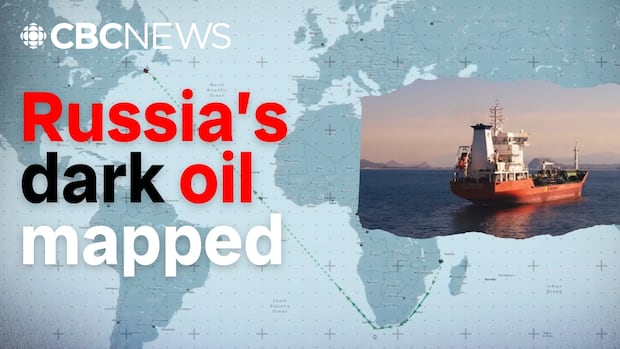
Russian ‘dark oil’ is getting into Canada through this loophole
Russian oil is currently under sanctions by the federal government, but hundreds of millions of dollars worth has entered Canada, potentially fuelling cars and planes, since the start of the war in Ukraine. Using trade data and satellite imagery, CBC News tracked marine traffic carrying sanctioned oil — some aboard Russia’s ‘shadow fleet.’
Also known as the “dark fleet” or “ghost fleet,” the vessels are mostly oil tankers — largely from Venezuela, Russia and Iran — that operate outside the international framework with the intention of avoiding sanctions and price caps.
“This is the fleet that effectively facilitates illegal exports of crude oil,” said Carney. “So, we’re tightening that lifeblood from the Russian economy along with our allies.”
A price cap on the sale of Russian oil, a major source of revenue for the Kremlin, has been lowered by G7 nations, including Canada, to $44.10 per barrel. By lowering the cap from the previous $47.60 (and the original $60), allies are hoping to force Russia to choose between selling at a near-break-even price or losing market access.
David Silbey, a military history and defence studies professor at Cornell University, says very little has changed on the battlefield over the last year.
“The Russians are still winning the war, in the bare sense that they hold the eastern provinces of Ukraine and are advancing, if slowly and at extortionate cost,” Silbey said.
“I don’t see popular will on either side breaking any time soon. For Ukrainians, this is perceived as an existential war. For Russians, there is still fairly broad support for the war, and Putin’s intelligence apparatus keeps dissent pretty well squashed. Given that, I’m thinking that this will remain stagnant for a while to come.”
Including Tuesday’s announcements, Canada has since February 2022 committed more than $25.5 billion in overall aid to Ukraine, including fiscal assistance, humanitarian aid and $8.5 billion in military assistance.
The funds for new armoured vehicles are coming out the upcoming federal budget year, which begins on April 1.
The Ukrainians will receive 66 brand-new LAV-6s from General Dynamics Land Systems-Canada and 383 Senator armoured patrol vehicles from Roshel.
Defence Minister David McGuinty said the purchases for Ukraine are not being made at the expense of rearming the Canadian military.
“As part of our defence industrial strategy launched last week, we are hyperstimulating the defence sector,” McGuinty said, adding that production will hopefully increase at both companies.
“I have confidence that we’re going to be able to replenish not only the needs of the Ukrainian contributions we want to make but also for ourselves, including in our forward operating location in Latvia where we have 3,000 members of the Canadian Armed Forces.”