
FIFA’s Congress is coming to Vancouver on April 30, and six weeks later FIFA World Cup games will follow.
The games arrive against a backdrop of new zoning laws set to speed up the gentrification of the Downtown Eastside (DTES) and Chinatown, the recriminalization of drugs during a public health emergency, and a host of intersecting social crises faced by people in the city.
FIFA has become increasingly known for extracting enormous surpluses from the host cities in which it operates. Yet the City of Vancouver and the Host City Committee – a group assembled to organize FIFA 2026 – have not fully disclosed the expected economic and social costs of FIFA’s arrival.
Public information about FIFA’s expected magnitude, costs, and impact has been sparse, aside from a celebratory website, and a handful of public city-run sessions held in Yaletown and Downtown. There will be no 2010 Winter Olympics-style “community office” in Vancouver during FIFA, despite the similarities between the international mega-events.
In the absence of information from the City of Vancouver, an informal coalition of organizations, individuals and collectives in the DTES and Chinatown has recently come together. The group has gathered information, conducted community-based surveys, and is monitoring the planning process to support mitigating potential impacts of FIFA on Vancouver.
What is FIFA bringing to Vancouver?
Before the games kick off this summer, Vancouver will be hosting FIFA’s Congress in April at the Vancouver Convention Centre.
Congress brings together representatives of all 211 members of FIFA, the world’s largest governing body of soccer. This is a trial run of the FIFA World Cup games set in Vancouver, featuring three delegates from each country, plus representatives from FIFA’s six confederations, media, and stakeholders. FIFA usually stages a legends match around Congress – a game featuring recently retired soccer stars. International government officials and representatives from all levels of Canadian government are also expected to be present to rub elbows on the world stage.
The FIFA World Cup 2026 itself is a multi-city event that will take place from June 11 to July 19. Vancouver match days are currently scheduled for June 13, 18, 21, 24, 26 and July 2 and 7. On days that Vancouver is not hosting a game, a “Fan Fest” will be in operation, which will be created for viewers to watch FIFA games being played in other cities.
After submitting a late bid to the games, Vancouver was selected to play host city to FIFA – a sports body that carries with it numerous reports of corruption, fraud, and money laundering, some of which have led to indictments in the US.
There have also been highly publicized and significant human rights violations and fatalities before, during, and after games in World Cup host cities.
These violations have included the deaths of migrant workers during the building of stadiums and unpaid wages in Qatar’s 2022 FIFA games. Brazil’s 2014 FIFA games saw the widespread displacement of residents in numerous favelas and villages across the country. We can deduce based on decisions to date that Vancouver City Council and FIFA will prioritize tourism and powerful interests over human rights, even without a raft of new infrastructure projects.
Human rights observers, including the American Civil Liberties Association, Amnesty International and the NAACP issued a statement raising concerns over discrimination, a lack of workers’ rights, and the mistreatment of unhoused residents in host city communities during and in the lead up to FIFA 2026.
Who has what responsibility during FIFA?
FIFA has operations control over stadiums and stadium grounds, supply chain decisions, bidding, and the power to outline hosting requirements. The City of Vancouver is responsible for safety and policing, security, transportation, event oversight, workforce management, and venues, and the drafting of a human rights “action plan.”
The costs for the City of Vancouver will be significant. In the 2024 budget update for FIFA, the total cost jumped from $230 million to $624 million, now set to be jointly funded by the City of Vancouver, Province of BC, and Government of Canada.
According to the BC government’s breakdown, the City of Vancouver will pay at least $261 million of this to cover its responsibilities for policing, the provision of two soccer training sites, the staging of a five-week-long FIFA Fan Festival at the Pacific National Exhibition fairgrounds, traffic management, and “other costs.”
Some public sector areas – health and Translink were noted – will receive a temporary boost in funding between $54 and $64 million total to manage increased pressures. The City of Vancouver has purported that “the overwhelming majority of the City of Vancouver’s costs will be paid by visitors, not residents and businesses.” Revenue streams include a newly implemented hotel tax, commercial revenues such as sponsorship, and facility rental fees.
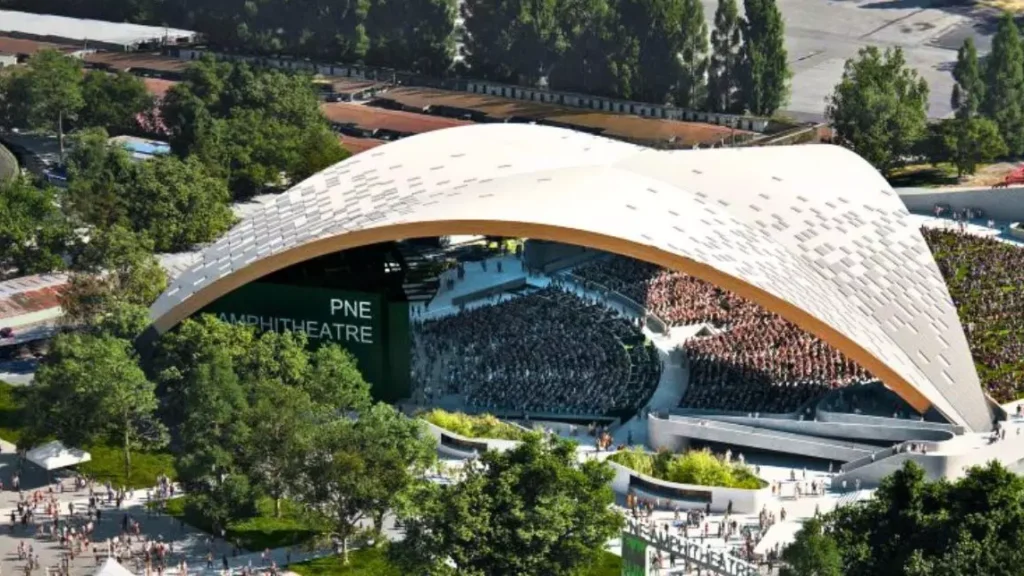
But the next public budget update is likely to see another increase. According to City News, the PNE amphitheater upgrades for the ‘fan zone’ – including the construction of Freedom Mobile Arch – have tripled since the original estimate and are now set to cost $183 million.
These costs – in the hundreds of millions – contrast starkly with the current reality of austerity budgets at all levels of government, mass firings in the public sector, and potential cuts to vital programs and services, which are already threadbare in far too many cases.
Government officials and FIFA representatives claim that potential revenues could recoup costs – if not earn profit – through merchandising, tourism, and events. However, this revenue is not likely to find its way back into public coffers. Profits are more likely to accrue to private enterprises and, of course, to FIFA itself.
The “bubble zone”: When is it in effect, where is it, what does it mean?
Logistical planning and FIFA-related disruptions in Vancouver will include everything from road closures and security operations to signage and marketing restrictions, requiring “businesses around BC Place stadium [to] remove or cover up their signs.” One item in particular is expected to have a significant impact on Downtown, DTES, and Chinatown communities, is the creation of a “bubble zone” surrounding BC Place, with a number of bylaws accompanying the zone’s implementation.
The bubble zone will be a two-kilometre radius surrounding BC Place throughout the tournament period, in which “the City of Vancouver is committed to supporting public safety, mobility, and upholding the rights of FIFA World Cup commercial partners within the Controlled Area,” according to the FIFA Vancouver website. This two-kilometer radius will also be impacting the court system, with BC Courts issuing a statement advising “to expect very significant impacts for its operations during the period of the 2026 FIFA World Cup.” The Vancouver Law Courts – alongside several other courthouses in BC – will be shut down completely between June 12 and July 8.
Changes to bylaws, made in accordance with FIFA World Cup 2026 Bylaws, were recently approved by Vancouver city council through a vote. These changes consist of a set of temporary amendments to several existing bylaws that regulate things like noise, graffiti, street vending, signage, and truck routes throughout the city, with fines of up to $1,000 for a violation.
In a statement, Pivot Legal Society warned that the collection of new bylaws will empower bylaw officers with further tools to displace people, much like the 2010 Winter Olympics.
At the same time, Ken Sim has stated that the displacement of unhoused people or people who rely on public space will not occur due to FIFA. This seems hard to believe given the escalation of city-led street sweeps under Sim’s ABC-majority city council. The odds are that someone is being displaced in the Downtown Eastside as you read this. Critics are right to worry about a precipitation of such displacement blitzes in the lead-up to and during FIFA.
Also impacted by FIFA’s non-competition requirements are significant, long-standing cultural events in the city like the cancellation of the 2026 Dragon Boat Festival – the largest Dragon Boat festival in North America.
Surveillance and policing
Changes to policing during FIFA 2026 have been kept hush-hush, but we can draw conclusions from increased policing budgets and new surveillance infrastructure.
As part of the FIFA 2026 policing strategy, 200 new security cameras have been installed around BC Place, the PNE, and training grounds. City officials have claimed that these cameras will be removed after the games, but data control remains uncertain. Vancouver’s Host City Committee has stated that “footage will be shared as needed with FIFA and security contractors.” This raises potentially significant privacy and data management concerns.
Surveillance creep could be further facilitated by a motion passed by Vancouver City Council in 2024 granting the Vancouver Police Department access to every traffic camera in the city. Coalition of Peers Dismantling the Drug War and Police Oversight with Evidence and Research called for the motion to be repealed in their recently released report.
Notably, Vancouver never saw police budgets decrease after the increases associated with the 2010 Winter Olympics.
Also known at the time of writing is that RCMP are being contracted from Saskatchewan, according to Chief Steve Rai’s comments to city council late last year. The specific role of these officers before and during FIFA 2026 was not stated when this information was shared.
Human rights and FIFA
FIFA has provided an overly broad “standard” of human rights, with host cities being responsible for creating an “action plan” to prevent discrimination, support workers’ rights, protect children, and combat human trafficking.
For the last year, city committee members have been working on a Vancouver Action Plan, with a draft now released for community feedback as of February 19 and a final version to be released in May.
Although we have yet to see the draft of the Vancouver Action Plan, red flags have been raised by community members, collectives, and organisations in the DTES and Chinatown. Of particular concern is the recent anti-sex work moral panic under the guise of human trafficking concerns, and the resulting impact of surveillance and policing on the right to a safe workplace for sex workers. Concerns have also been raised about discriminatory policing and surveillance based on perceived social condition. This refers to discrimination based on visible markers of poverty, class, and social exclusion in public space, especially in a context of FIFA requirements around so-called “beautification.”
As Taylor McNallie has outlined in her writing on the Calgary Stampede: “Ironically, many of the things unhoused people are criminalized for on a daily basis…suddenly become the social norm” for wealthier and more privileged people during these mega-events – including drug use, intoxication, and use of public space.
In 2025, FIFA held the Club World Cup – a trial run for FIFA 2026 that took place in six US host cities. Prior to this event FIFA withdrew their anti-racism and anti-discrimination campaigns, in a move that was rightly criticized by some sports and human rights analysts.
Even though these forms of symbolic campaigns are extremely limited in their utility, the homophobic chants that overtook a FIFA game soon after their cancellation show how the abandonment of ensuring basic humanity within events can risk fuelling hate.
The reporting mechanism put in place by FIFA during the 2025 World Cup to record human rights violations tracked 145 violations, including 82 that were considered severe (many involving ICE), 24 related to accessibility, five linked to harassment, and four violations of freedom of speech and excessive use of force during the games.
All of which begs the question, why are we paying for this?
Instead of funding a one-month billionaire playground on the public dime, governments should be focused on ensuring a strong social safety net through long-neglected programs like adequate rates of social assistance, $10-a-day childcare, investments in public health and transportation, and housing. Our communities deserve better.
To learn more about FIFA and its impacts in the DTES and Chinatown communities, the Carnegie Housing Project will host a Town Hall on Thursday, February 26th from 5:30pm-8:00pm in the theatre of Carnegie Community Centre.
Consider supporting The Mainlander through our OpenCollective