
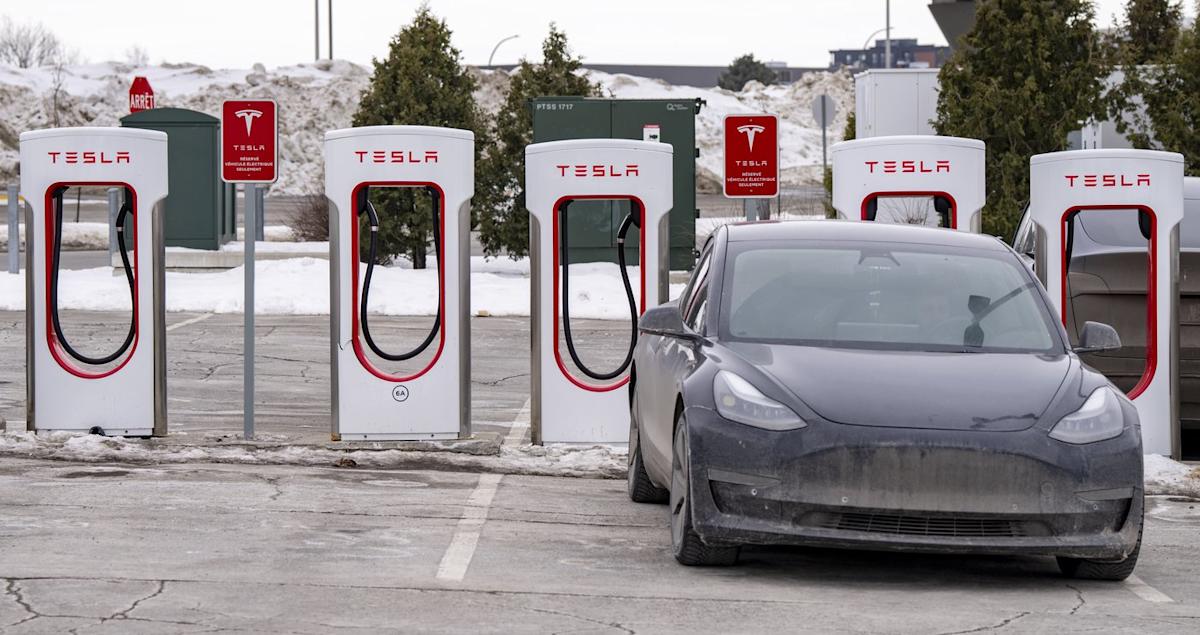
HALIFAX — As Ottawa incentivizes Canadians to buy electric vehicles or hybrids, Nova Scotia is making it more expensive to drive them.
Nova Scotia’s budget tabled on Monday includes a $500 fee for electric vehicles and $250 fee for hybrids — to be paid every two years. Ottawa, meanwhile, has started offering incentives of up to $5,000 to buy electric cars and up to $2,500 for plug-in hybrid vehicles.
Sal Falk lives in the rural community of Middle LaHave on Nova Scotia’s South Shore and purchased a used electric car in November. She said the levy is “absurd” and penalizes Nova Scotians who have chosen to drive low-emission vehicles.
“For someone who just made the switch to an EV, I am now staring down this new tax that feels like being punished for making an environmental choice,” Falk said in an interview Tuesday.
Abby Lefebvre, an energy coordinator with Halifax’s Ecology Action Centre, says the province’s new fee is disappointing.
“This sends a very confusing message … it’s discouraging to people who are looking to explore EVs and discouraging to those who have already taken that step and are enjoying their EVs to now have this (fee) slapped on them,” she said.
Provincial officials say the levy ensures electric and hybrid car owners are contributing to road maintenance, as gas-reliant drivers are already paying for roads through the provincial tax on fuel. The province estimates the fees will raise $1.6 million in the 2026-27 fiscal year and $3.3 million in 2027-28.
Kurt Sampson, the executive director of Electric Vehicle Association of Atlantic Canada, called the government’s new fee “short-sighted and irresponsible.”
“And it will slow the clean transportation progress our province needs,” Sampson said in a statement.
Sampson said in principle he supports the idea that all drivers should contribute to road maintenance. However, research shows that heavy commercial trucks cause far greater damage to roads than passenger cars do, he said.
Damage to highways and roads are largely caused by “freight volumes and our collective spending on delivered goods,” not passenger vehicles, Sampson said. “A flat fee on EVs unfairly targets low-damage vehicles while ignoring this reality.”
In March 2021, under Nova Scotia’s former Liberal government, the province announced an electric vehicle rebate program of up to $3,000 for new, fully electric vehicles, $2,000 for used EVs and new hybrids, and $1,000 for used hybrid vehicles. It also offered $500 for e-bikes that cost $1,200 or more.
That rebate program has ended, and final payments were issued in May 2025. In 2021, the government estimated that such rebates would cost $9.5 million.
Premier Tim Houston’s Progressive Conservative government introduced rebates in April 2024 for industrial and commercial “medium and heavy-duty” zero-emission vehicles. Eligible vehicles are vans and trucks used for commercial or industrial purposes that weigh more than 3,856 kilograms.
The Department of Natural Resources said at the time it would spend $500,000 on the one-year program. However, applications for this rebate are still open.
A spokesperson with the Department of Energy did not immediately respond to a request for comment.
This report by The Canadian Press was first published Feb. 24, 2026.
Lyndsay Armstrong, The Canadian Press