
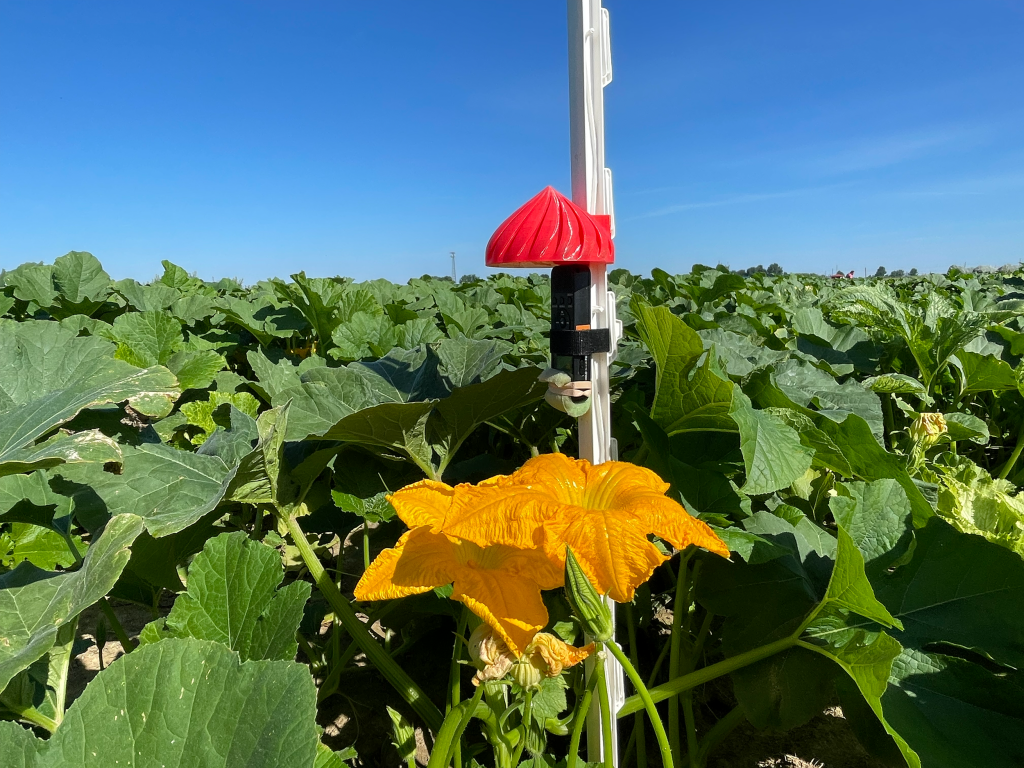
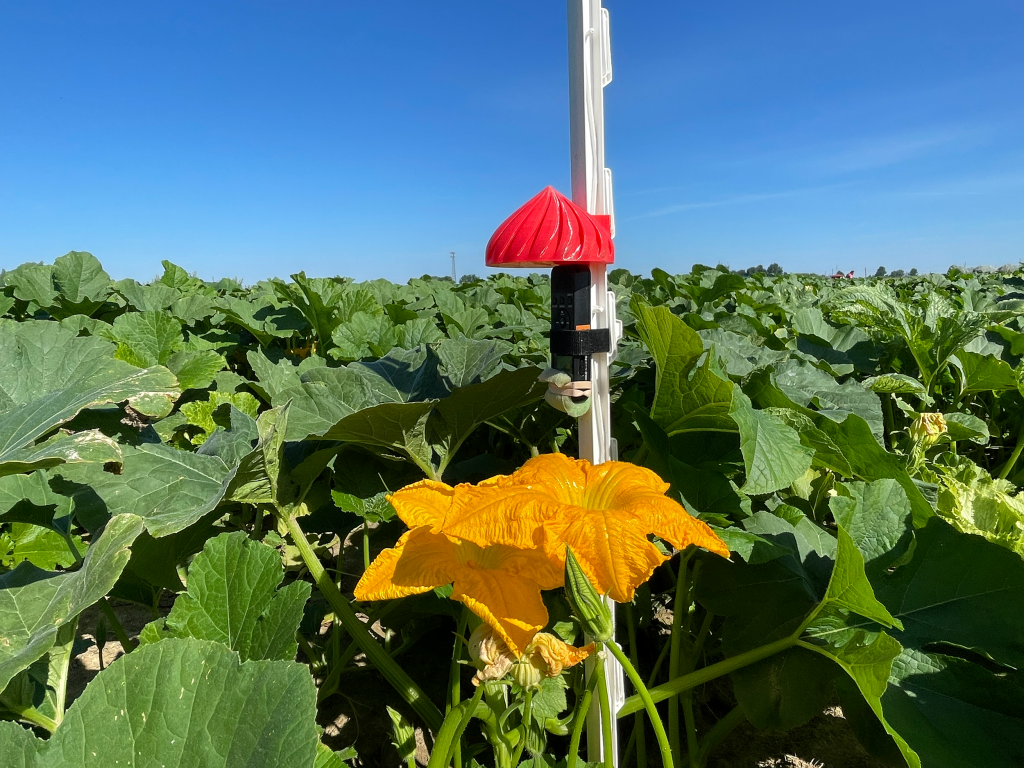
 Buzzdetect, a new open‑source AI tool, uses simple microphones and machine learning to continuously detect pollinator activity. A new study shows how the tool can offer researchers and growers a low‑cost way to “listen” for bees in real time. Shown here is a buzzdetect recorder deployed in a pumpkin field. (Photo courtesy of Luke Hearon, Ph.D.)
By Fabiana Fragoso, Ph.D.
 Fabiana Fragoso, Ph.D.
Imagine you are standing in the center of a soybean farm, thousands of acres stretching out around you. What do you hear? Maybe a tractor working a few fields over, the wind rustling the leaves? Or perhaps a faint buzz, barely noticeable against the background hum of the landscape. For most of us, the sounds of the outdoors are usually just that: background noise. But what if we could tune our ears to uncover hidden layers of data within the environment?
That is exactly what researchers from The Ohio State University (OSU) Department of Entomology and Dartmouth College’s Department of Computer Science set out to do. In a study published in December in the Journal of Insect Science, the team describes a new open-source tool called “buzzdetect,” which uses machine learning and passive acoustic monitoring to detect pollinator activity.
The Limits of Traditional Sampling
Anyone who has done pollinator fieldwork knows: Collecting data across an entire day—or an entire season—is a serious logistical challenge. “Let’s say you want to study the daily trend of pollination activity with a 30-minute resolution,” says Luke Hearon, a Ph.D. student at OSU and lead author of the study. “That means you need to be in the field from sunup to sundown, taking samples with a sweep net or swapping out bee bowls or conducting visual counts every 30 minutes. That’s not a bad way to spend a day, but your effective sample size after all that is n = 1.”
Now multiply that effort across multiple sites, multiple days, or an entire growing season, and the limitations of traditional methods quickly become clear. Passive acoustic monitoring offers a way around this bottleneck. “With passive acoustic monitoring you can quickly deploy microphones at all of your sites and leave them to continuously record over the following days,” says Hearon. “The data you get back have practically unlimited temporal resolution.” In other words, buzzdetect’s ability to “listen” around the clock allows researchers to track pollinator activity continuously, across multiple sites, and at a much finer temporal scale than it is possible through traditional methods.
Turning Buzzes Into Data
Hearon and his colleagues created buzzdetect by applying deep learning models to field audio. Deep learning is a branch of machine learning in which computer models, inspired by the structure of the human brain, learn to recognize patterns by being exposed to large amounts of data.
In the case of buzzdetect, the team began by placing simple audio recorders in farm fields and listening to the recordings to mark when an insect buzz was present. Then, rather than starting from scratch, they used a shortcut known as transfer learning: They took YAMNet, a pre-trained Google audio model (already trained on many everyday noises), and fine-tuned it to focus specifically on insect flight sounds. The result was a model capable of distinguishing insect buzzes from environmental noise on a second-by-second basis with a sensitivity of 28% and a precision of 95%.
To see how buzzdetect performed outside the lab, the researchers deployed microphones in agricultural fields and analyzed 24-hour recordings from five different plants: pumpkin, watermelon, mustard, soybean, and chicory. The patterns they detected largely matched what previous studies had already shown about pollinator behavior: Chicory showed clear early-morning peaks in activity while soybean peaked later in the day, and overall activity was higher in mustard and soybean than in the other crops. Buzzdetect also revealed how much variation exists even within a single crop. In watermelon fields, for example, some recorders captured more than 4,000 buzzes in a day, while others detected closer to 1,200, highlighting real differences in local pollinator activity rather than just noise in the model.
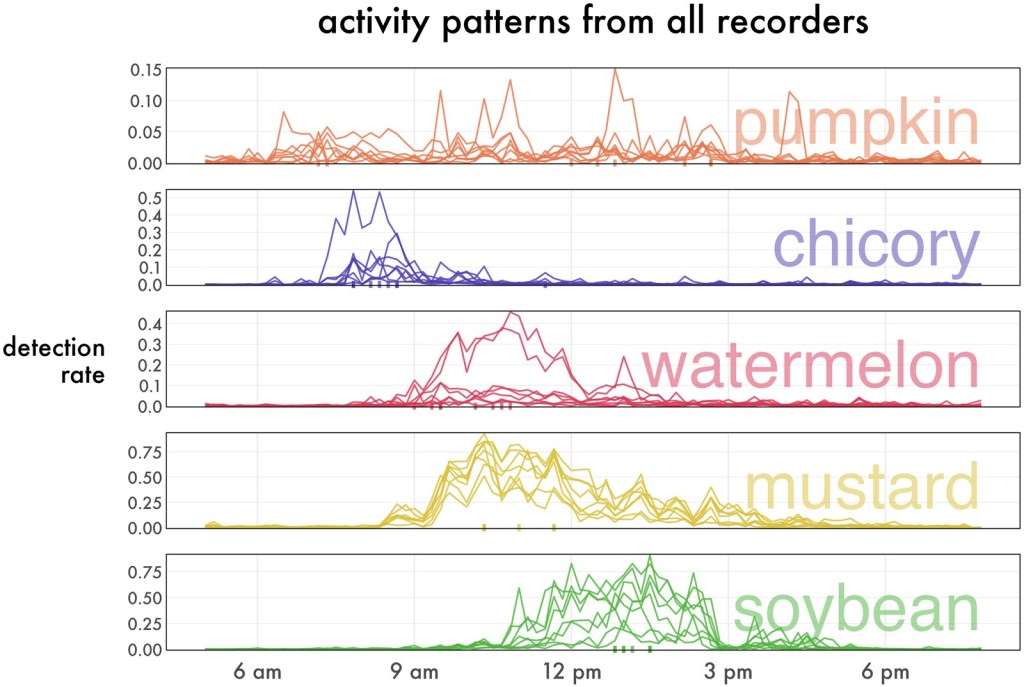 Buzzdetect, a new open‑source AI tool, uses simple microphones and machine learning to continuously detect pollinator activity. A new study shows how the tool can offer researchers and growers a low‑cost way to “listen” for bees in real time. Shown here are activity patterns for five different crops in which buzzdetect was tested in a recent study. (Image originally published in Hearon et al. 2025, Journal of Insect Science)
Even with such a strong performance, buzzdetect, like any automated system, sometimes makes mistakes. But, as Hearon points out, they are often reasonable ones. “Most false positives are things you can listen to or look at the spectrogram and think, ‘yeah, I see why it heard a bee in that.’”
Some confusions are memorable though. “We have heard mysterious rattles and clicks, heated arguments between squirrels, and a hundred different variations of the insect buzz,” he recalls. These examples highlight some of the challenges when labelling a training set. “You come up with your set of labels to use, ‘frog,’ ‘propeller plane,’ ‘siren,’ and then you hear some unknown animal loudly sniffing at your mic at 2 a.m. Do you lump it in with ‘ambient noise’? Do you create a new label called ‘ambient snuffling’? Can we train a snuffledetect model? There are many novel questions in the field of bioacoustics.”
An Open, Accessible Tool for Many Users
Hearon emphasizes that the team is proud to have created a tool that is free, open-source, and designed to run on relatively modest hardware. “For the record, ‘modest’ was a bit of a euphemism—the GPU we run our analyses on (GTX 1650) was one of the cheapest cards four GPU generations ago. Our audio recorders are also simple MP3 recorders, so there’s no expensive or complicated scientific gear in the pipeline,” he says.
Because of this, buzzdetect could be useful far beyond academic research labs. “Crop growers might measure pollinator activity in fields before pesticide application, public gardens could compare the attractiveness of different pollinator habitats, citizen scientists could track the activity patterns of native bees nesting in their backyards. There are a lot of open questions when it comes to figuring out how to apply and interpret bioacoustics,” Hearon says, “so the more people that get involved, the better.”
He also stresses that building and using tools like buzzdetect is becoming increasingly accessible. “Other than decrypting some extremely confusing error messages from TensorFlow, the process is surprisingly easy,” Hearon says. “The barrier to entry for machine learning lowers every day; the software packages are designed to be as low-friction as reasonable, and online walkthroughs abound. I didn’t even know a lick of Python before I started working on buzzdetect. I encourage curious readers to jump in with both feet and see where it leads.”
Buzzdetect, a new open‑source AI tool, uses simple microphones and machine learning to continuously detect pollinator activity. A new study shows how the tool can offer researchers and growers a low‑cost way to “listen” for bees in real time. Shown here is a spectrogram of a series of buzzes recorded by buzzdetect. (Video courtesy of Luke Hearon, Ph.D.)
A Complementary Tool
Although buzzdetect offers a promising new way for automated, large-scale monitoring of pollinators, Hearon and colleagues are careful to frame it as a complement—not a replacement—for traditional methods.
“So far, the trends from buzzdetect are largely corroborated by previously published research, so there haven’t been any particular surprises,” he says. “Every sampling method is biased in some way, including bioacoustics. So, while future bioacoustic results may disagree with a previously published trend, it could be difficult to determine which trend is the misleading one. This is why we present buzzdetect as a tool that is complementary to existing methods: The strongest conclusions should be supported by synthesizing multiple streams of evidence, including traditional sampling methods.”
Listening Beyond the Data
Beyond its practical applications, Hearon reflects that working on buzzdetect also changed how he thinks about sound in natural environments. “One thing that I realized during the course of this work is that there is a massive amount to be learned by listening,” he says. “I have listened to many hours of field audio to build our training dataset. Relative to a city, the depths of a soybean field is a quiet environment, but it’s still chock full of noises. Our senses are filtered through attention and context, so these background sounds hardly ever register in our mind. But when you strip away every other sense and you sit with your eyes closed at your desk listening intently to the recordings, you start to become aware of an entire soundscape that has always been there. The chorus of bird calls, the rising and falling rustle of wind through the foliage, even the quiet parts of the day sound different than the quiet parts of the night. And all of this is reduced to a single label in the training set: ‘ambient background.’”
Perhaps for Hearon, as important as the tool his research produced, is the broader lesson he learned along the way. “I love exciting new methods and training powerful models, but they are, at the end of the day, only models. The truth remains out there, in the world, and it always shall.”
Fabiana Fragoso, Ph.D., is an entomologist, biologist, translator, and interpreter native to Brazil and now based in Italy. She most recently served as a postdoctoral researcher with the U.S. Department of Agriculture’s Agricultural Research Service in Madison, Wisconsin, USA. Email: fabianapfragoso@gmail.com.
Related
Discover more from Entomology Today
Subscribe to get the latest posts sent to your email.