
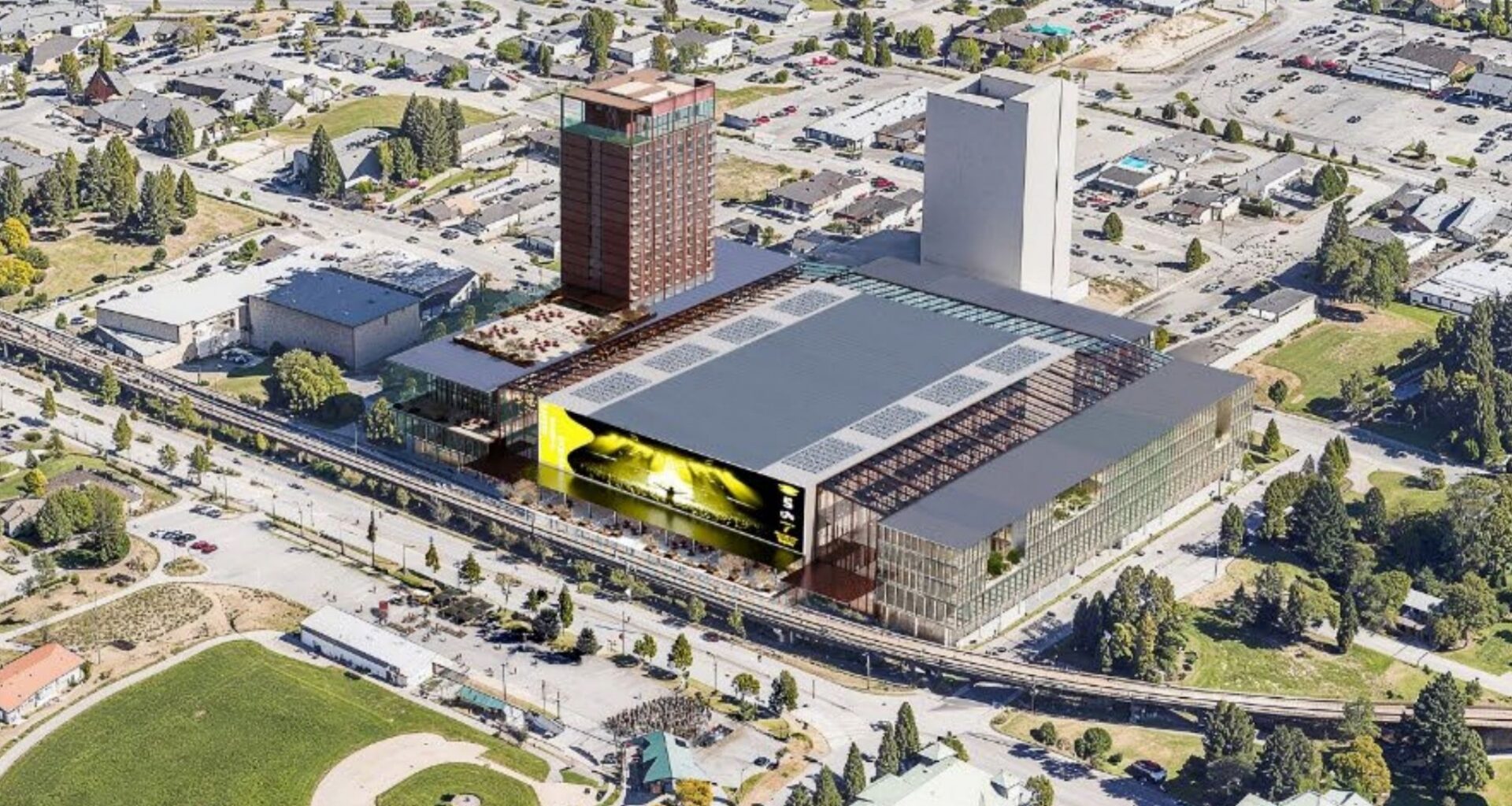
The City of Surrey is looking to make a major capital contribution towards the cost of building its new 10,000-seat indoor arena in Surrey City Centre.
According to the municipal government’s newly released budget plan, the five-year, 2026-2030 capital plan includes almost $200 million over five years specifically for building the arena.
This only represents the City’s public funding for the project — it does not include any potential additional contributions from private partners and other entities.
It is also the first time the municipal government has publicly revealed how much it is willing to contribute to the project, which will anchor the newly designated entertainment district area in Surrey City Centre. The project is a key priority for Surrey Mayor Brenda Locke to further catalyze the potential growth of Surrey’s emerging downtown.
With 10,000 seats, it would be British Columbia’s third highest-spectator capacity indoor arena after Rogers Arena and Pacific Coliseum in Vancouver.
Earlier this winter, the City launched the bidding process seeking a private developer, operator, and sports tenants for the mixed-use project with the arena, which is eyed to replace City-owned site of the BC Lions’ longtime training facility at 10605 City Parkway — the northeast corner of the intersection of University Drive and 105A Avenue, just south of SkyTrain’s Gateway Station and Chuck Bailey Recreation Centre and east of Whalley Athletic Park.
As part of the mixed-use project, there would also be a hotel, conference and meeting space, retail and restaurant space, and residential uses.
“Contract negotiations with private sector partners are expected to result in development agreements for the construction of various private sector opportunities adjacent to or integrated with the arena,” states this week’s budget proposal.
“It is expected that the revenue generated from development agreements, tenanting of the arena and the sale of naming and other commercial/marketing rights will assist in funding the construction, operation, and maintenance of the arena.”
The capital plan states the municipal government’s cash flow funding for the arena portion of the mixed-use project is $20 million in 2026, $45 million in each of 2027, 2028, and 2029, and $43 million in 2030.
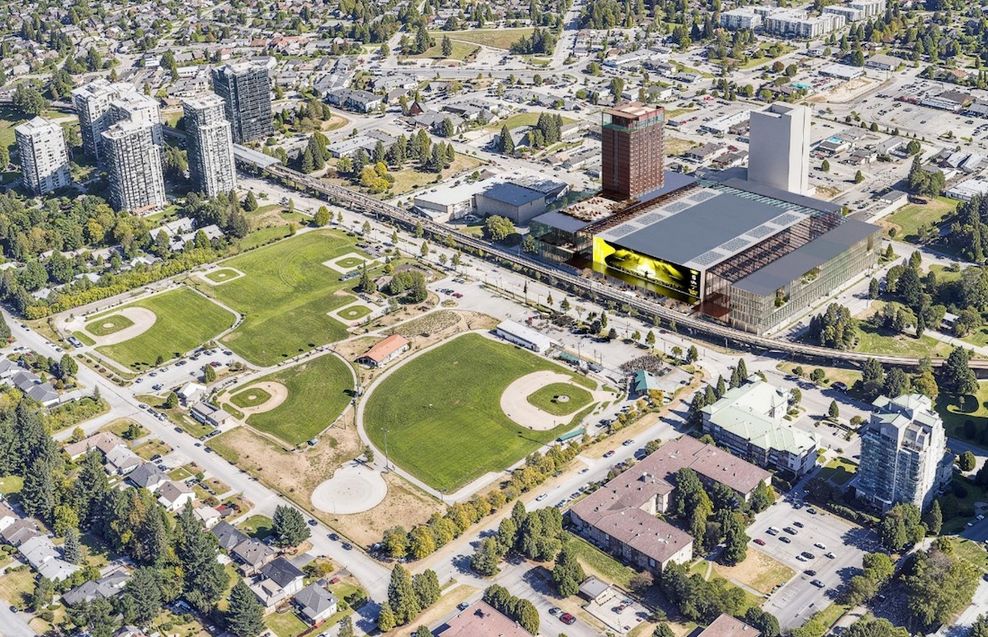
Preliminary conceptual design of the new 10,000-seat arena, hotel, conference centre, and commercial space project at the site of BC Lions’ training facility in Surrey City Centre. (Perkins&Will/City of Surrey)
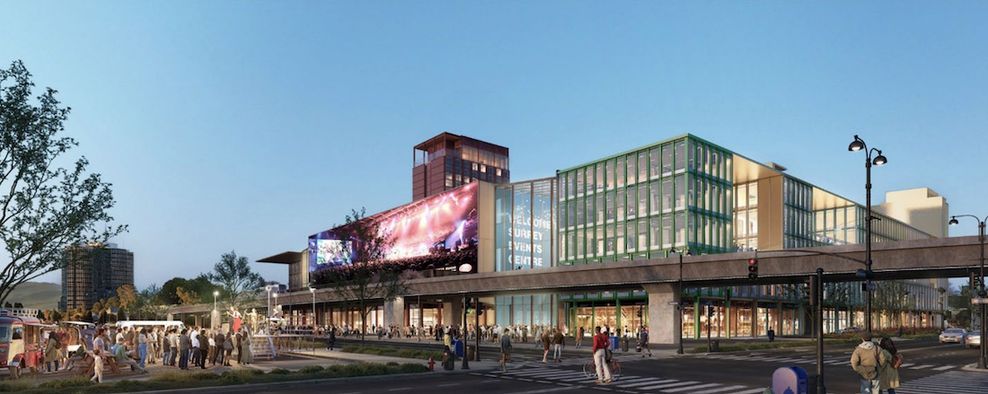
Preliminary conceptual design of the new 10,000-seat arena, hotel, conference centre, and commercial space project at the site of BC Lions’ training facility in Surrey City Centre. (Perkins&Will/City of Surrey)
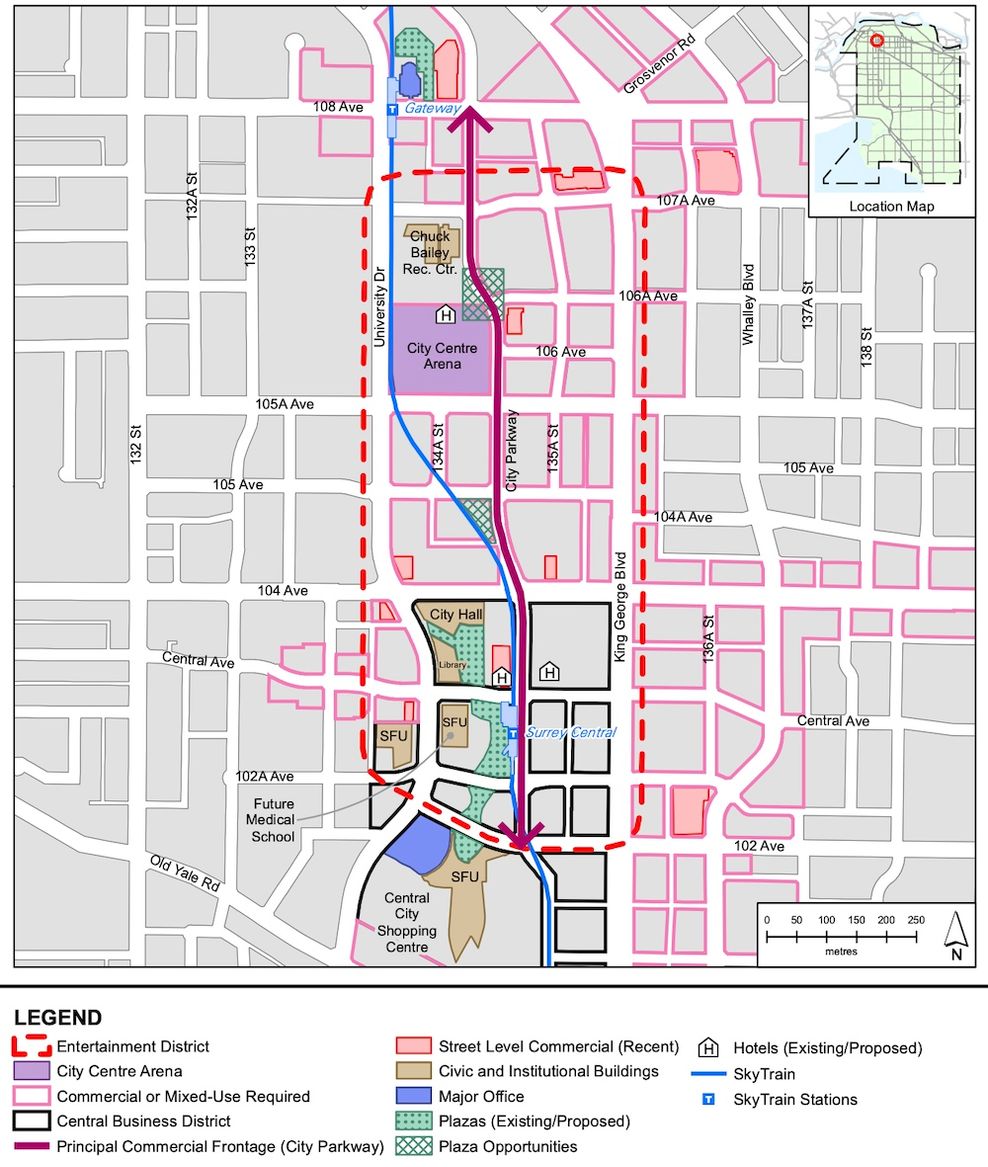
Map of Surrey City Centre showing the new entertainment district area and the proposed site of the new 10,000-seat arena. (City of Surrey)
The City will create a shortlist of proponents by March 3, 2026, inviting them to participate in the request for proposals (RFP) stage of submitting a detailed bid package. The deadline for the RFP submission is May 22, 2026, and the contract award will be made in August 2026.
After the selection of the successful proponent, the City will create the first detailed plans later in 2026 to show how the arena and surrounding buildings could look and fit on the development site. The outcome of this procurement process will also determine the arena’s ownership and operating structure.
Construction is currently targeted to begin in 2027.
$152 million towards building the office building with SFU’s new medical school
The arena is Surrey’s municipal government’s most expensive capital project in the 2026-2030 capital plan by a wide margin.
The second-highest-cost project is the first phase of the Centre Block office complex at 10261-10275 City Parkway, on the former site of the North Surrey Recreation Centre and North Surrey Arena. It is located just south of Surrey City Hall and Civic Plaza, west of the SkyTrain’s Surrey Central Station, and north of Central City.
This will be a 12-storey office and academic institutional building in partnership with Simon Fraser University and the Government of British Columbia.
The municipal government will provide about $152 million for the office building, according to the capital plan, while the remaining $520 million will be covered by the provincial government and SFU.
The municipal government’s cash flow for funding the office building is $12.7 million in 2026, $44.1 million in 2027, $46.2 million in 2028, $34.5 million in 2029, and $3.1 million in 2030. The provincial government’s contribution was also reaffirmed in last week’s 2026 B.C. budget, through internal borrowing.
The City’s contribution will cover the building’s ground-level retail/restaurant space and 3.5 storeys of office space. The provincial government and SFU’s contribution will cover the remaining eight levels to create SFU’s new medical school for training new doctors and nurses — the second medical school in B.C. after the long-established Faculty of Medicine at the University of British Columbia. It is also the first new medical school in Western Canada in about six decades.
There will also be a community gathering space and a childcare facility.
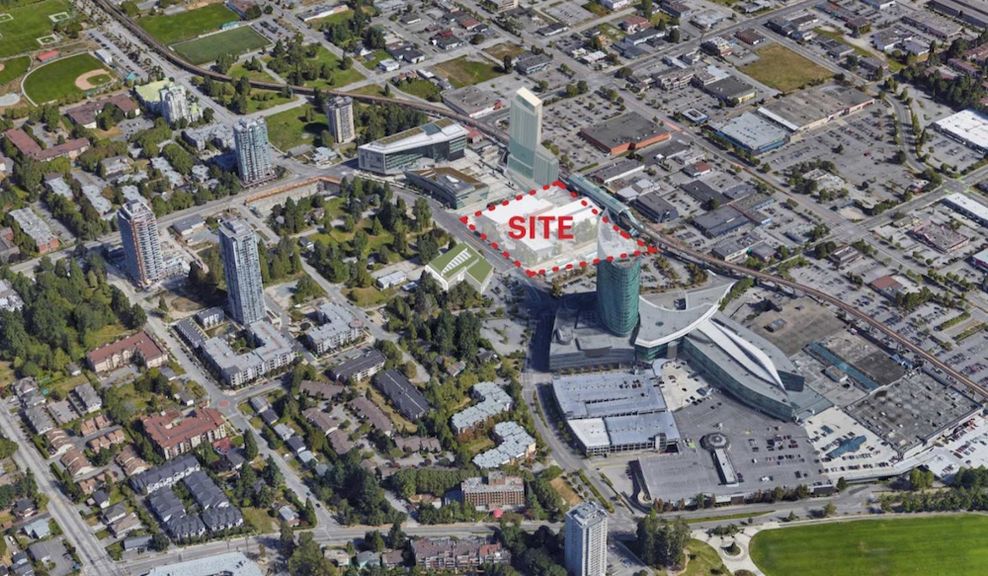
Site of the north parcels of Centre Block at 10261-10275 City Parkway, Surrey. (City of Surrey)
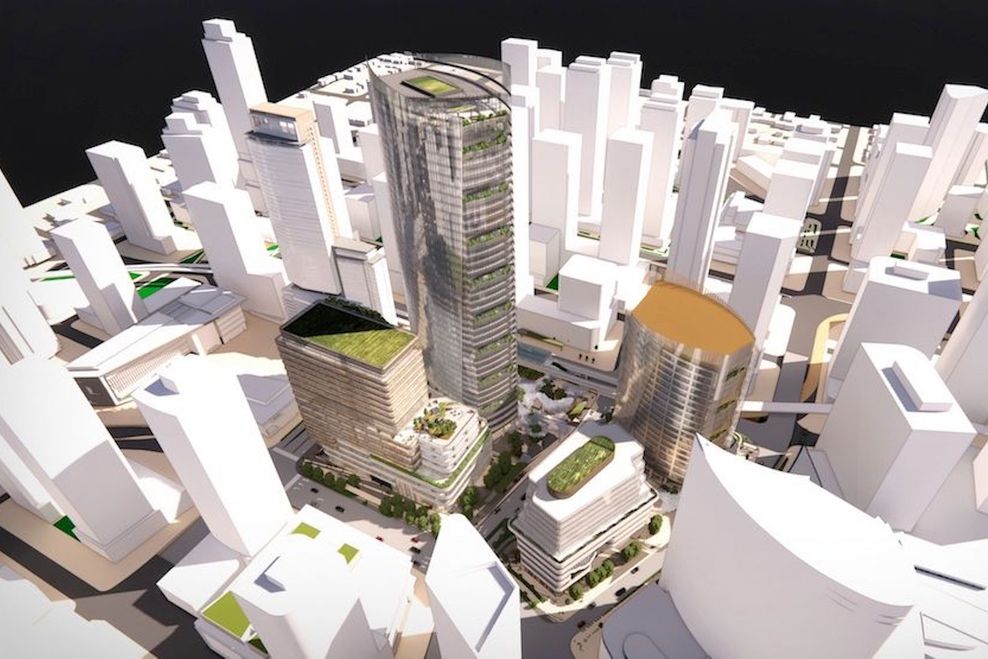
2024 revised concept for the Centre Block’s north parcels redevelopment. (Hariri Pontarini Architects/Adamson Architects/SCDC)
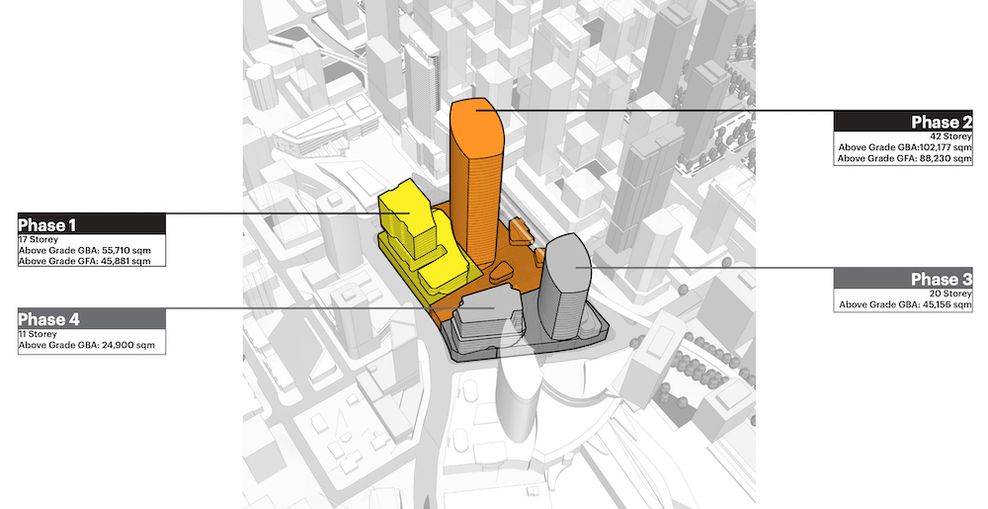
2024 revised concept for the Centre Block’s north parcels redevelopment, and the future south parcels redevelopment. (Hariri Pontarini Architects/Adamson Architects/SCDC)
“The City’s component will provide future office space for City services in addition to revenue generating commercial retail and office lease opportunities. SFU’s portion of the project will provide academic and administration spaces for their School of Medicine, a primary care-focused medical school and the first new medical school in western Canada since 1967,” reads the City’s budget document.
Construction on the first building of the Centre Block complex is scheduled to begin in the fourth quarter of 2026 for a completion in the second half of 2030. Site preparation began in 2025, including the demolition of the previous community and recreation centre buildings. Future phases of the complex will involve the redevelopment of the TransLink bus exchange and surface vehicle parking lot.
The project is being led by the City-owned, for-profit real estate development company of Surrey City Development Corporation, which was also responsible for the nearby 3 Civic Plaza tower.
The City’s 2026-2030 capital plan carries a total cost of $779 million, including $324 million for the ongoing maintenance of existing facilities and infrastructure and $455 million for major general capital projects, which includes the arena and Centre Block projects. The major general capital projects component will be largely covered by internal borrowing ($304 million), a contribution from the general operating budget ($69 million), capital projects reserve ($35 million), and other City reserves ($37 million).
For the 2026 budget, the City is pursuing a 2.6 per cent average property tax increase, which will be among the lowest of Metro Vancouver’s municipal governments.
According to the City, the 2026 property tax increase will also support the hiring of 20 additional firefighters, 10 additional bylaw officers, and 189 additional Surrey Police Service (SPS) police officers. SPS will have an operating budget of about $285 million, which is $84 million more than what the new municipally-controlled department spent in 2025.
The City of Surrey is also pursuing Canada Soccer to build the National Training Centre for Canada’s most elite soccer talent. The national sporting federation is looking for a site of over 40 acres to accommodate various indoor and outdoor soccer fields, buildings with high-performance training facilities, and other supporting uses, including a small outdoor stadium.