
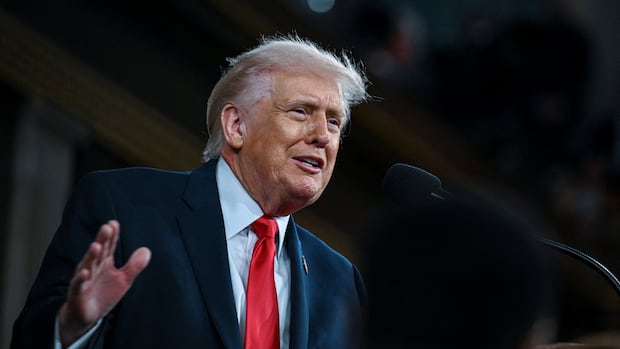
Given Donald Trump’s track record of telling lies, exaggerating, spreading misinformation and making misleading and confusing statements, it was unlikely he would stop doing that for his state of the union address. Indeed, he didn’t.
When it comes to facts, holding Trump to account is difficult. None of the fact-checking done by the media, political opponents, government institutions or others has changed his behaviour. But setting the record straight continues to show its value for anyone wanting to know the facts.
Here are five significant claims Trump made during his speech, compared to the facts.
‘Inflation is plummeting’
In the first few minutes of the speech, Trump said “inflation is plummeting” and said it was worse under his predecessor, Joe Biden, than at any point in history.
This is not the case. In 1980, inflation in the U.S. was 13.5 per cent, nearly double what it was in 2022 (when it was eight per cent).
The overall inflation rate has fallen slightly since Trump was elected and as of January, sat at 2.4 per cent, higher than the two per cent target set by the Federal Reserve. That means prices are still rising.
Food costs are rising at an even faster 2.9 per cent. Electricity is up 6.3 per cent, and natural gas is up 9.8 per cent. The shelter index is also up three per cent, meaning housing continues to get more expensive.
How much money have U.S. tariffs raised?
Trump said “hundreds of billions” of dollars have been raised by his tariffs. This is true.
In 2025, the U.S. collected $287 billion US in tariffs and related taxes and customs duties, almost triple the amount in recent previous years. Nearly $100 billion US of that arrived in the last three months of the year.
But Trump also said foreign countries are paying the tariffs. This is not true. Earlier this month, the Congressional Budget Office said foreigners are only paying about five per cent of the tariffs. The other 95 per cent is paid by Americans.
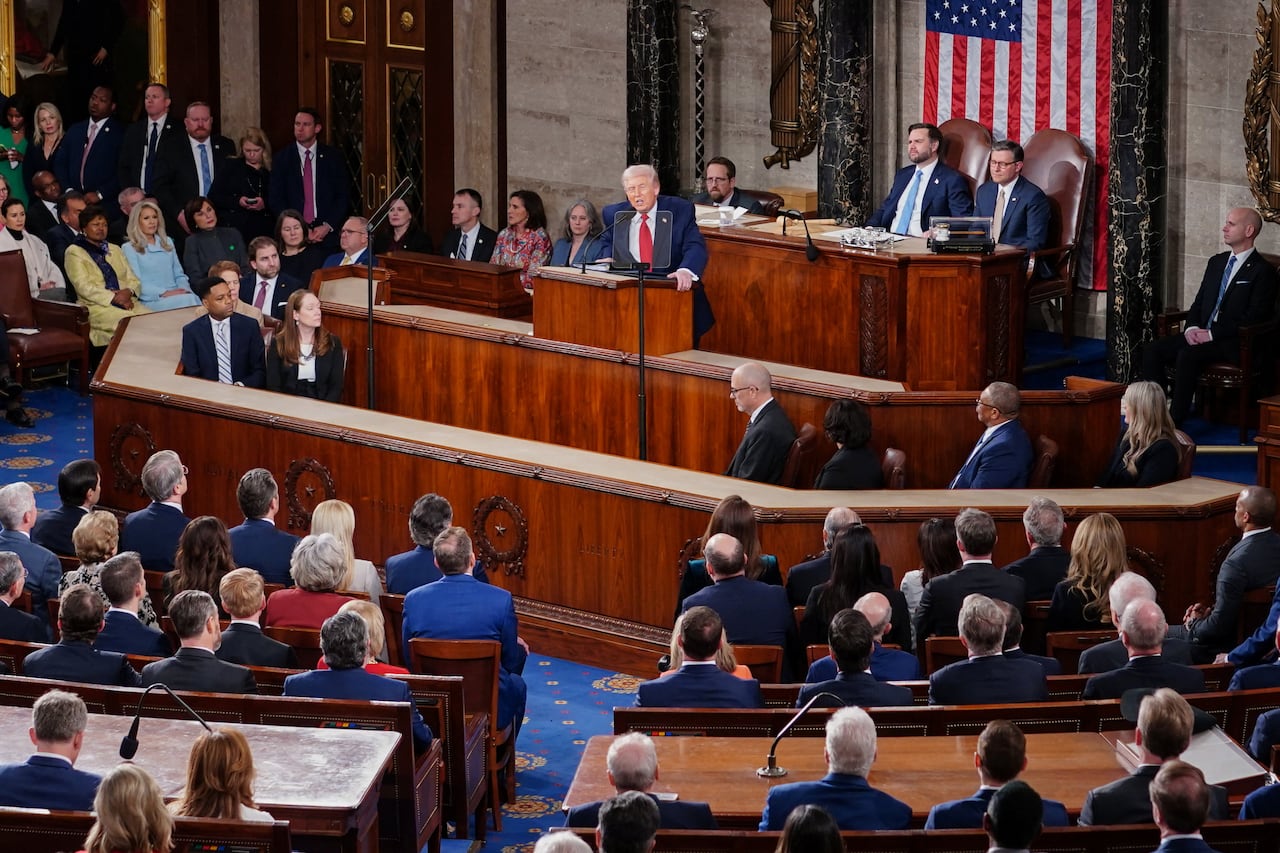 Trump delivers his speech in the House chamber of the U.S. Capitol. (Nathan Howard/Reuters)$18 trillion in investments?
Trump has said for months that he secured commitments of $18 trillion US in investments from countries and companies around the world, and he repeated it again in the speech. In short, no one but Trump knows where the number comes from, or how he arrived at it.
The White House cites $9.7 trillion US in investments, but even that number isn’t firm and some of the pledges are for far in the future. Others, such as $600 billion US in spending agreed to by the European Union, does not legally bind European countries to carry through with it.
The numbers also bear no relation to the current reality. Total private investment in the United States was most recently running at a $5.4 trillion US annual pace. In 2024, the last year for which figures are available, total foreign direct investment in the United States amounted to $151 billion US.
So if Trump’s figure were accurate, it would represent a level of investment many times higher than the U.S., or any country, has ever experienced.
Stock market records
Trump said stock markets have been rising all year, and setting records.
It’s true that the Dow Jones Industrial Average hit an all-time high in January of 50,000 points (it has since fallen a bit). The S&P 500 also recently hit a record 7,000 points. But the performance of U.S. stock markets in 2025 was not as good as in other places.
Over the past year, the Dow has gained about 13 per cent in value, the S&P 500 is up about 15 per cent and the NASDAQ about 18 per cent.
But compared to some other global economies, that is weak. Canada’s S&P/TSX is up 35 per cent in the past year. Japan’s Nikkei is up 49 per cent, the U.K.’s FTSE 100 is up 23 per cent, and South Korea’s main stock index has more than doubled.
‘I ended eight wars’
No, he didn’t. Trump makes this claim regularly.
It is accurate to credit him with helping to end some conflicts. Trump mediated a peace agreement between Armenia and Azerbaijan. He also helped stop a conflict between Cambodia and Thailand last summer, although some violence has erupted since. The U.S. also brokered a ceasefire between Iran and Israel after the 12-day war and Trump helped Israel and Hamas reach a ceasefire, although both sides have accused the other of violating it.
However, when India and Pakistan were on the brink of war last year, Trump claimed he brought an end to the fighting. India insists Trump had nothing to do with it.
The U.S. did broker a ceasefire between Rwanda and the Democratic Republic of the Congo last summer, but the M23 rebel group was not included in the negotiations and the fighting continues.
Egypt and Ethiopia are engaged in a dispute over a dam project but it is not a war.
In Trump’s first term, an economic co-operation agreement was signed between Serbia and Kosovo, but the two countries were not at war.
Trump also said he was trying to end his “ninth” war, the one between Ukraine and Russia. Trump has acknowledged it’s more difficult to do that than he expected. Before he resumed the presidency, he said he could end it in 24 hours.