
Most night photographers use ultra-wide angle lenses when night falls. And for good reason. If they are photographing the Milky Way, it arcs over a wide expanse of sky. But night photographers shouldn’t sleep on these three lens categories, which can crank up your creativity.
The following lenses offer amazing creative opportunities and can help separate your photography from the pack. Even better, they’re often great to pull out of your camera backpack when you’re feeling stuck or need a creative jolt.
I’ll list a few examples of each. However, you’ll not only want to find something that fits your camera mount, but you’ll also want to explore further options within each category.
Fisheye
Aim a fisheye lens straight up and the results can be astounding.
I mentioned above that most night photographers use ultra-wide angle lenses. The focal length for these is typically around 15–20mm. But if you keep going wider and wider, you can get a lens that is capable of producing a 180-degree fisheye view. Fun, eh?
Even better, many fisheye lenses are fast lenses, capable of opening to as much as f/2.8—perfect for capturing the Milky Way or stars as pinpoints.
But best of all, many of them are also inexpensive while still capable of producing sharp, high-quality images.
I use a Rokinon 12mm f/2.8 fisheye lens on my Nikon D750 DSLR (discontinued), which has an F-mount lens. But there are numerous fisheye lenses on the market with wide apertures with various kinds of mounts to fit your camera, including the TTArtisan 11mm f/2.8 Fisheye and the Venus Optics Laowa 8‑15mm f/2.8 FF Zoom Fisheye.
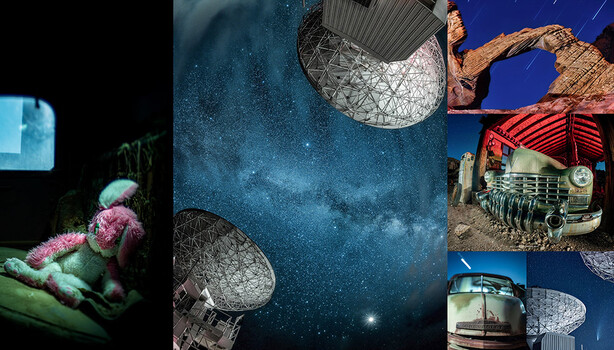
A bonus of fisheye lenses is that you can jam them right up against subjects to get amazing views that offer a different perspective that people may not see much. Night photo of a Cadillac with an old Buick grille.
Long Lenses
Ordinarily, a 50mm lens is not considered a “long lens.” However, it’s not so commonly used in night photography, so I’m bending the definition a bit here. Here, it brings Comet NEOWISE a bit closer relative to the radio telescopes.
Now we’ll go in the opposite direction from fisheye lenses and that sort of thing. We’ll talk about long lenses. Most photographers regard long lenses as being 70–80mm or more. However, given that we typically use ultra-wide angle lenses, I’ll fudge a little and include a 50mm lens as well as longer focal lengths.
Obviously, if you are doing deep-sky astrophotography, you’re most likely already using long lenses, or possibly a telescope. But we’re discussing night photography generally here, including astrolandscape, Milky Way, star trails, and other kinds of night photography.
Comparing 16mm to 112mm focal length, Arch Rock, Valley of Fire State Park, NV.
When photographing star trails, a longer lens will produce longer, more dramatic trails in a shorter amount of time. Of course, the more you zoom in on the stars, the less circular those trails will appear—even if you’re facing Polaris or the Southern Celestial Pole.
On my Pentax K-1 DSLR, I use a 28-105mm f/3.5-5.6 zoom lens. On my Nikon D750 DSLR, I use a Nikon AF-S DX NIKKOR 18-300mm f/3.5-6.3G ED VR Lens.
Lensbaby
Lensbaby Edge 35 in this surreal night photo with light painting of a rare vintage Commerce truck. Only 1,500 of these were made, manufactured over only 3-4 years, and there are very few left.
There are a number of Lensbaby lenses that offer a chance for experimentation and fun, all with manual control. That’s what these lenses are all about.
The Lensbaby Edge 35, shown here with the Composer Pro II mount, which supports numerous Lensbaby lenses. You can physically bend and manipulate the mount to change the plane of focus to produce unusual bokeh and blurring effects.
I’ll focus on the Lensbaby Composer Pro II with Edge 35 Optic, but you should know that Lensbaby is always issuing new, fun lenses. The Edge 35 Optic, which is what I grab for most, uses a Composer Pro II mounting system, which accepts various optics from the Optic Swap System. You physically tilt and move the optic within the mount, creating a wide range of creative effects. This movement changes the angle of the focus plane relative to the sensor, allowing the focus plane to run diagonally or vertically through the frame rather than just horizontally.
The Edge 35 lens features a flat-field design for sharp, accurate rendering, and its unique optical design also enables producing a dramatic slice of focus surrounded by a smooth, blurred border. And the more you open the aperture, the stronger and more pronounced the blurring effect.
The Edge 35 and some of the other Lensbaby lenses are somewhat challenging to focus at night. Sometimes, it’s better to stop down to something like f/8 to aid in focusing, then change the aperture back to a wider opening to bring some of the blur effect back, if that’s what you want.
Another photo with my trusty Lensbaby Edge 35, this of an old white GMC flatbed truck. The night photo also has some ghostly lighting with a handheld light, including creating the shadow of the steering wheel in the windshield. The fascinating blur extends from the windshield onto the sky.
If you really want to go further, Lensbaby can be a true “gateway lens.” It often leads photographers toward other unusual optics, including tilt-shift lenses, Soviet industrial lenses (such as the Helios-44 or Jupiter-9), Lomography lenses, the Mir-1B 37mm f/2.8, and many other character-rich options. These lenses tend to produce distinctive bokeh, swirls, and unconventional blur.
Lensbaby Edge 35, creating an eerie glow on this photo taken Halloween night in an abandoned airfield in California. The bunny is a prop that I brought just for this photo. I hid this and the other creepy dolls I had in the back of my car in case I was pulled over!
Down, Down, Down the Rabbit Hole
For some of you, I’ve probably just sent you down a rabbit hole that will take many hours.
There are countless lenses to explore, both vintage and modern. If you’re looking for new and experimental designs, Kickstarter can also be an interesting place to browse. But just remember… Kickstarter is not a store.
Feel free to share the fascinating lenses and eBay finds you discover, along with the night photographs you create using them.