

Listen to this article
Estimated 5 minutes
The audio version of this article is generated by AI-based technology. Mispronunciations can occur. We are working with our partners to continually review and improve the results.
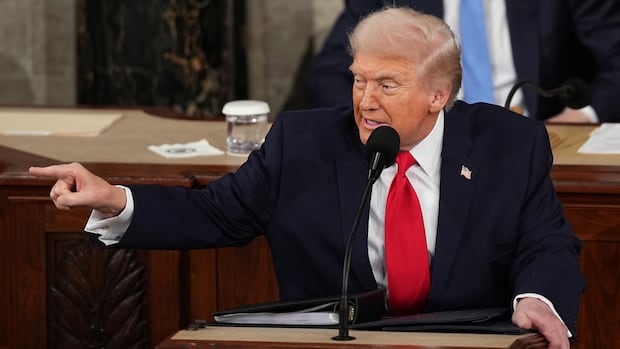
U.S. President Donald Trump delivered a state of the union address that by his standards came across as relatively focused and disciplined, giving a preview of how the Republicans may try to campaign to keep control of Congress in this fall’s midterms.
Trump notably reined in the visceral anger he displayed just a few days ago toward the Supreme Court justices who struck down his global tariff regime.
On Tuesday night — as three of the justices who ruled against him sat directly in his line of sight — the strongest language he used about the court decision was to call it “unfortunate.”
The bulk of Trump’s speech was celebratory.
He began by listing off what he sees as his key domestic accomplishments so far in his second term, and appeared to largely stick to the prepared text of his speech. That’s something he often fails to do, with his penchant for wandering off on tangents.
Then Trump sought to capitalize on the country’s euphoria over Team USA’s Olympic hockey victories.
WATCH | Trump welcomes Olympic champion men’s hockey team to the White House: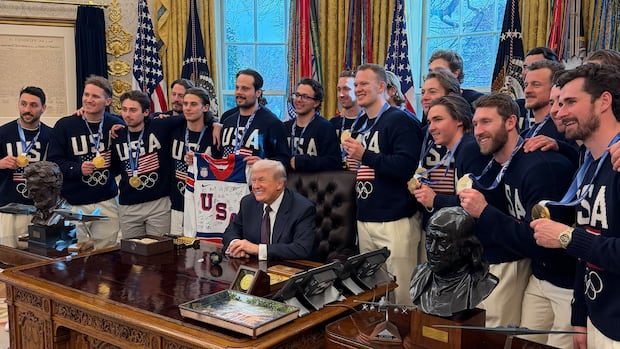
U.S. men’s hockey team visits White House after gold medal win
Twenty members of the gold-medal winning U.S. men’s hockey team visited the White House and attended the state of the union address, an offer the women’s team declined.
He basked in the appearance of the men’s team in the House for the speech. It can’t hurt him to be associated with images of them in their USA sweaters with gold medals, the first for USA men’s hockey since 1980.
Tapping into Americans’ deep sense of patriotism, Trump also touted plans for the upcoming 250th anniversary of U.S. independence, and told stirring stories of U.S. military heroism as he conferred medals on veterans.
Trump on the attack
But the generally triumphant tone of the address shifted markedly when he pivoted to go on the attack against two of his favourite targets: the Democrats, and what he calls “illegal alien criminals.”
For anyone who thought the president might be easing up in his mass deportation campaign following the backlash over the killings of Renee Good and Alex Pretti in Minneapolis, Trump’s speech suggested he is in no mood to pull back on enforcement.
His language grew more stark and his tone angrier as he blamed the Democrats for allowing “millions and millions” of people to enter the U.S. illegally, claimed Somali Americans are ripping off taxpayers with fraud, and accused Democrat lawmakers of blocking the deportation of violent criminals.
He baited the Democrats by challenging them to stand up if they agree with this statement: “The first duty of the American government is to protect American citizens, not illegal aliens.”
WATCH | How the U.S. economy is really doing in Trump’s second term: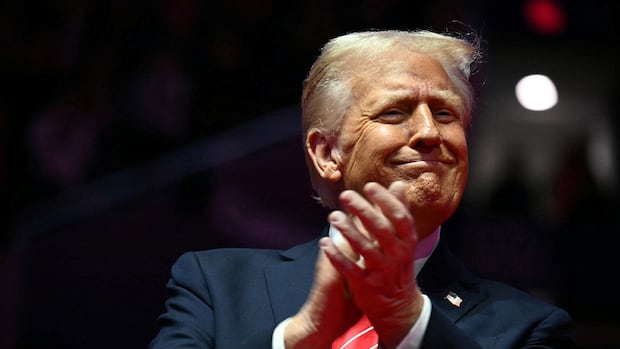
Report card: How is Trump’s economy doing
When Donald Trump was sworn back into office he declared that ‘the golden age of America begins right now.’ For The National, CBC’s Eli Glasner gathers a report card on the U.S. president’s economic progress, just over a year into his second term.
When the Democrats declined to stand, Trump glared at them. “You should be ashamed of yourselves,” he said.
“These people are crazy,” he added. “Democrats are destroying this country.”
‘He tries to enrage us’
Virginia Gov. Abigail Spanberger delivered the Democratic Party rebuttal a few minutes after Trump finished his address.
“In his speech tonight, the president did what he always does. He lied, he scapegoated, and he distracted,” Spanberger said. “He tries to divide us. He tries to enrage us, to pit us against one another, neighbour against neighbour.”
Trump had an opportunity to make a bipartisan condemnation of political violence, but chose not to.
He mourned the death of conservative political activist Charlie Kirk, shot to death at a rally in Utah in September.
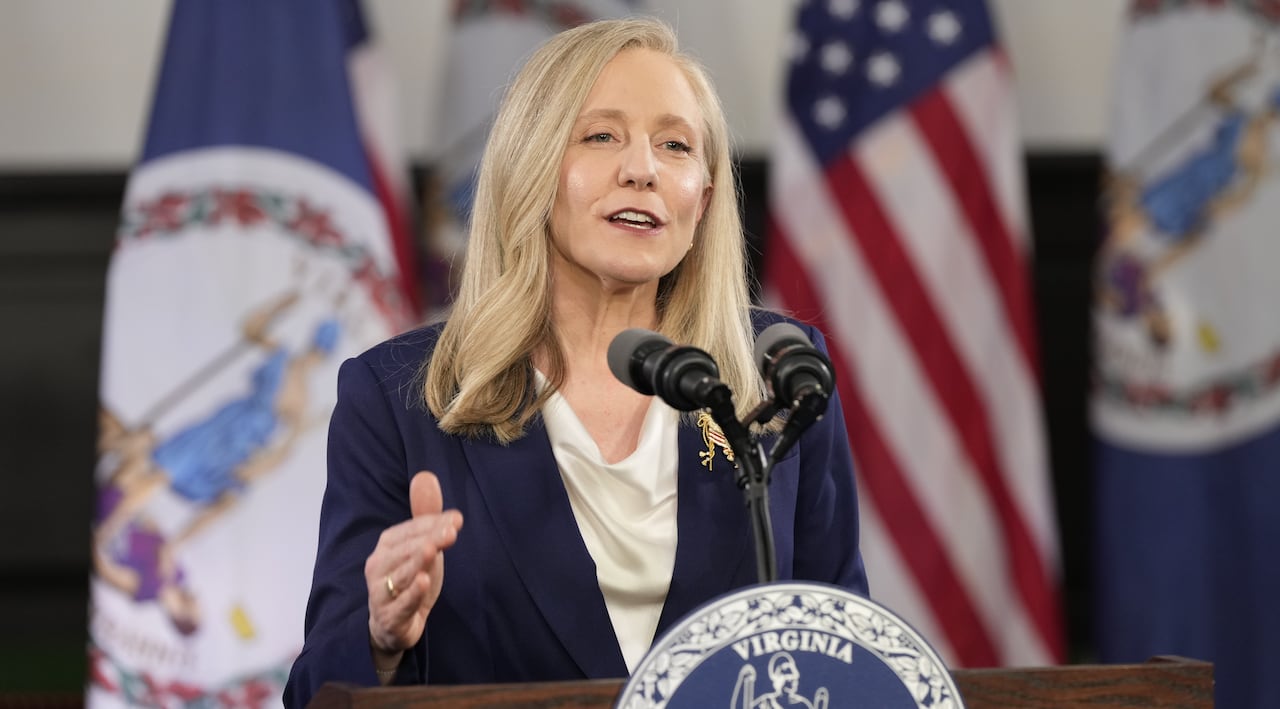 The Democratic Party’s response to Trump’s state of the union address was delivered by Virginia Gov. Abigail Spanberger in Williamsburg, Va. (Steve Helber/Pool/The Associated Press)
“We must totally reject political violence of any kind,” Trump said and paid tribute to Kirk’s widow Erika, an invited guest at the speech.
But Trump did not mention the June assassination of Minnesota state representative Melissa Hortman, a Democrat, killed along with her husband.
Nor did he allude to the shooting deaths of Good and Pretti at the hands of federal agents last month as they protested ICE raids in Minneapolis.
The state of the union address matters because it is watched by tens of millions of voters, the largest television audience that Trump is likely to draw for a speech this year.
The stakes were particularly high for him this time around because he’s facing dwindling approval ratings and the rapid approach of the midterm elections, in which his Republican Party could lose control of Congress.
WATCH | Fact-checking Trump’s state of the union address: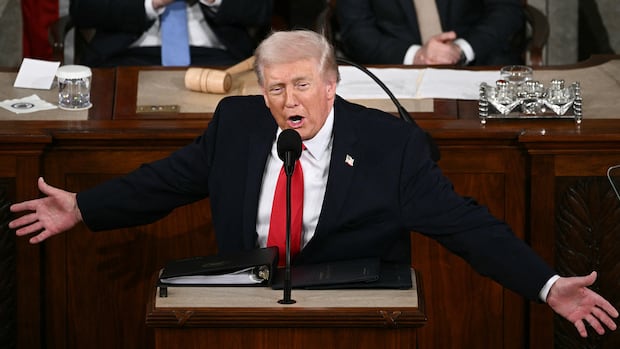
Checking the facts in Trump’s state of the union address
For The National, CBC’s Lyndsay Duncombe breaks down some of the false claims and exaggerations made by U.S. President Donald Trump during the state of the union address.
That’s why a lot of observers were looking to the address to see whether Trump could communicate a strong message on the state of the economy and demonstrate he knows he must do more to tackle the rising cost of living, shown in poll after poll to be the top concerns of U.S. voters.
For several months, Trump’s staff have been trying to steer him toward talking more about affordability during his public events.
Trump has done so somewhat, but often in a dismissive manner, downplaying cost of living concerns and insisting that inflation is in check, even though it continues to hover around the same level as when he took office.
While Trump didn’t come across on Tuesday night as exactly empathizing with the financial struggles of working class American voters, he didn’t fall into his frequent habit of complaining that he’s the one who’s hard done by, not getting credit for all the things he’s doing to make the economy better.
He did however stick with another of his long-running habits: peppering his speech with exaggerations and outright falsehoods, particularly on economic measures.