
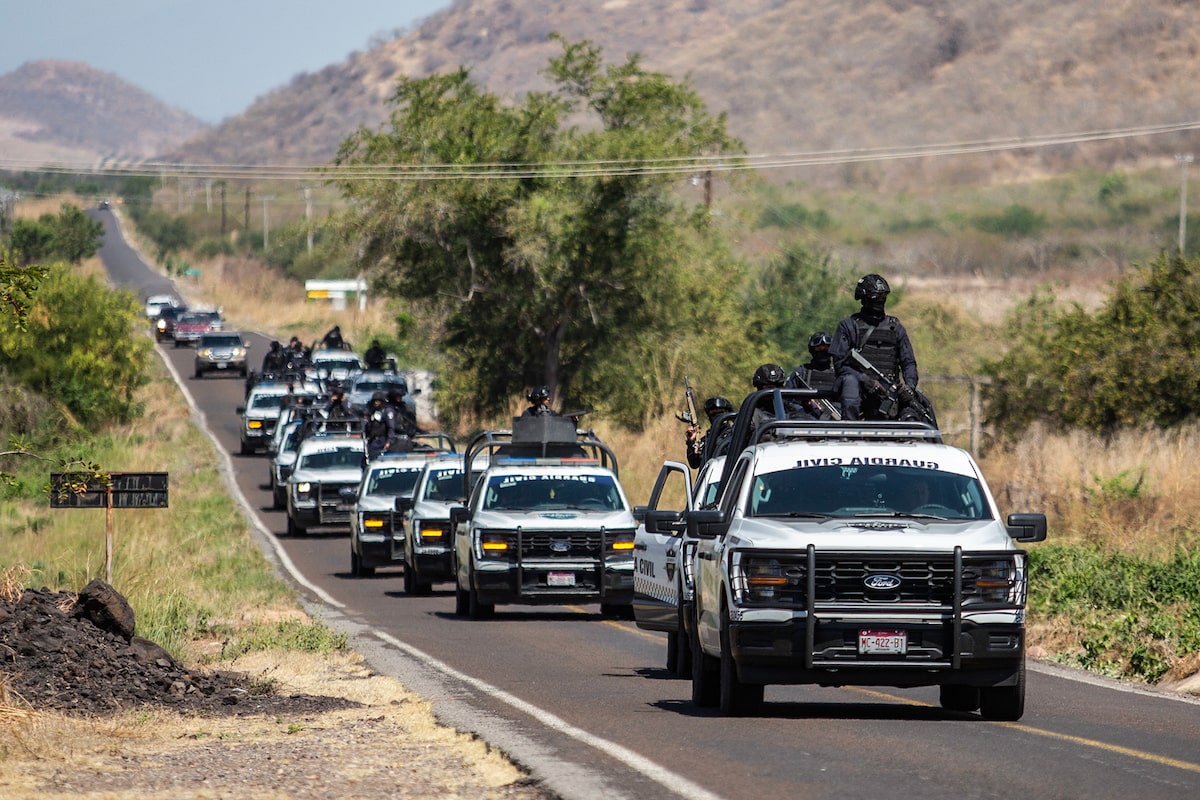
Members of the Civil Guard of Michoacan patrol a highway supported by armored vehicles after a wave of violence in the town of Aguililla, the birthplace of drug kingpin Nemesio Oseguera Cervantes in Mexico, on Tuesday.ENRIQUE CASTRO/AFP/Getty Images
The Mexican government has moved swiftly to project a sense of control after the killing of the long-time leader of the Jalisco New Generation Cartel. In Guadalajara, Puerto Vallarta and other major population centres, extra patrols can be seen around key intersections, and armoured vehicles have been stationed near strategic buildings to protect airports and tourist areas.
But outside the metropolitan spotlight, in towns along the borders of the states of Jalisco, Michoacán, Guanajuato, Colima and Zacatecas, highways have been blocked by cartel members, limiting travel between smaller cities and along rural corridors ever since Mexican special forces killed Nemesio Oseguera Cervantes, known as “El Mencho,” on Sunday.
At least 70 killed in Mexican military’s attempt to capture cartel leader
The biggest toll has been borne by the residents of Michoacán, El Mencho’s birthplace, where a rolling wave of retaliation and intimidation continues.
Father Gilberto Vergara García, a former parish priest of Aguililla in Michoacán, said the small town had endured more than 48 hours of terror. It wasn’t until Tuesday that members of the National Guard appeared in the streets.
“It is understandable the government is prioritizing emblematic places like Guadalajara and other large cities, which may leave towns like Aguililla in second place,” said Father Vergara, who wondered who would pay citizens for the damages to their cars and businesses.
By Tuesday, reports began emerging of the fear and violence in towns and villages. Over two days in Coalcomán, Michoacán, unknown assailants blocked the highways toward the coast of Aquila and Tepalcatepec, effectively cutting off the municipal seat by land. The unrest escalated as cars, a passenger bus, a gas station, a government bank branch and store were set ablaze.
Residents responded with panic buying, forcing grocery stores to close after selling out of basic goods. Most workshops, small businesses, tortilla shops and eateries shut down, and even the local radio station suspended regular programming to protect staff.
A burned bus following a series of roadblocks and attacks by organized crime near Tapalpa on Tuesday.Jose Luis Gonzalez/Reuters
Alberto Noboa, 34, drives an Uber during the week in Mexico City and spends time with his family in Epitacio Huerta, Michoacán, almost every weekend.
“I couldn’t get back to the city yesterday,” he said, adding that members of his family reported blocked roads in small towns in the states of Guanajuato and Querétaro.
At a news conference Tuesday, President Claudia Sheinbaum said that the country was “under control and returning to normalcy.”
“In the vast majority of the national territory, activities are proceeding with complete normalcy,” she said.
U.S. pressure was behind raid that killed Mexican drug cartel leader, analysts say
Federal officials have promised that the operation that killed El Mencho will be followed by sustained pressure on the cartel’s networks – financiers, logistics operators and local bosses.
But Julio César Franco Gutiérrez, a human security specialist and a collaborator with the security council in Apatzingán, Michoacán, said residents in the hardest-hit towns say what they want most is not a news conference but permanence: reliable policing, protected roads and prosecutors who can pursue cases without being threatened out of office.
Mexico’s security strategy in recent years has often leaned heavily toward protecting major cities and economic nodes – where disruption is visible and politically costly – while leaving smaller jurisdictions to municipal forces with insufficient resources.
Mr. Franco said “this moment is a window of opportunity, and we don’t know which of the actors in positions of power will take advantage of it.”
Members of the Civil Guard of Michoacan patrol a road in Aguililla.ENRIQUE CASTRO/AFP/Getty Images
While the retaliatory action from the cartels has been blockades, communities that have long lived under the rule of the Jalisco New Generation Cartel are more concerned about how the organization will reorder itself.
Father Vergara was skeptical.
“This event marks a historic moment, but it does not mean all the work is finished,” he said, referring to El Mencho’s death. “On the contrary, now we must watch how the cartel reorganizes and what consequences will follow, internally and externally.”
He said regular people have always been caught in the middle.
“We do not see in the official discourse a strategy that seeks to use this moment to dismantle criminal organizations,” he said. “We have a long history of ‘decapitating’ these organizations – that is, capturing or killing the leaders who head them – but this does not stop the criminal machinery.”